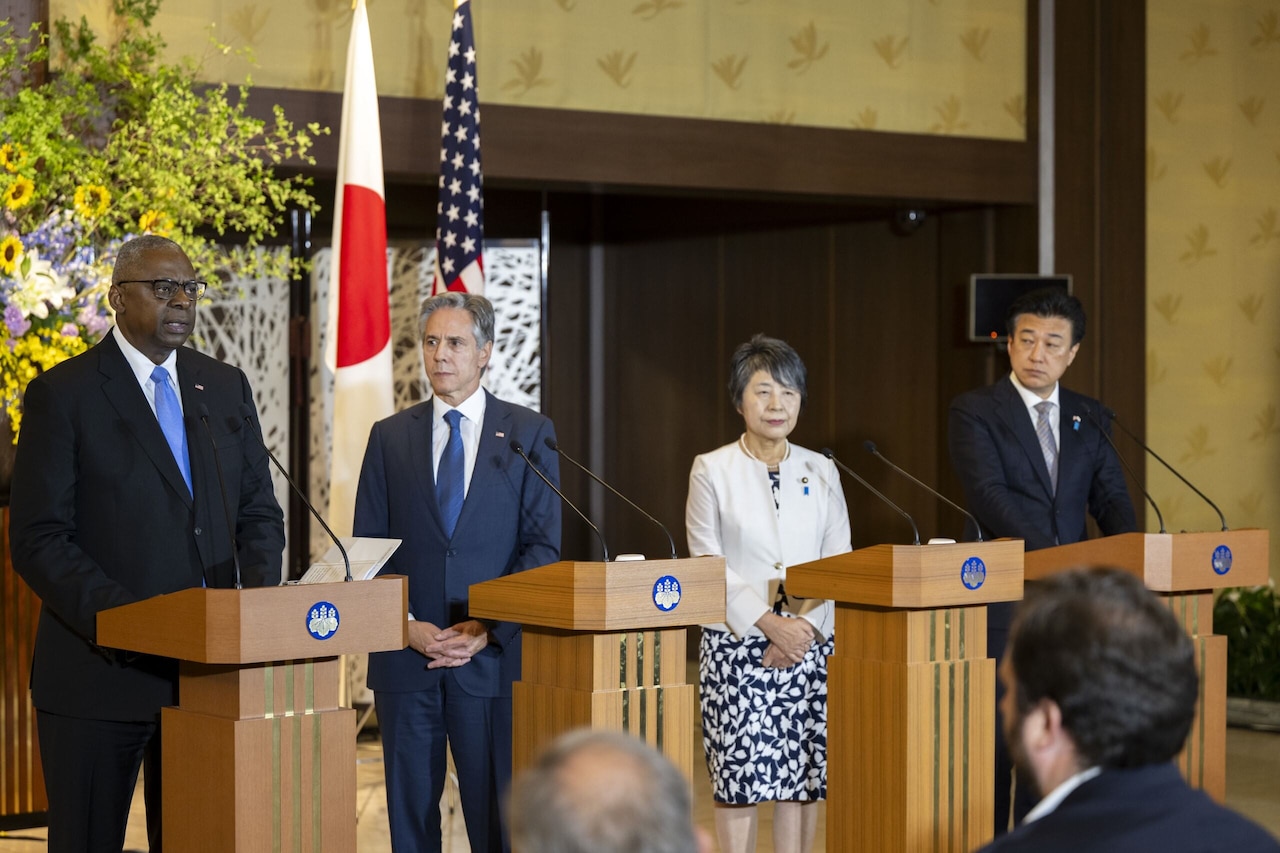
The United States plans to convert U.S. Forces Japan into a joint force headquarters that will report to the commander of U.S. Indo-Pacific Command. This decision was announced following a two-plus-two ministerial meeting in Tokyo, which included Secretary of Defense Lloyd J. Austin III, Secretary of State Antony Blinken, Japan’s Minister for Foreign Affairs Yoko Kamikawa, and Japan’s Minister of Defense Minoru Kihara. The goal of this conversion is to modernize the alliance command and control to better address current and future challenges. The new joint force headquarters will be led by a three-star officer and will work closely with Japan’s Joint Operations Command to enhance operational capabilities and advance collective deterrence.
The establishment of the joint force headquarters is considered the most significant change to U.S. Forces Japan in 70 years and a major improvement in military ties between the U.S. and Japan. This decision reflects a mutual desire to work more closely together and strengthen the existing relationship. Discussions during the meeting also focused on increasing bilateral presence in Japan’s Southwest Islands, cooperation on cybersecurity, intelligence, surveillance, and reconnaissance, cross-domain operations, and bilateral exercises and training. The participants also explored new areas for defense industrial cooperation, including opportunities for co-production of Advanced Medium-Range Air-to-Air Missiles and Patriot Advanced Capability-3 Missile Segment Enhancement missiles.
In a separate two-plus-two ministerial meeting on extended deterrence, participants reaffirmed the commitment to defend Japan with the full range of capabilities, including nuclear capabilities. The discussions during this meeting covered various security concerns in the region, such as North Korea’s nuclear and ballistic missile programs, China’s nuclear arsenal expansion, and Russia’s arms transfers with North Korea. Secretary Austin emphasized the success of both meetings in Tokyo, highlighting the reinforcement of the combined ability to deter and respond to coercive behavior in the Indo-Pacific and beyond. The agreements reached during the meetings aim to strengthen the rules-based international order and ensure that the U.S.-Japan alliance remains a cornerstone of security and stability in the region.
Overall, the decision to convert U.S. Forces Japan into a joint force headquarters represents a significant step towards enhancing military cooperation between the U.S. and Japan. This move is part of a broader effort to modernize the alliance command and control structure to address evolving security challenges in the region. The establishment of the joint force headquarters will enable closer collaboration between U.S. and Japanese forces, improve operational capabilities, and strengthen collective deterrence. The success of the meetings in Tokyo underscores the commitment of both countries to reinforce the rules-based international order and maintain security and stability in the Indo-Pacific region.