Amazon Escalates Battle With NYC Over Delivery Protection Act, Now Putting Warnings on Shipping Labels
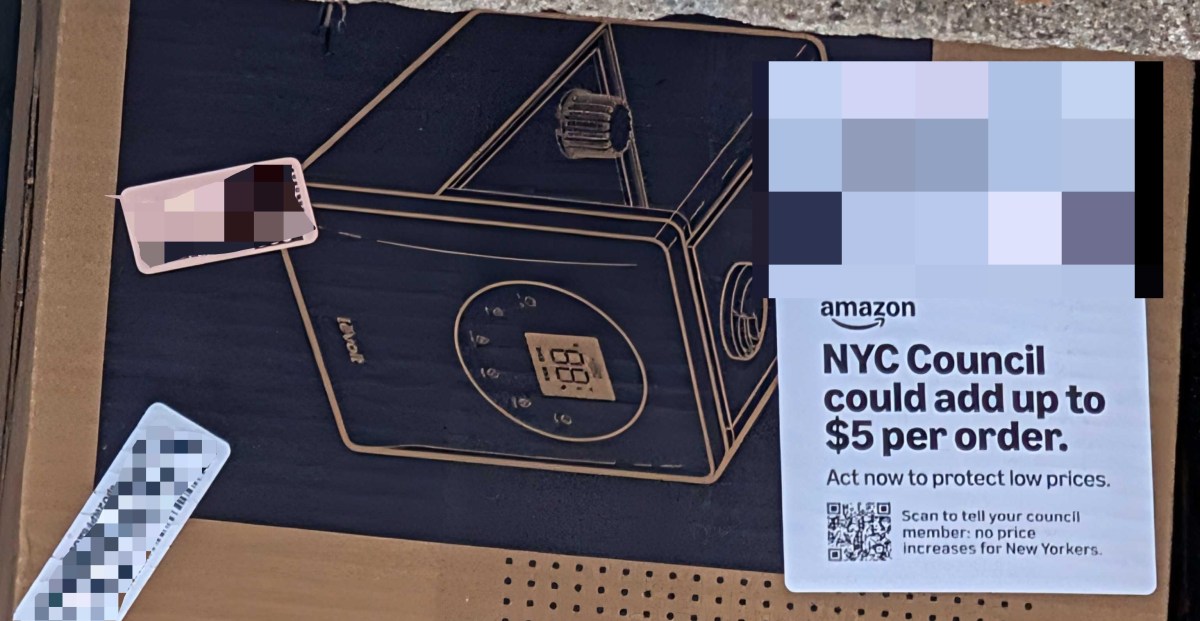
Amazon is leaving no venue unexplored in its intensifying fight against the New York City Council and the proposed Delivery Protection Act. The company, which has already pushed alerts to shoppers through its mobile app and website, is now placing warnings directly on shipping labels. The labels tell customers that the City Council could add up to $5 to the cost of any Amazon order if the legislation becomes law.
The Delivery Protection Act, which has become one of the most contentious pieces of local legislation in New York City in recent memory, would effectively ban the sort of third-party arrangements Amazon currently relies on to deliver many of its packages. Those arrangements include small delivery companies and independent contractors who handle the so-called “last mile” of the delivery process — the final leg that brings a package from a local warehouse to a customer’s door. Under the proposed law, last-mile delivery firms operating warehouses in the city would need to be licensed by New York City and would be required to directly employ their workers, rather than treating them as independent contractors or subcontractors.
Amazon has responded aggressively. Earlier this week, the company began showing notifications to customers in its mobile app and on its website, reading: “Attention NYC Council could add up to $5 per order.” Now, the company is including an almost identical message on shipping labels attached to packages bound for New York City customers. The move marks a significant escalation in the company’s public campaign against the measure, bringing the political dispute directly into the hands of the consumers who would be affected.
In addition to the customer-facing warnings, Amazon has also issued a formal statement laying out its objections to the bill. The company claims that the Delivery Protection Act, if passed, “would likely mean slower and more expensive delivery for millions of customers in New York City.” Amazon has gone further, threatening to move its warehouses outside of the city entirely, a move that would have major implications for its logistics network, local employment, and the speed of deliveries across the five boroughs.
But the company’s tactics have not gone unchallenged. Labor unions, City Council Speaker Julie Menin, and Mayor Zohran Mamdani have all pushed back against Amazon’s campaign. They argue that the company is trying to “threaten New Yorkers and intimidate this City Council” with its warnings and threats. They have also accused Amazon of acting out of “greed,” pointing to the company’s staggering market capitalization of nearly $3 trillion as evidence that it can afford to treat its workers fairly. From their perspective, the Delivery Protection Act is not about harming Amazon or slowing down deliveries. It is about ensuring that the people who perform the essential work of delivering packages are treated as employees, with the protections, benefits, and legal rights that come with that status.
The conflict between Amazon and New York City is not new. The company has a long history of battles with labor organizers and city officials, particularly over working conditions, unionization efforts, and the use of independent contractors. The Delivery Protection Act represents one of the most direct attempts by the city to regulate Amazon’s business model, specifically its use of outsourced and gig-based delivery workers. For years, Amazon has built its delivery network around a highly flexible model that relies on a patchwork of small businesses and individual drivers. These workers often use their own vehicles, set their own schedules to some degree, and are not classified as traditional employees. That arrangement has allowed Amazon to scale up its delivery capacity quickly and keep costs down, but it has also drawn criticism from labor advocates who say it denies workers basic protections such as minimum wage guarantees, overtime pay, workers’ compensation, and access to collective bargaining.
The Delivery Protection Act aims to change that. Under the proposed legislation, any last-mile delivery firm operating a warehouse in New York City would have to obtain a license from the city. More importantly, it would have to directly employ the workers who make deliveries. That means Amazon would no longer be able to rely on independent contractors or small subcontracting companies for the final leg of its deliveries within the city. Instead, the workers would be employees of the delivery firm, subject to labor laws and entitled to the full range of statutory benefits.
Supporters of the bill say this is a necessary step to address the exploitation of gig workers and to bring accountability to the rapidly growing last-mile delivery industry. They argue that the current model leaves workers vulnerable to unpredictable income, unsafe working conditions, and retaliation when they try to organize. By requiring direct employment, the bill would make companies like Amazon responsible for their workforce in a way that the current subcontracting model avoids.
Amazon, for its part, has framed the legislation as an attack on consumer choice and convenience. The company has repeatedly warned that the bill would make deliveries slower and more expensive, and the new shipping-label notifications are designed to drive that message home to customers at the very moment they receive a package. The labels effectively turn every delivery into a political advertisement, urging New Yorkers to consider the potential cost of the City Council’s actions.
The warnings are notable not only for their content but also for their reach. Amazon ships millions of packages to New York City every year, and by placing the message on shipping labels, the company ensures that a vast number of customers will see it. The app and website notifications may reach only those who actively check their orders, but shipping labels are impossible to miss. It is a direct and highly visible form of lobbying, conducted through the company’s own logistics infrastructure.
Critics of Amazon’s campaign have questioned the accuracy of the $5 figure. The company has not publicly explained how it arrived at that estimate, nor has it provided a detailed breakdown of how the Delivery Protection Act would translate into higher prices for consumers. The message on the labels says only that the City Council “could add up to $5 per order,” leaving open the possibility that the actual impact could be lower — or higher — depending on the final shape of the legislation and how Amazon chooses to respond. The vagueness of the warning has led some observers to suggest that Amazon is engaging in scare tactics rather than good-faith policy debate.
The dispute also highlights a broader national debate about the future of work in the gig economy. Delivery apps, ride-hailing services, and e-commerce giants have all built their business models around the classification of workers as independent contractors. That classification has been challenged in courtrooms and legislatures across the country, with mixed results. In some places, lawmakers have moved to reclassify gig workers as employees, while in others, the companies have successfully pushed for ballot measures that preserve the contractor model. New York City’s Delivery Protection Act would be a significant victory for the labor movement if it passes, and it could serve as a model for other cities and states considering similar legislation.
The stakes are high for Amazon, for New York City, and for the workers who deliver packages across the city. If the Delivery Protection Act becomes law, Amazon will be forced to restructure its delivery operations in the city. That could mean hiring thousands of workers as direct employees, either through its own logistics division or through licensed firms that comply with the new requirements. It could also mean higher operating costs, which Amazon may pass on to consumers in the form of higher prices or delivery fees. Alternatively, Amazon could follow through on its threat to move its warehouses outside the city limits, which would allow it to continue using independent contractors for deliveries that cross into the city, though that could make deliveries slower and more complicated.
For now, the fight continues to unfold in public view. Amazon has shown no signs of backing down, and neither have the city officials and labor unions supporting the legislation. The shipping-label warnings are just the latest chapter in a battle that is likely to intensify as the City Council moves closer to a vote. In the meantime, New Yorkers will continue to receive their packages with a new message attached: the cost of convenience, and the fight over who will pay it.