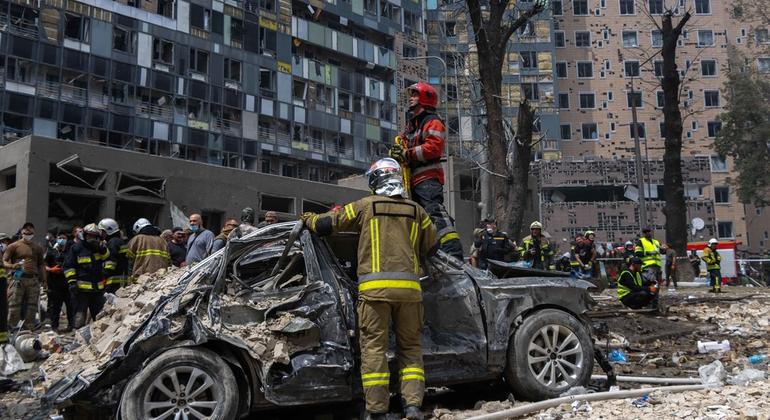
The conflict in Ukraine continues to escalate, with devastating consequences for civilians on both sides. Miroslav Jenča, Assistant Secretary-General at the UN Department of Political and Peacebuilding Affairs, recently spoke out about the alarming increase in civilian casualties in the region.
According to Jenča, last month was particularly deadly for Ukrainian civilians, with at least 219 people killed and over 1,000 injured. Since the full-scale invasion by Russia on February 24, 2022, the UN human rights office, OHCHR, has documented a staggering 11,662 civilian deaths and 24,207 injuries. However, these numbers are likely to be even higher in reality.
Jenča expressed deep concern over the ongoing violence and its impact on civilians in Ukraine. He highlighted the constant threat faced by civilians as missiles, shells, and drones continue to target cities, towns, and villages across the country on a daily basis. The situation is dire, with no end in sight to the bloodshed and destruction.
In a troubling development, the fighting has now spread to Russian soil, specifically in the Kursk, Belgorod, and Bryansk regions. Since Ukraine’s incursion into the Kursk region on August 6, at least 12 people have been killed and 121 others injured, according to local Russian officials. Over 130,000 people have been evacuated from the region as a result of the violence.
Jenča reiterated the UN Secretary-General’s condemnation of attacks on civilians and infrastructure, wherever they may occur. He emphasized that such attacks are prohibited by international humanitarian law and must cease immediately. All parties involved in the conflict are urged to act responsibly and ensure the protection of civilians caught in the crossfire.
Another cause for alarm is the reported incidents around nuclear facilities in both Ukraine and Russia. Jenča expressed particular concern about the deteriorating nuclear safety situation at Ukraine’s Zaporizhzhia Nuclear Power Plant. A drone strike on August 17 hit the road near the plant’s perimeter, following a significant fire at one of the cooling towers on August 11, causing extensive damage.
In addition, there are growing concerns about nuclear safety and security in Russia’s Kursk region. On August 22, Russia informed the International Atomic Energy Agency (IAEA) that remains of a drone were found within the territory of the Kursk Nuclear Power Plant. Jenča stressed the importance of maximum restraint and vigilance to avoid a potential nuclear incident, which could have catastrophic consequences for the region and the world.
The humanitarian situation in Ukraine is dire, with millions of people in need of assistance. Jenča highlighted the severe impact of the crisis, especially on women, who make up 56 percent of the 15 million people in need of aid. Entire villages and towns in frontline areas, particularly in the east and south of Ukraine, have been devastated by the conflict, leaving humanitarian operations struggling to reach those in need.
This year, the UN and its humanitarian partners aim to reach 8.5 million people with lifesaving assistance, including through the harsh winter months. However, the response is hindered by funding constraints, with only 41 percent of the $3.1 billion needed under the Humanitarian Needs and Response Plan received so far.
As the conflict in Ukraine continues to escalate, the international community must step up its efforts to protect civilians, ensure access to humanitarian aid, and prevent further escalation of the crisis. The situation is dire, and urgent action is needed to alleviate the suffering of those affected by the ongoing violence and instability in the region.