Israeli security forces conducted a raid on the offices of the Union of Agricultural Work Committees (UAWC) in Ramallah and Hebron on December 1, resulting in property damage and the detention of several staff members. The Office of the High Commissioner for Human Rights (OHCHR) reported that individuals present at the time were subjected to blindfolding, handcuffing, and forced kneeling or lying on the floor for hours. Eight men were ultimately detained as a result of the raid.
The UAWC is a Palestinian organization that has been licensed under Palestinian law and has been providing support to farmers and rural communities for many years, particularly those facing settler violence or the threat of forced displacement. However, in 2021, Israeli authorities labeled the UAWC as a “terrorist” organization, along with five other Palestinian NGOs, under legislation that the UN has criticized for being overly broad and allowing for unjustified restrictions on civil society. The UN emphasized that Israel has not provided any evidence to support these allegations.
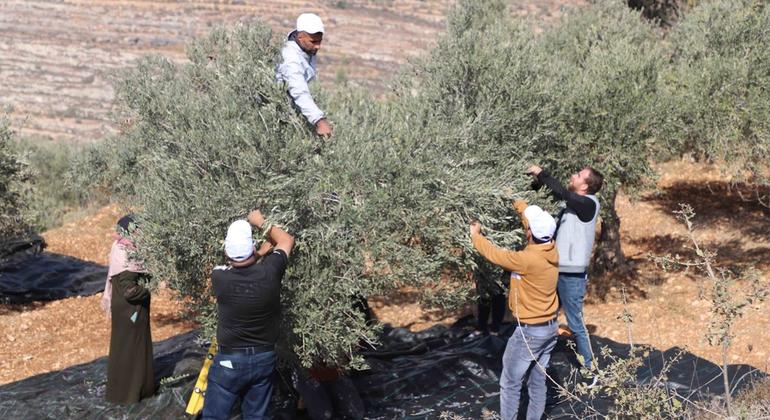
The raid on the UAWC’s offices came after weeks of harassment and incitement by Israeli settlers and settler leaders who specifically targeted the organization during the olive harvest season. This year’s olive harvest has been marked as the most violent on record, with OHCHR documenting 167 settler attacks affecting 87 Palestinian communities by mid-November.
The violence has not been limited to just farmers, as human rights defenders, volunteers providing protective presence, and NGOs supporting communities targeted by settler violence or threatened by settlement expansion have also been subjected to violations. Since October 1, the UN has recorded 81 instances of violations by settlers and Israeli security forces, including arrests, detentions, and physical assaults.
OHCHR noted that Israeli security operations in the West Bank often involve unnecessary or disproportionate force, arbitrary detention, and ill-treatment. This has contributed to a rapid shrinking of both physical and civic space for Palestinians as settlement expansion and what the UN deems as Israel’s “unlawful annexation” of the territory continue.
Ajith Sunghay, the head of OHCHR in the Occupied Palestinian Territory, emphasized the unequivocal legal position that Israel must end its unlawful presence in the Occupied Palestinian Territory and remove all settlers in accordance with the International Court of Justice’s conclusions. As an occupying power, Israel is obligated to uphold international law, including respecting and protecting Palestinians’ rights to earn a living and exercise freedom of expression and association.
The situation in the Occupied Palestinian Territory remains complex and fraught with tensions, as Palestinians continue to face challenges in accessing their rights and freedoms amid ongoing conflicts and occupation. The actions of Israeli security forces, settlers, and authorities have raised concerns among international human rights organizations and the UN, highlighting the need for a peaceful and just resolution to the longstanding Israeli-Palestinian conflict.