Assistive Technologies Empower Persons with Disabilities
When designed with lived experience at its heart, AI tools like conversational screen readers, adaptive dashboards, and real-time captioning don’t just remove barriers; they expand possibility. They transform access into agency and the freedom to learn, lead, and contribute fully.
Avoiding a ‘shinier version of the same old bias’
Surashree Rahane was born with several physical disabilities, including clubfoot and polymelia, a condition in which affected individuals are born with extra limbs. Growing up in a family where disability was part of daily life, she never saw it as a limitation, but just another way of navigating the world.
“My mentors always said, don’t just seek jobs, create them,” she shares. “That’s how I learned that leadership itself is inclusion.”
Ms. Rahane is now the founder and CEO of Yearbook Canvas, a technology platform that specializes in digital yearbooks for academic institutions. As she built her company, she saw how structural barriers, such as inaccessible infrastructure, biased funding networks, and rigid education systems, persist.
To address these challenges, she is currently working with Newton School of Technology near New Delhi, focusing on inclusive academic design and AI-based learning tools that adapt to each student’s pace. “AI can democratize access to education,” she says, “but only if we teach it to understand diverse learners. Otherwise, we risk building a shinier version of the same old bias.”
‘The great equalizer’
From voice-to-speech tools for people with speech impairments to gesture-based wheelchair controls, technology is now breaking barriers once seen as permanent.
Prateek Madhav, CEO of AssisTech Foundation (ATF), describes AI as “the great equalizer.” “While the world worries about AI taking jobs,” he says, “for people with disabilities, AI is creating them.”
Ketan Kothari, a consultant at Xavier’s Resource Centre for the Visually Challenged in Mumbai, demonstrates how AI tools have made him fully independent at work. “Today I can format a document, access meetings with live captions, and even generate visual descriptions through apps,” he explains. “AI has turned imagination into function.”
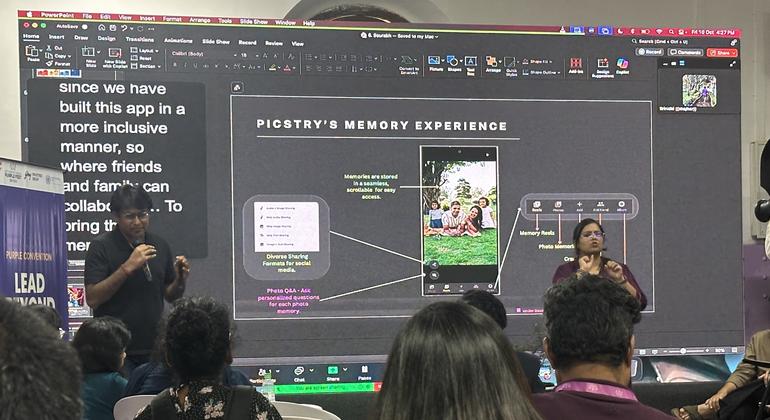
Purple Fest predominantly features Indian entrepreneurs and business leaders but, as Tshering Dema from the UN Development Coordination Office reflects, “this is not a single-country story – it’s a global transition. Inclusion isn’t only about laws or infrastructure; it’s about mindset and shared design. The future of work must be built not just for people, but with them.”
Assistive technologies have become a crucial tool in empowering persons with disabilities to lead independent and fulfilling lives. These technologies, ranging from conversational screen readers to adaptive dashboards and real-time captioning, have revolutionized the way individuals with disabilities navigate the world. By incorporating lived experience into the design of AI tools, barriers are not only removed but possibilities are expanded, allowing for agency and the freedom to learn, lead, and contribute fully.
One individual who exemplifies the power of assistive technologies is Surashree Rahane, who was born with physical disabilities such as clubfoot and polymelia. Growing up in a family where disability was a part of daily life, she learned to navigate the world with a different perspective. Rahane is now the founder and CEO of Yearbook Canvas, a technology platform specializing in digital yearbooks for academic institutions. Through her work, she has seen firsthand the structural barriers that individuals with disabilities face, including inaccessible infrastructure, biased funding networks, and rigid education systems.
To address these challenges, Rahane is collaborating with Newton School of Technology near New Delhi to focus on inclusive academic design and AI-based learning tools that adapt to each student’s pace. She emphasizes the importance of teaching AI to understand diverse learners in order to democratize access to education. Without this understanding, there is a risk of perpetuating bias in the development of AI tools, creating a “shinier version of the same old bias.”
AssisTech Foundation (ATF), led by CEO Prateek Madhav, views AI as “the great equalizer” for individuals with disabilities. While there may be concerns about AI taking away jobs, Madhav highlights how AI is actually creating opportunities for people with disabilities. Ketan Kothari, a consultant at Xavier’s Resource Centre for the Visually Challenged in Mumbai, shares his experience of becoming fully independent at work with the help of AI tools. He can now format documents, access meetings with live captions, and generate visual descriptions through apps, showcasing how AI has transformed his abilities into functional skills.
Purple Fest, an event featuring Indian entrepreneurs and business leaders, serves as a platform to showcase the impact of assistive technologies on individuals with disabilities. Tshering Dema from the UN Development Coordination Office emphasizes that this is not just a single-country story but a global transition towards inclusivity. Inclusion goes beyond laws and infrastructure; it requires a shift in mindset and collaborative design to ensure that the future of work is built not just for people with disabilities but with them.
Overall, assistive technologies have the potential to empower persons with disabilities by providing them with the tools and resources they need to lead independent and fulfilling lives. By incorporating lived experience into the design of AI tools and focusing on inclusive practices, we can create a more accessible and equitable society where all individuals have the opportunity to learn, lead, and contribute fully.