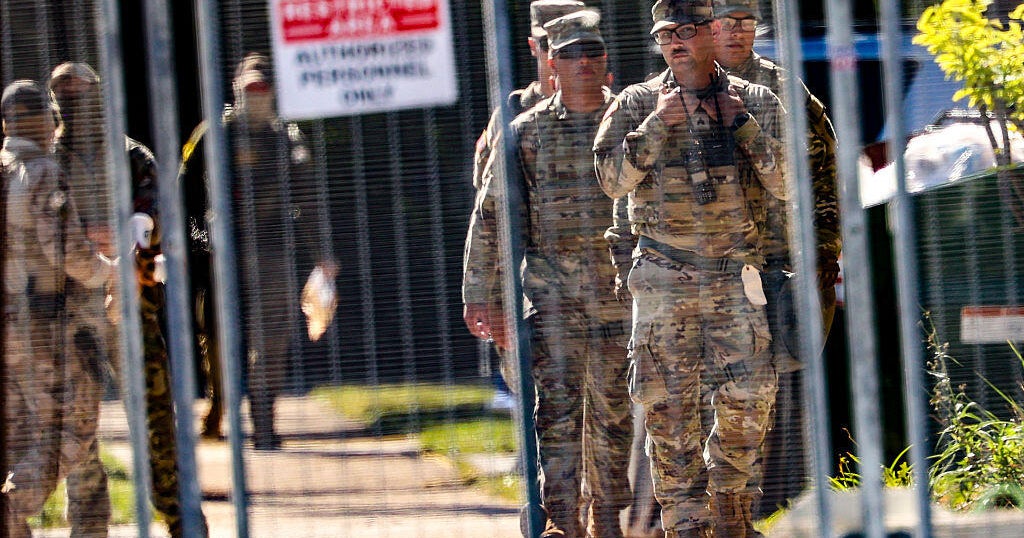
The federal appeals court decision to block the deployment of National Guard troops in the Chicago area amidst ongoing protests at U.S. Immigration and Customs Enforcement facilities has sparked a legal battle between the Trump administration and the state of Illinois and the city of Chicago. The Seventh Circuit Court of Appeals upheld a ruling from U.S. District Judge April Perry denying the White House’s request to deploy National Guard troops on the streets of Chicago in response to the lawsuit. However, the court granted a temporary stay to keep the National Guard troops under federal control, pending further legal proceedings.
The decision comes after the Defense Department announced the federalization of approximately 200 National Guard soldiers from Texas and another 300 from Illinois under Title 10, sending them to the Chicago area for at least 60 days to protect federal personnel and property, including U.S. Immigration and Customs Enforcement facilities. The ICE processing facility in the Broadview suburb of Chicago has been a site of ongoing clashes between protesters and law enforcement, highlighting the tensions surrounding immigration policies and enforcement.
Similar legal battles have also unfolded in Portland, Oregon, where a Trump-appointed federal judge issued a temporary restraining order blocking the federalization and deployment of Oregon National Guard troops. The judge later blocked the deployment of National Guard troops from other states to Oregon as the Pentagon planned to send additional troops to Portland. An appeals court temporarily granted a White House request to keep the Oregon National Guard troops under federal control, but they are still prohibited from deploying to Portland while the legal case continues.
The rulings in both Chicago and Portland raise questions about the use of National Guard troops in response to civil unrest and protests, particularly in the context of immigration enforcement. The Trump administration’s efforts to crack down on protests at ICE facilities have faced legal challenges from state and local governments, highlighting the ongoing debate over the role of federal forces in domestic law enforcement.
The decision to block the deployment of National Guard troops in Chicago underscores the importance of upholding constitutional rights and ensuring that law enforcement responses to protests are conducted in a manner that respects civil liberties. The court’s ruling to keep the troops under federal control while the legal process plays out reflects a cautious approach to balancing the need for security with the protection of individual rights and freedoms.
As the legal battles in Chicago and Portland continue, the role of the National Guard in responding to civil unrest and protests remains a contentious issue. The use of federal forces to quell demonstrations raises concerns about the militarization of law enforcement and the potential for escalation of tensions between protesters and authorities. The decisions by the courts to limit the deployment of National Guard troops reflect a recognition of the need to exercise restraint in the use of military forces in domestic situations.
The ongoing protests at ICE facilities in Chicago and Portland highlight the deep divisions in American society over immigration policies and enforcement. The clashes between protesters and law enforcement underscore the challenges of balancing public safety with the protection of individual rights and freedoms. The legal battles over the deployment of National Guard troops in response to these protests reflect the broader debate over the role of federal forces in maintaining order and upholding the rule of law.
In the midst of these legal challenges and protests, it is essential for all parties to respect the rights of individuals to peacefully demonstrate and express their views. The courts play a critical role in ensuring that constitutional rights are upheld and that law enforcement actions are conducted in a manner that respects the principles of democracy and the rule of law. The decisions in Chicago and Portland serve as a reminder of the importance of judicial oversight and legal accountability in safeguarding the rights and liberties of all Americans.