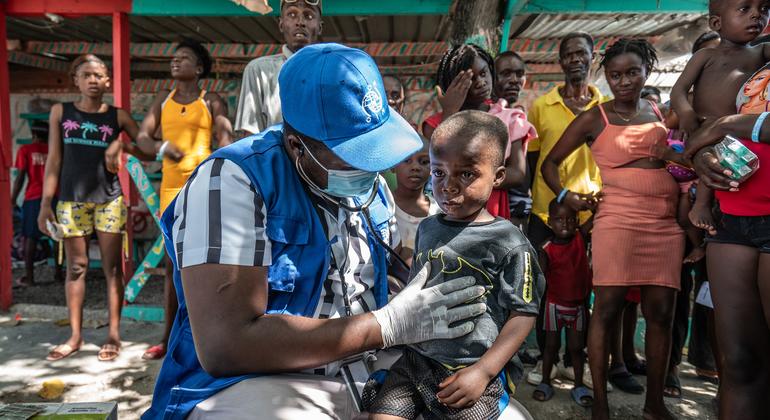
The crisis in Haiti has escalated dramatically in recent months, with the number of people forced to flee their homes skyrocketing from 362,000 in early March to over 578,000 in June. This represents a staggering 60 percent increase in just three months, underscoring the urgent need for humanitarian assistance in the country.
When people are displaced in Haiti, the situation becomes dire as they are often forced to leave their homes at short notice and with few possessions. The United Nations, through its Office for the Coordination of Humanitarian Affairs (OCHA), plays a crucial role in coordinating the response mechanism with the Haitian Government, local non-governmental organizations (NGOs), and international partners. However, responding to the crisis in Haiti is not a straightforward task, as the violence that has displaced people also poses a challenge in delivering aid.
Mr. Sawadogo, a representative from OCHA, highlighted the difficulties of providing assistance in the midst of ongoing violence. He emphasized that aid cannot be delivered in the middle of a gunfight, underscoring the complex nature of the crisis in Haiti. The International Organization for Migration (IOM) works closely with Haitian NGO partners who have teams on the ground to reach out to people and assess their individual needs.
One of the most pressing issues in situations of displacement is the protection of vulnerable individuals, particularly women and children. When people are uprooted from their homes, they become susceptible to violence, sexual assault, exploitation, abuse, and family separation. There are reports of children being coerced into working for gangs, highlighting the dire circumstances faced by displaced populations in Haiti.
The UN and its partner organizations work to ensure the protection of individuals by supporting the Haitian Government in providing legal documentation and social protection to those affected by displacement. They also help people access services and protection from exploitation and abuse. Organizations such as the UN Population Fund (UNFPA), the UN Children’s Fund (UNICEF), and local NGOs provide psychosocial support to traumatized individuals, including children, to help them cope with the traumatic experiences they have endured.
Preparedness is a key element in responding to displacement in Haiti, as the situation on the ground can change rapidly in unstable and dangerous environments. Having financial resources, sufficient staff, access to affected areas, and government support are crucial for an effective response. The logistics of supplying relief aid, such as airlifting medicines and shelter materials, play a vital role in ensuring that displaced populations receive the assistance they desperately need.
In June, the World Food Programme (WFP) airlifted over 55 tonnes of medicines and shelter materials for displaced people, as well as prepositioning stock for the upcoming hurricane season. Médecins Sans Frontières (MSF), also known as Doctors Without Borders, airlifted 80 tonnes of medicine to sustain its operations in Port-au-Prince. These efforts are essential in providing much-needed support to displaced populations in Haiti.
The assistance provided to displaced people in Haiti is tailored to their specific needs, with a focus on health, shelter, food, water, and protection. The UN and its partner organizations are working tirelessly to address the humanitarian crisis in the country and provide essential support to those forced to flee their homes. Despite the challenges posed by ongoing violence and instability, the international community is committed to aiding the people of Haiti in their time of need.