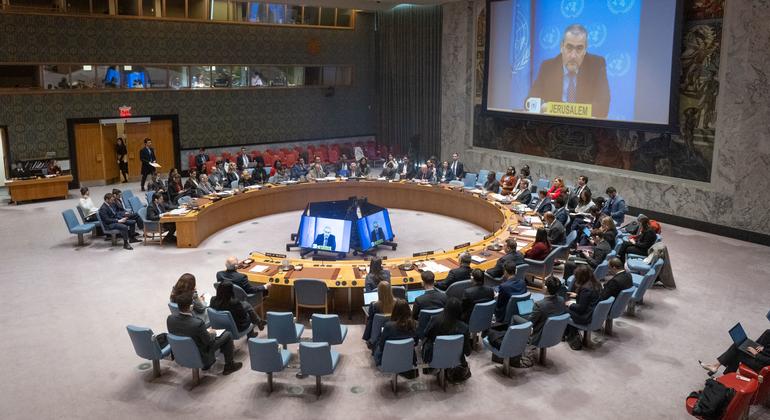
The United Nations Security Council convened a crucial meeting amidst the fragile ceasefire in Gaza, with ambassadors from various nations expected to call on Israel and Hamas to uphold their commitments in light of renewed violence and growing humanitarian needs. The session aimed to address key issues such as ensuring the sustainability of the truce, facilitating aid access, and maintaining the political progress made thus far. Against the backdrop of escalating tensions in the West Bank and southern Lebanon, the meeting served as a litmus test for the Council’s ability to help stabilize the situation and advance the cause of Palestinian self-determination.
The Security Council’s meeting came at a critical juncture, with the international community closely monitoring developments in the region. The ceasefire in Gaza, brokered by Egypt and the United Nations, had brought a temporary respite to the conflict between Israel and Hamas. However, recent clashes and the deteriorating humanitarian situation underscored the fragility of the truce and the urgent need for sustained efforts to prevent a return to violence.
Ambassadors representing member states of the Security Council gathered to discuss ways to support the ceasefire, address the humanitarian crisis, and promote a lasting political solution to the Israeli-Palestinian conflict. The meeting was an opportunity for the Council to reaffirm its commitment to upholding international law, protecting civilians, and advancing the goal of a two-state solution based on the pre-1967 borders.
In his opening remarks, the President of the Security Council underscored the importance of maintaining the ceasefire in Gaza and called on all parties to respect their obligations under international law. He emphasized the need for unhindered access for humanitarian aid and underscored the Council’s commitment to working towards a comprehensive and lasting peace in the region.
Ambassadors from various countries expressed their concerns about the recent escalation of violence and the impact on civilians in Gaza and the wider region. They called for an immediate cessation of hostilities, the protection of civilians, and the resumption of negotiations towards a political solution. Many stressed the importance of addressing the root causes of the conflict and the need for a just and lasting resolution that respected the rights and aspirations of both Israelis and Palestinians.
The discussion in the Security Council focused on several key issues, including the need for increased humanitarian assistance to address the growing needs of the population in Gaza. Ambassadors highlighted the critical importance of ensuring access to essential services such as healthcare, food, and water, particularly in light of the ongoing blockade and restrictions on movement imposed by Israel.
Moreover, the Council debated the broader implications of the conflict on regional stability, with concerns raised about the situation in the West Bank and southern Lebanon. Ambassadors underscored the need for a comprehensive approach to addressing the root causes of the conflict and called for renewed efforts to promote dialogue, reconciliation, and mutual understanding among all parties involved.
Throughout the meeting, there was a strong consensus among Council members on the importance of upholding international law and respecting the rights of all civilians in the region. Several ambassadors reiterated their support for a two-state solution based on the pre-1967 borders, with Jerusalem as the capital of both Israel and Palestine.
The Security Council’s meeting concluded with a call for renewed efforts to support the ceasefire in Gaza, address the humanitarian crisis, and advance the political process towards a just and lasting resolution of the Israeli-Palestinian conflict. Ambassadors pledged to continue working together to promote peace, security, and stability in the region, with a firm commitment to upholding the principles of the United Nations Charter and international law.
Overall, the Security Council’s meeting served as a critical forum for addressing the pressing challenges facing Gaza, the West Bank, and southern Lebanon. It underscored the importance of international cooperation, dialogue, and diplomacy in resolving conflicts and advancing the cause of peace and security in the Middle East. As the international community continues to monitor developments in the region, the Council’s ongoing engagement will be crucial in supporting efforts to build a more stable, prosperous, and peaceful future for all people in the region.