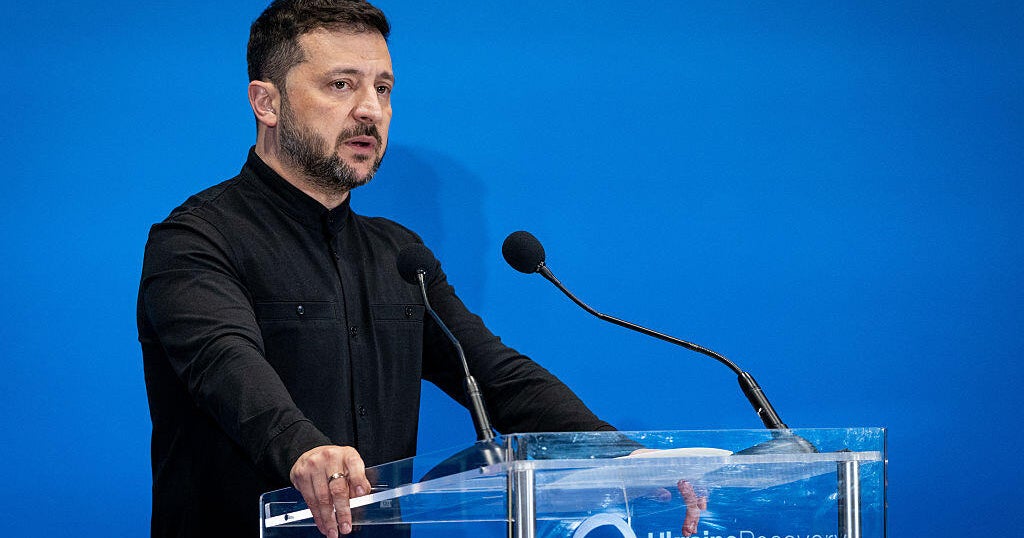
In a significant new development in international diplomacy, recent reports suggest that Russia has shown an openness to ending the ongoing war in Ukraine. Ukrainian President Volodymyr Zelenskyy conveyed this information while addressing reporters, illustrating a potential shift in the conflict that has drawn global attention and concern.
President Zelenskyy revealed these insights following a conference call involving U.S. President Donald Trump and various European leaders. Notably, U.S. special envoy Steve Witkoff participated in the discussion and indicated that Russia was ready to take initial steps toward ceasing hostilities, beginning with a potential ceasefire. “This is the first such signal from them,” President Zelenskyy noted, highlighting the possible significance of this development in the context of the prolonged conflict.
However, the Ukrainian leader also expressed caution, emphasizing the principle of “talks about us, without us, will not work.” This statement came ahead of a scheduled one-on-one summit between President Trump and Russian President Vladimir Putin in Alaska. The meeting, set to occur on Friday, marks the first direct discussion in person between Putin and a sitting U.S. president since the escalation of the Ukrainian conflict more than three years prior.
The strategic setting of the summit at Joint Base Elmendorf-Richardson, located on the northern outskirts of Anchorage, was chosen due to limited options available during the tourist-heavy season in Alaska and the necessity to meet stringent security requirements for such high-stakes international discussions. Karoline Leavitt, the White House press secretary, described the forthcoming meeting as “a listening exercise for the president,” where President Trump aims to grasp a firmer understanding of the situation and explore avenues to potentially bring the war to an end.
Widely anticipated topics for the summit include the fate of Ukraine’s Donbas region. Parts of this area have been under Russian control since the annexation of Crimea in 2014 and further exacerbated by the full-scale invasion initiated by Russia in 2022. Despite these challenges, Ukrainian forces continue to hold ground in parts of Donetsk, a province within the contested Donbas region.
Parallel to these diplomatic interactions, a spokesperson for President Zelenskyy’s office confirmed that the Ukrainian leader would participate in a virtual meeting with President Trump and European leaders to deliberate on the ongoing conflict. This virtual dialogue, taking place on Wednesday, seeks to foster a collaborative international approach to resolving the conflict.
President Trump, too, expressed optimism about the outcomes of his impending meeting with President Putin. In a briefing at the White House, he mentioned that he hopes the summit will be “constructive” and laid out plans for a subsequent meeting that would also include President Zelenskyy, potentially joined by Putin. Despite these plans, President Zelenskyy remains firm that no meeting discussing Ukrainian issues should proceed without the active involvement of European leaders.
“The presence of Europe in one form or another is very important because, ultimately, so far, no one but Europe has provided us with security guarantees,” President Zelenskyy stated. He also expressed a wary perspective on the Alaska summit, suggesting that it might primarily benefit President Putin who, according to Zelenskyy, seeks significant media attention from such high-profile engagements.
These unfolding events symbolize a critical juncture in the Ukraine conflict, bringing to light the complex interplay of international relations, the unyielding stance of national leaders, and the relentless quest for peace in a region marred by prolonged and violent conflict. As the world watches, the outcomes of these meetings could potentially redefine the geopolitical landscape in Eastern Europe and beyond.