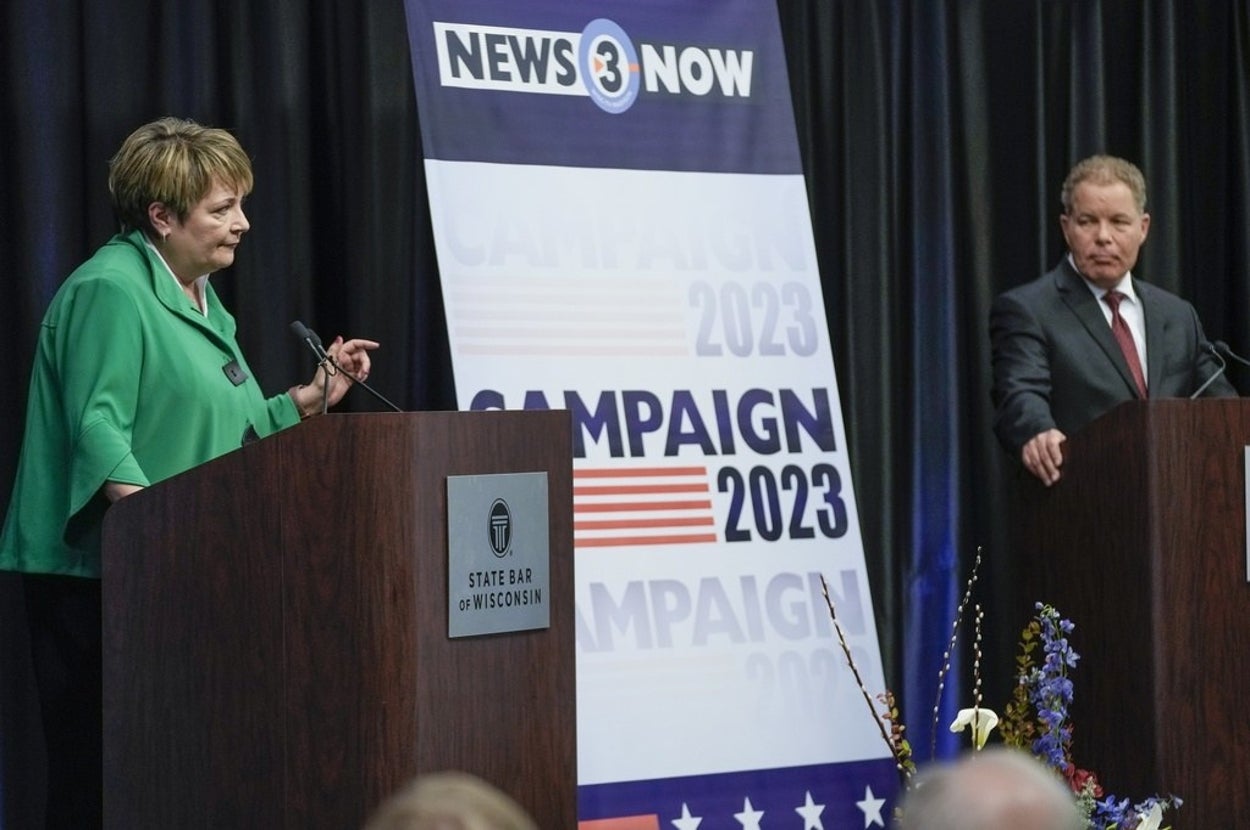
In the state of Wisconsin, an election that’s poised as potentially the most critical of the year for abortion rights is gearing up, setting the stage for a pivotal ruling that could reshape the legal landscape of reproductive rights within the state.
This election, scheduled for Tuesday, isn’t just about choosing any political figure or judge—it revolves around electing a member to the Wisconsin Supreme Court. While the court itself is officially nonpartisan, the ideological leanings of its members are not. The incoming justice will play a crucial role in determining the future of an antiquated, yet suddenly relevant, law: an 1849 statute that bans abortions in nearly all instances, save for when the life of the pregnant individual is at risk.
The gravity of this election springs from a seismic shift in the judicial perspective on abortion in the United States, following the U.S. Supreme Court’s decision to overturn Roe v. Wade last June. This landmark reversal didn’t merely nudge the topic of abortion rights back into the conversation—it hurled it into the spotlight, transforming it into a pivotal issue at state levels across the nation.
Howard Schweber, a political science professor at the University of Wisconsin-Madison, highlights a critical misunderstanding in the post-Roe landscape. “When the US Supreme Court overruled Roe v. Wade, there was a lot of talk about the issue of abortion being sent to the state legislatures. In fact, that’s wrong: Ultimately, the question goes to the 50 state supreme courts, each of which has to interpret its state’s constitution,” he explained to BuzzFeed News.
This backdrop sets the stage for Tuesday’s critical vote. The outcome will decide if the Wisconsin Supreme Court retains its current conservative lean or shifts towards a liberal bend. This balance is vital, given that the court is expected to rule on whether the 1849 ban should be upheld or struck down in the near future.
The reinstatement of the 1849 law has already had profound effects. Following the overturning of Roe, confusion and legal uncertainty led many abortion providers in Wisconsin to cease offering services, despite the state’s Democratic Attorney General, Josh Kaul, and Governor Tony Evers, also a Democrat, asserting their opposition. They pledged not to enforce the outdated ban while a legal challenge to overturn it makes its way through the courts. Both Kaul and Evers, who were reelected last November after vocalizing their support for abortion rights, play a crucial role in this ongoing legal battle.
As the case weaves its way through the legal system, public opinion and electoral outcomes in the state could significantly influence its trajectory. This is where Tuesday’s election comes into sharp focus. The newly elected justice will likely be a deciding factor in the ultimate fate of abortion rights in Wisconsin.
The national context in which this local election takes place cannot be overstated. Following the reversal of Roe, several states have seen significant electoral battles over abortion rights. For example, last summer, voters in Kansas decisively rejected a measure that would have stripped abortion protections from their state constitution. During the midterm elections, states like Michigan and Kentucky saw voters come out in strong support of reproductive rights.
The intense spotlight on Wisconsin’s Supreme Court election has not gone unnoticed nationally. Former President Barack Obama has weighed in, urging Wisconsinites to vote, underlining the election’s broader significance beyond state boundaries. Moreover, the campaign has shattered financial records, becoming the most expensive state Supreme Court election in U.S. history. Nearly $29 million has been funneled into political advertisements, according to a report by the Brennan Center for Justice, underscoring the high stakes and deep investment in the court’s ideological composition.
This Tuesday, as the voters of Wisconsin head to the polls, they’re not just choosing a Supreme Court justice—they’re making a decision that could reverberate through the state’s legal and societal framework for years to come. Given the strategic importance of this single election, its implications on one of the most divisive and fundamental issues in contemporary politics—abortion rights—are immense.
As campaigning intensifies, the election serves as a potent reminder of the continuing impact of the U.S. Supreme Court’s decision to overturn Roe v. Wade. It’s a decision that has reshaped the political landscape across the U.S., bringing into sharp relief the power and influence of judicial bodies at every level. As Wisconsin goes to the polls, its voters are on the front lines, deciding not just a state matter, but setting a precedent in the national dialogue on reproductive rights. The outcome in Wisconsin could very well be a bellwether for how deeply entwined the judiciary is with the evolving narrative of rights, freedoms, and body autonomy in America.