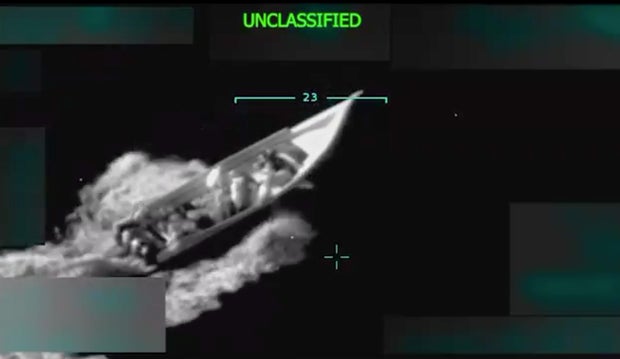
In a significant disclosure on a recent military operation, The White House confirmed that multiple strikes were executed on a suspected drug smuggling boat in the Caribbean on September 2. This acknowledgment appears to support a Washington Post report that indicated a second strike was directed specifically at survivors of the initial attack.
The contentious operation drew public attention after The Washington Post reported last Friday that Defense Secretary Pete Hegseth had verbally commanded that no survivors be left in the aftermath of the strike on the alleged drug boat. According to The Post, the first missile strike left two men alive in the water. Allegedly, Admiral Frank Bradley, the commander in charge of the operation, then ordered a second strike in compliance with Hegseth’s directive, which resulted in the deaths of the two survivors. CBS News has yet to independently verify this narrative as described by The Washington Post.
Prompted by these reports, members of Congress from both parties have called for a thorough investigation into the incident, voicing concerns that targeting survivors might constitute a war crime. Defense Secretary Hegseth, however, has denounced these claims as “fabricated, inflammatory, and derogatory,” defending the operation as lawful under both U.S. and international statutes.
During a press briefing on Monday, White House Press Secretary Karoline Leavitt was pressed for clarity on whether the second strike had indeed occurred and whether Secretary Hegseth had ordered it. Leavitt confirmed that Hegseth had authorized Admiral Bradley to conduct these “kinetic strikes,” asserting that the operations were carried out legally. “Admiral Bradley operated well within his authority and the law, ensuring that the threat was completely neutralized,” Leavitt stated in a prepared message.
Further inquisition concerned whether Sec. Hegseth’s order had originated from President Trump himself. Leavitt firmly rejected the notion that such a specific directive had come from the Secretary of War or the President. However, she reiterated President Trump’s stance that if narcoterrorists pose a threat by trafficking drugs towards the United States, lethal action is within his authority.
Later on Monday, Secretary Hegseth took to social media to express his unwavering support for Admiral Bradley, describing him as “an American hero” and affirming his confidence in Bradley’s decision-making abilities regarding the September 2 operation and beyond.
This conversation about the operation’s legality further intensified following a statement from former Defense Secretary Leon Panetta, who argued that the alleged second attack might qualify as a war crime. Speaking on CBS Evening News, Panetta emphasized that once individuals are wounded and pose no threat, they should be protected, not targeted.
Official responses have been prompted from various sectors of the government. Senator Roger Wicker of Mississippi, the chairman of the Senate Armed Services Committee, has spoken with both Hegseth and General Dan Caine, chairman of the Joint Chiefs of Staff, about the incident. Senator Wicker anticipates receiving complete audio and visual records of the event to better understand the circumstances surrounding the second strike.
Moreover, President Trump commented on the strikes during a conversation with reporters aboard Air Force One. He noted the efficiency and necessity of the first strike but expressed his intention to obtain more details about the second strike, which he claimed he was not anticipating.
Democratic Senator Tim Kaine of Virginia and Republican Representative Mike Turner of Ohio have both acknowledged the gravity of the situation, with the former stating on CBS’s “Face the Nation” that if the claims are accurate, it would be tantamount to a war crime.
This ongoing controversy underscores the complexity and ethical dilemmas inherent in military operations against narcoterrorism. As more details come to light, congressional leaders from the House and Senate Armed Services Committees are adamant about conducting a thorough assessment to determine the full scope and legality of the actions taken on September 2. The incident not only raises critical questions regarding the conduct of military operations but also about the oversight of such operations and the implications of targeting practices that may breach established rules of engagement and international humanitarian law.
Adding to the political ramifications, this incident also reflects on broader policy decisions and the administration’s stance towards combating drug trafficking and narcoterrorism, highlighting the challenges of balancing aggressive enforcement with adherence to national and international legal standards. As the investigation progresses, the findings will likely have significant implications for U.S. military and foreign policy, particularly in how narcoterrorism is engaged globally.