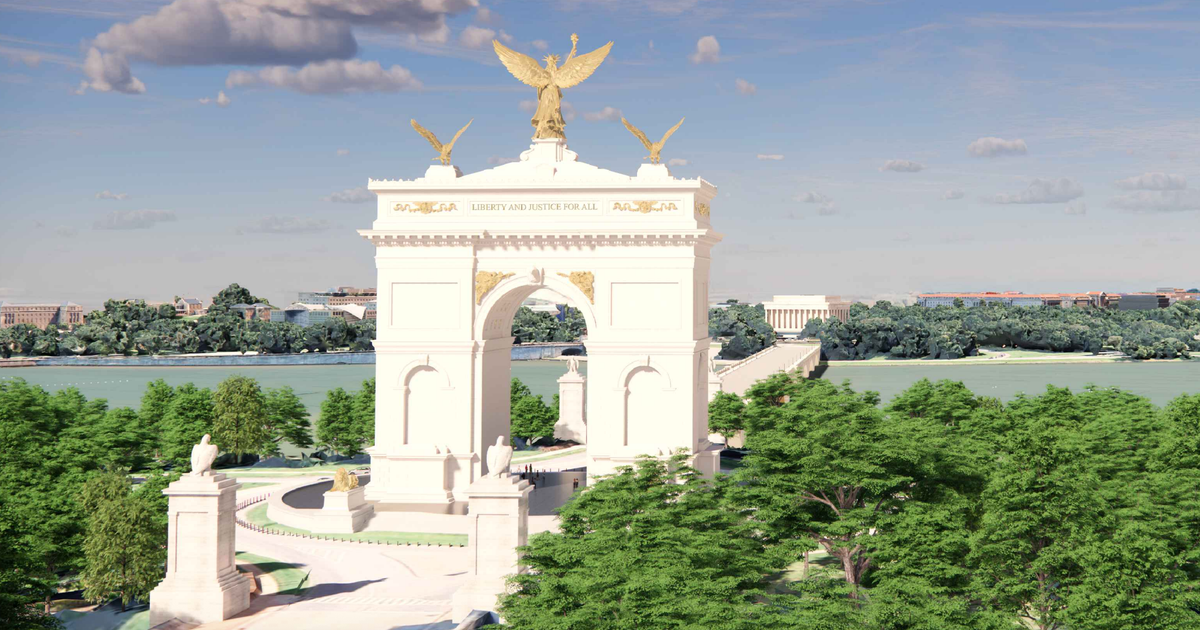
In the heart of Washington, D.C., a legal battle is brewing over the construction of a monument that has been described by some as a testament to one man’s ego and by others as a triumphal arch to symbolize America’s 250th birthday. At the center of this brewing storm are two men, Shaun Byrnes and Jon Gundersen, both veterans who have served multiple U.S. presidents throughout their decades-long careers in the military and State Department.
These men, now in retirement, are doing what they believe is their patriotic duty and challenging the commander-in-chief in a court of law. In February, the duo, alongside another Vietnam veteran and a historian, filed a lawsuit in an attempt to thwart the construction of the 250-foot arch that is set to be erected in a currently vacant traffic circle between Arlington National Cemetery and the Lincoln Memorial.
The arch, as per the complainants, is a disruptive architectural structure that has been hastily planned and executed without proper congressional approval. They argue that the monument, projected to be more than double the height of the Lincoln Memorial, would interfere with the symbolic connection between the Lincoln Memorial and the Robert E. Lee Memorial. This sightline is a carefully designed feature meant to symbolize unity in the aftermath of the Civil War.
For Byrnes and Gundersen, however, their legal challenge against President Trump’s triumphal arch isn’t a partisan quest. “I think what we’re doing is being loyal to the country. And loyalty can be measured in different ways,” stated Gundersen, a retired Army Special Forces officer, during an interview with CBS News.
Expressing his reasons for joining the suit, Byrnes, a Navy veteran who served two tours in Vietnam, shared that his motivation was driven by respect for the fallen soldiers buried in Arlington. “It’s more about the duty I feel towards my colleagues and friends who did not come home to stand up against this project, regardless of who’s in charge,” he said. “I think it’s just disrespectful to those that I served with who didn’t come back, and then, of course, to all those who are lying in Arlington National Cemetery.”
Byrnes, who aspired to be interred in Arlington National Cemetery, disclosed that the construction of the arch would lead him to reconsider his final resting place.
The legal wrangling over the controversial monument has seen the Justice Department make a move to dismiss the lawsuit, arguing that the group lacks the proper standing to sue. The administration officials have suggested that Congress has already sanctioned the project, citing a plan adopted over a century ago, which called for the construction of “two stately columns,” each 166 feet tall, to symbolize the unity of the North and South.
The legal proceedings took a turn last month when a federal judge denied a motion to temporarily halt the construction of the monument, which is yet to commence.
For Gundersen, 81, and Byrnes, 83, the arch signifies not a commemoration of America’s 250th birthday, but a monument to one man: Mr. Trump. Last year, the president unveiled a model of the proposed arch, bearing a striking resemblance to the Parisian Arc de Triomphe, to a group of reporters in the Oval Office. When asked who the arch was being built for, Mr. Trump pointed to himself and stated, “Me.”
The proposal for the arch has moved forward, with the U.S. Commission for Fine Arts approving the project last week, despite encountering overwhelming public opposition. During the CFA meeting, the group’s secretary, Thomas Luebke, revealed that they had received no comments in support of the project. An urban planning commission, filled with allies of the president, is expected to give the final nod to the project in early June.
In the course of their illustrious careers, Gundersen and Byrnes were deployed to Moscow and were instrumental in setting up U.S. embassies in post-Soviet Eastern Bloc countries. The proposed arch, which has been dubbed the “Arc de Trump,” reminds them of the countries they have served in and fought against.
“We know how authoritarian dictatorships work,” Gundersen observed. “There’s no rule of law, there’s no consent of the governed, and there are monuments for the leaders there.” Gundersen expressed skepticism over Mr. Trump’s assertion that the arch would be financed by private donations rather than taxpayer dollars, questioning, “Even if you took private donations, is that how we want to build monuments? To the oligarchs who give money for favors?”
Despite the odds, Gundersen and Byrnes remain undeterred in their quest to prevent the construction of the proposed monument. “We have fought for our country. We believe in this country, and we’re going to continue to the end, and I think we can change things,” Gundersen said. Their story is a testament to their unwavering loyalty to their country and their relentless pursuit of what they believe is in the best interest of their fallen comrades and the nation they have served.