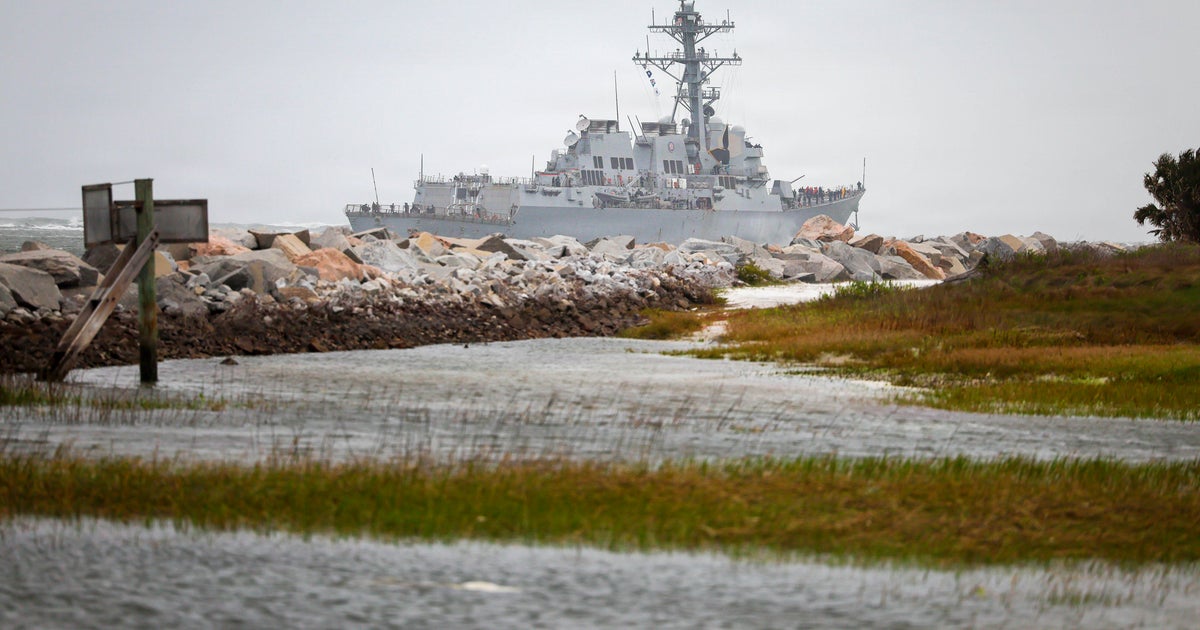
In a recent escalation of maritime tensions, three U.S. Navy destroyers, the USS Truxton, USS Mason, and USS Rafael Peralta, encountered a hostile offensive from Iranian forces while navigating the strategic Strait of Hormuz. This incursion has brought the spotlight back onto an increasingly delicate ceasefire agreement between the United States and Iran, highlighting the fragility of peace in a region vital to global oil markets.
The attack, occurring amidst precarious negotiations, involved a multifaceted assault using missiles, drones, and small boats targeting the American vessels. According to CBS News, which first reported the incident, the confrontation was confirmed by the U.S. military’s Central Command (CENTCOM). The attack prompted a swift retaliatory response from the U.S., executing “self-defense strikes” against Iranian military infrastructure. Notably, the targeted facilities included Iranian drone and missile launch sites, although the initial assault left the U.S. ships unscathed.
Further detailing the scale of the American response, multiple U.S. officials disclosed that the counterstrikes focused on the Iranian ports of Bandar Abbas and Qeshm. These locations, critical to Iran’s maritime operations, now represent a significant escalation in the military engagement between the two nations.
Simultaneously, President Donald Trump maintained that the ceasefire was still ongoing, despite these significant military exchanges. In comments to ABC News, the President downplayed the severity of the strikes, referring to them metaphorically as “just a love tap” in the broader context of U.S.-Iran relations. His remarks aimed to minimize the perception of conflict escalation, although his later statements suggested a firmer stance. During a public engagement at the Lincoln Memorial Reflecting Pool repair project, President Trump expressed discontent with Iran’s aggressive actions, indicating a potential hardening of his administration’s approach if provoked further.
According to accounts from American officials, the Iranian attack was not only direct but also notably more intense than previous encounters reported earlier in the week. The USS Truxton and USS Mason, both previously targeted, had again faced a barrage of Iranian small boats, drones, and missiles before successfully navigating into the Persian Gulf. This repeated aggression has illustrated a pattern of Iranian hostility in a critical waterway.
On the tactical front, U.S. forces engaged in robust defensive operations as the attack unfolded. Naval gunfire, including the use of five-inch guns and Close-In Weapon Systems (CIWS), was employed to repel fast-approaching Iranian boats. Support was also provided from above, with American Apache helicopters deploying Hellfire missiles and aircraft deploying .50-caliber machine guns, forming a comprehensive aerial and maritime defense which successfully thwarted the Iranian assault with no reported casualties or damage to U.S. vessels.
Despite the absence of physical damage, CENTCOM reported the engagement’s impact on Iranian forces was significant, with President Trump noting on social media that the U.S. action resulted in “great damage done to the Iranian attackers,” analogously describing the destruction of Iranian drones as “butterflies dropping to their grave.”
This high-tension situation unfolds in the backdrop of a delicate ceasefire between the two nations, brokered about a month prior. The ceasefire represented a temporary halt in hostilities, providing a window for negotiation towards a more enduring peace agreement. Defense Secretary Pete Hegseth and Secretary of State Marco Rubio have reiterated that the ceasefire remains in effect, signaling a complex balancing act between diplomatic negotiations and military readiness.
The Strait of Hormuz, through which about one-fifth of the world’s oil transit occurs, remains a critical flashpoint. The region’s stability is significant not only for U.S.-Iran relations but for global economic stability, especially considering the strait’s role in international oil supply. Following initial U.S. and Israeli strikes on Iran in late February, oil prices surged, and commercial shipping was severely disrupted. Most commercial vessels have since avoided the strait, heeding warnings from Iran against unauthorized passage.
In efforts to assert control and reopen the strait for safe passage, President Trump initiated and then temporarily suspended “Project Freedom,” an operation aimed at guiding commercial vessels through the waterway. The project’s suspension was reportedly to allow space for continued negotiations, underscoring the precarious nature of the diplomatic efforts underway.
President Trump has explicitly warned of more severe consequences should Iran fail to engage constructively in the negotiation process, highlighting a U.S. position that oscillates between seeking diplomatic solutions and demonstrating military prowess.
As this situation continues to evolve, the international community watches closely, understanding that the outcomes here could have far-reaching implications not only for U.S.-Iran relations but for the broader geopolitical landscape in the Middle East.