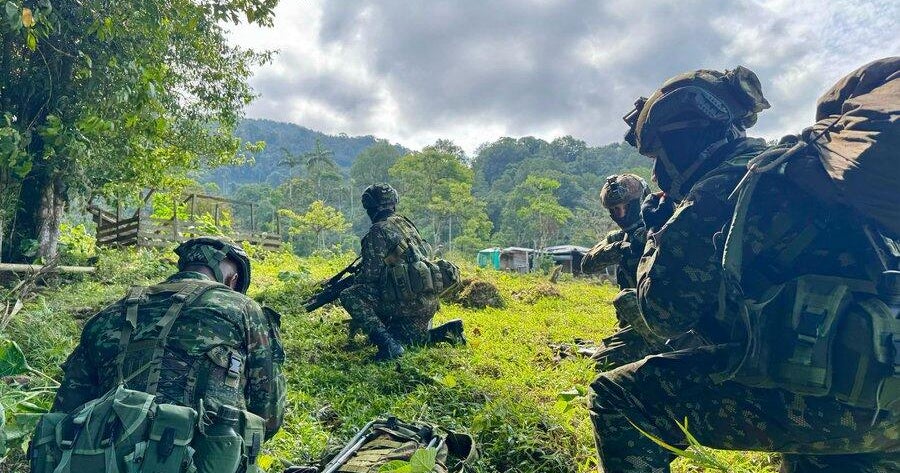
On Tuesday, the Trump administration made a significant move identifying another major Latin American drug organization as a foreign terrorist group, escalating the financial clampdown on its operatives and paving the way for potential military interventions. The U.S. State Department announced that Colombia-based Clan del Golfo has been classified as both a foreign and a global terrorist organization. This designation stems from the group’s involvement in violent and influential criminal operations that heavily rely on cocaine trafficking as a primary source of funding for their violent acts.
The U.S. government described Clan del Golfo as a robust and violent criminal entity, notorious for orchestrating terrorist attacks targeting public officials, law enforcement personnel, military members, and civilians across Colombia. This new label as a terrorist organization aligns with the increased pressure from the Trump administration on nations and groups implicated in narcotics operations, highlighting a growing emphasis on combating drug-related activities on a global scale.
The decision to designate Clan del Golfo follows a controversial action in September when the administration added Colombia to a list of countries deemed insufficiently cooperative in the international drug war. This marked the first such designation in nearly three decades and represented a significant rebuke of Colombia, a longstanding ally of the United States. The move was reflective of the strained relations between the White House and Colombia’s leftist leader, President Gustavo Petro, amid a sharp increase in cocaine production under his tenure.
Further escalating tensions, the U.S. sanctioned President Petro in October, accusing him of allowing Colombian drug cartels to thrive and increase cocaine exports to the U.S. President Petro has robustly denied these accusations, pointing to Colombia’s record-high cocaine interception rates and a policy of not fatally targeting suspected smugglers.
Clan del Golfo, also known as AGC (its acronym in Spanish), has evolved significantly over the decades. Originally emerging from right-wing paramilitary groups that battled Marxist guerrillas in the 1990s and 2000s, AGC now commands an estimated force of 9,000 fighters, making it one of Colombia’s most formidable armed groups. The Human Rights Defender’s Office in Colombia issued a report last year documenting the group’s extensive presence in about one-third of Colombia’s municipalities. There, it not only engages in extortion of local businesses but is also notorious for its recruitment of children and the alleged rewards it offers for the assassination of police officers.
Recent months have seen significant upheavals involving Clan del Golfo. In May, Colombian authorities detained over 200 cartel members following their alleged involvement in the killing of two dozen security personnel. In April, the confrontation reached a zenith when eight members of the cartel, including a top leader, were killed during skirmishes with national security forces.
Another major development occurring in 2022 was the group’s violent reaction to the extradition of one of its leaders to the U.S. This resulted in Clan del Golfo imposing a shutdown that affected dozens of towns in northern Colombia for several days. These actions underscore the powerful hold and the violent reach of the group within the region.
Meanwhile, peace talks have been initiated between the Colombian government and Clan del Golfo as of September, discussing the potential disarmament of the group in exchange for reduced sentences for its leaders. Early indications of progress emerged with an agreement signed in Qatar, allowing AGC fighters to assemble in designated zones free from prosecution starting next March.
Elizabeth Dickinson, a senior analyst with the International Crisis Group focusing on Colombia, suggested that this latest designation by the U.S. might be intended to push the Colombian government towards adopting a more stringent stance against Clan del Golfo. She noted that the current tensions between Colombia and Washington were especially pronounced, remarking on the typically cautionary nature of such terrorist designations aimed at deterring third-party involvements with targeted groups.
The labeling of AGC as a terrorist organization by the U.S. also comes amidst ongoing peace negotiations with other militant groups in Colombia and past agreements, such as those with FARC. Although this designation does not immediately authorize U.S. military strikes, it does create a legal foundation that could potentially facilitate military actions if deemed necessary.
Earlier this year, similar designations were applied to Venezuelan gangs like Tren de Aragua and Cartel de los Soles, followed by the U.S. launching targeted attacks against drug trafficking operations off the Venezuelan coast—actions that have sparked legal and ethical debates among U.S. legislators.
Adding to the regional complexities, President Trump recently advocated for a “total and complete blockade” against sanctioned Venezuelan oil tankers, a stance aligning with the broader U.S. strategy to curb illegal drug shipments purportedly supported by Venezuelan President Nicolas Maduro.
These unfolding events reflect a period of intensified and multifaceted confrontations between the U.S. and various actors in Latin America, characterized by a mix of diplomatic pressures, military posturing, and evolving alliances, all underpinned by the broader goal of combating international drug trafficking and its associated networks.