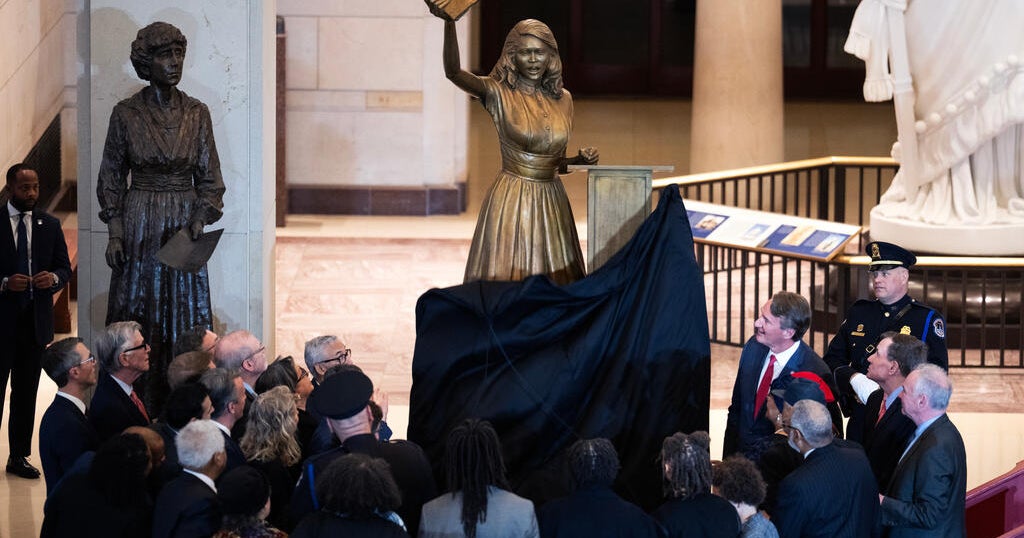
In a moment brimming with historical significance and reflective of America’s ongoing journey toward racial equality, the U.S. Capitol witnessed the unveiling of a statue of Barbara Rose Johns, a fearless teenage advocate for educational equality. This event symbolically replaced the Capitol’s previous homage to Confederate Gen. Robert E. Lee, whose statue had stood for 111 years before its removal in December 2020 amidst a national reckoning on race and history following George Floyd’s tragic death.
On a bright Tuesday morning, Emancipation Hall at the Capitol teemed with anticipation as a diverse gathering of political figures, including Republican House Speaker Mike Johnson, Democratic Minority Leader Hakeem Jeffries, and Virginia’s Republican Governor Glenn Youngkin, along with the incoming Democratic Governor-elect Abigail Spanberger, convened for the ceremony. The air was charged with a palpable sense of change as over 200 members of Johns’ family, alongside Virginia’s congressional delegation, were present to witness this monumental occasion.
Fittingly held in a place called Emancipation Hall, the ceremony was accompanied by stirring musical performances by the Eastern Senior High School choir of Washington, D.C., including renditions of “How Great Thou Art,” “Ain’t Gonna Let Nobody Turn Me ‘Round,” and “Total Praise.” These songs of liberation and spiritual depth added layers of emotional resonance to the proceedings, encapsulating the struggle and ultimate triumph of justice that Barbara Rose Johns represents.
Speaker Mike Johnson encapsulated the sentiment of the day by praising Johns as, “one of America’s true trailblazers” and a paragon of “the American spirit in her fight for liberty, justice, and equal treatment under the law.” His words not only celebrated her past actions but also acknowledged her continuing legacy in the fight for civil rights and education equity.
Barbara Rose Johns Powell, who became a courageous symbol of change at only 16, catalyzed a crucial chapter in the Civil Rights Movement when she led her classmates at R.R. Moton High School in Farmville, Virginia to strike against inadequate and unequal educational conditions in 1951. Frustrated by the overt disparities between the facilities provided for white students and those available to black students, Johns’ bold action garnered the support of NAACP lawyers. This led to a legal challenge that would eventually consolidate into the historic Brown v. Board of Education Supreme Court decision in 1954, effectively dismantling the doctrine of “separate but equal” and declaring segregated schools “inherently unequal.”
After making her indelible mark on history, Johns married Reverend William Powell and ventured into a career as a librarian with the Philadelphia Public Schools, dedicating her life to enriching the minds of young people. She raised five children, who remembered her as a devout, bold, and loving figure in their lives. She passed away in 1991 at the age of 56, but her legacy endures far beyond her lifetime.
Her statue, now part of the esteemed National Statuary Hall Collection, depicts Johns in a moment of determined advocacy, standing beside a lectern and holding aloft a tattered book—a poignant symbol of her quest for knowledge and equality. Engraved on its pedestal is a potent challenge she once issued: “Are we going to just accept these conditions, or are we going to do something about it?”—alongside a biblical quote from Isaiah, “And a little child shall lead them.”
This statue’s placement in the Capitol marks a profound shift in whom we choose to venerate as heroes: from figures like Robert E. Lee, a Confederate general who fought to preserve slavery, to Barbara Rose Johns, who stood for liberty and justice. As noted by Minority Leader Jeffries during the ceremony, Johns is “an actual patriot who embodied the principle of liberty and justice for all,” contrasting sharply with the divisive legacy of Lee.
The inclusion of Johns’ statue in the National Statuary Hall Collection, where each state is represented by two statues, redefines Virginia’s historical narrative in the halls of the nation’s Capitol. Alongside George Washington, she represents the new face of Virginia’s storied yet complex history—a beacon of hope and a testament to the power of youthful courage in challenging systemic injustice.
Beyond her representation in the Capitol, Barbara Rose Johns is commemorated in a sculpture at the Virginia Civil Rights Memorial in Richmond. Her former high school, the site of her bold activism, is now a museum dedicated to the civil rights movement, where visitors can step directly into the recreated setting of her historic protest.
As Governor Youngkin poetically reflected upon visiting the museum, it serves as a stark reminder of the harsh realities Johns and her peers faced—unheated, tar-papered classrooms which symbolized the broader injustice of racial segregation. Her ability to transform such adversity into a platform for systemic change speaks volumes of her character and the enduring impact of her actions.
In this era of continued social and political upheaval, the story of Barbara Rose Johns resonates as a powerful reminder of the ongoing struggle for equality and the critical role of youth activism in shaping a just society. Her legacy, now immortalized in stone, continues to inspire new generations to question, challenge, and strive for a world that upholds the true values of liberty and justice for all.