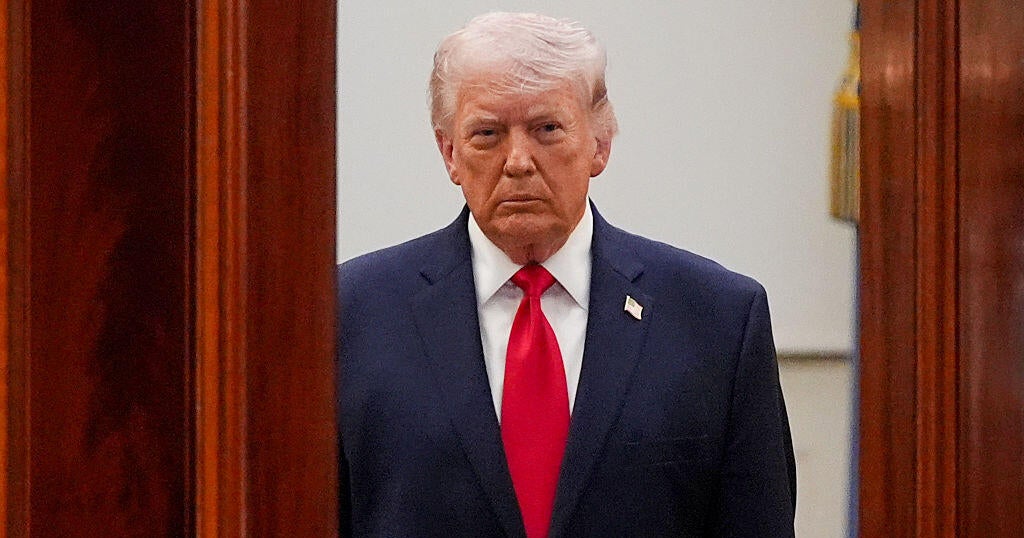
In a stern warning issued on Saturday, President Donald Trump gave Iran a 48-hour ultimatum to reopen the Strait of Hormuz, a crucial waterway for oil shipping, or face the wrath of disastrous consequences. This latest warning by the president is consistent with his previous declarations and continues to underscore the severity of the ongoing conflict between the U.S. and Iran.
In a post on Truth Social, Mr. Trump stated, “Remember when I gave Iran ten days to MAKE A DEAL or OPEN UP THE HORMUZ STRAIT. Time is running out – 48 hours before all Hell will reign down on them. Glory be to GOD!” The president’s ominous remarks highlight the escalating tensions between the two nations and the upcoming deadline for Iran to comply with the U.S.’s demands.
This recent proclamation echoes the president’s comments from a few days prior during his prime-time address to the American people. In this speech, the president claimed that the U.S. had “beat and completely decimated Iran.” He further stated, “They are decimated both militarily and economically and in every other way. Their radar is 100% annihilated. We are unstoppable as a military force.” These remarks are a testament to the U.S.’s military prowess and the devastation wrought on Iran through the ongoing conflict.
The war, which broke out as a result of joint U.S.-Israel strikes on February 28, has had far-reaching implications. Thousands of lives have been lost, global markets have been rattled, key shipping routes severed, and fuel prices have surged. The U.S. has also suffered casualties with 365 American service members reported injured as part of U.S. operations against Iran, according to recently released Pentagon figures.
Despite the significant impacts of the war, it shows no signs of slowing down. Iran has responded to the airstrikes with its attacks across the region. The situation escalated when Mr. Trump threatened on March 21 to “obliterate” Iran’s power plants, starting with the country’s largest, if they did not “FULLY OPEN, WITHOUT THREAT, the Strait of Hormuz, within 48 HOURS.”
However, two days following this threat, Mr. Trump revealed that “very good and productive conversations” were underway with Iranian authorities. He also announced that he had postponed any strikes on power plants for five days. The deadline was subsequently extended to April 6.
In the midst of this heated conflict, mediators from Pakistan, Turkey, and Egypt are working tirelessly to bring the U.S. and Iran back to the negotiating table. These negotiations are scheduled to take place in Pakistan. According to regional officials, these mediators are striving to find a compromise that bridges the gap between the demands of the two sides in order to halt the war and reopen the Strait of Hormuz.
A glimmer of hope emerged when Iran’s foreign minister, Abbas Araghchi, signaled on Saturday his country’s willingness to participate in talks. This development suggests a potential shift in Iran’s stance and an openness to dialogue, which could be pivotal in deescalating the ongoing conflict.
U.S. Senator Lindsey Graham lauded Mr. Trump’s ultimatum on Saturday, warning Iran of a “massive military operation” that awaited them if they made the wrong choice. “This regime has been severely crippled through Operation Epic Fury. Their reign of terror against the region and the world needs to come to an end, hopefully through a peace deal,” the Republican senator wrote in a social media post. He further added, “If it’s not clear to Iran and others by now that President Trump means what he says then I don’t know when it will ever be. Choose wisely.”
Amid the ongoing discourse, the U.S. is also engaged in a desperate search for a missing crew member of an F-15F fighter jet, which was shot down by Iran on Friday. One crew member of the two-person crew was rescued by American forces. This incident marks the first time the U.S. has lost an aircraft in Iranian territory during the war.
In related news, Iranian state media reported that a U.S. A-10 attack aircraft crashed after being hit by Iranian defense forces. The last instance of a U.S. fighter jet being shot down in combat was an A-10 Thunderbolt II during the 2003 U.S. invasion of Iraq, retired Air Force Brig. Gen. Houston Cantwell, a former F-16 fighter pilot, told the Associated Press.
This series of events underscores the severity of the conflict and the high stakes involved. The next 48 hours could prove to be critical in determining the trajectory of the U.S.-Iran conflict as the world watches anxiously.