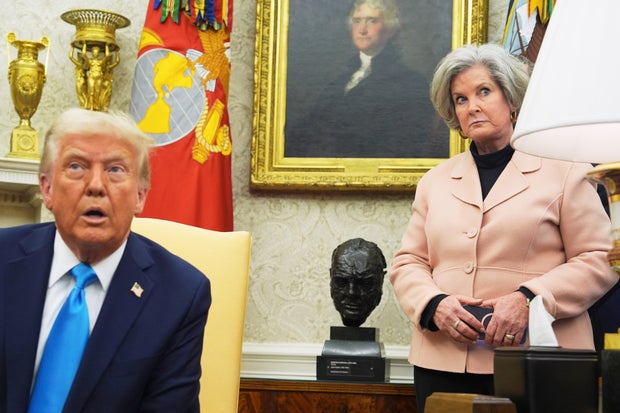
In a recent unfolding within the political sphere, Susie Wiles, the White House Chief of Staff under President Donald Trump, has found herself at the center of a media storm. This comes following a detailed narrative published by Vanity Fair, which spanned insights gathered over several interviews conducted between January and November of the preceding year by journalist Chris Whipple.
The two-part Vanity Fair article delved deep into Wiles’ candid perspectives on the operations within the Trump administration, her observations on Trump’s personality, as well as her critical take on other key figures in the administration. Describing President Trump, whom she notes as a non-drinker, Wiles intriguingly likened his personality traits to those of a “high-functioning alcoholic,” characterized by an exaggerated self-assuredness which conveyed an underlying belief in his boundless capability. She was quoted, “Nothing he can’t do. Nothing, zero, nothing.”
Responding to the portrayal in Vanity Fair, President Trump, despite not having read the piece, expressed unwavering support for Wiles, describing her as “fantastic” and endorsing her interpretations of his personality traits. In his defense, Trump stated that his self-aware hypothetical musings about potentially being prone to alcoholism due to his “possessive and addictive type personality” were known characteristics he often discussed about himself.
Moreover, Wiles’ reflections did not merely focus on Trump but extended criticism to other significant players. Vice President JD Vance was labeled as a consistently theorizing individual regarding conspiracies, while Attorney General Pam Bondi was reproached for her inadequate handling of the Epstein files. Wiles’ dissatisfaction also touched upon the pivotal decisions made about the U.S. Agency for International Development, which she deemed rationally untenable at the early stages of the administration.
Following the article’s publication, Wiles took to social media platform ‘X’, marking her first post there in over a year, to denounce the story as manipulative towards creating a negative impression of the administration. She argued that crucial contexts about the administration’s efficacy were intentionally omitted to craft a chaotic portrayal.
The article stirred a flurry of support for Wiles from within the administration. Figures such as White House Press Secretary Karoline Leavitt and Office of Management and Budget Director Russ Vought quickly came to her defense. Vought, praised as an “exceptional chief of staff,” condemned the narrative as a “hit piece” and emphasized that it would not deter their mission. Despite her criticisms highlighted in the Vanity Fair piece, AG Pam Bondi, on X, affirmed her support for Wiles, underscoring a rhetoric of unity and resilience against external efforts aimed at undermining the administration.
Defense Secretary Pete Hegseth and Transportation Secretary Sean Duffy also echoed sentiments of solidarity and commendation toward Wiles, denouncing the media’s efforts to sow discord within Trump’s team. Responding to Wiles’ comment about his penchant for conspiracy theories, Vice President Vance, during a media interaction in Pennsylvania, acknowledged his selective belief in such theories, linking them to broader, significant political narratives, such as scrutiny towards pandemic-related policies.
The article’s influence reverberated beyond the immediate circle of discussed personalities, encouraging a broader reflection on media dynamics and political narratives among officials. Vance pointed out the necessity of scrutinizing engagements with mainstream media, suggesting a cautious approach towards narrative framing that could distort public perceptions.
The discussion around Wiles’ portrayal in the media and her subsequent refutation underscores a persistent tug-of-war between media portrayals and political figures’ self-representations. It also glimmers the internal solidarity amongst Trump’s team members in face of external critiques, reinforcing a collective front against perceived media bias while simultaneously highlighting the complex interplay of personal traits and political dynamics within the highest echelons of American political machinery.
This episode of political and media interplay serves as a cogent reminder of the potency of narrative control, the strategic communications necessary within political spheres, and the overarching implications of media relations on public opinion and internal political coherence.