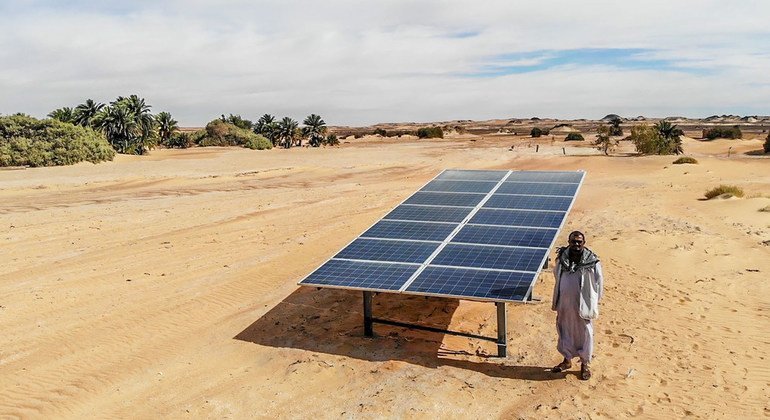
Mr. Ibrahim Thiaw, the Executive Secretary of the United Nations Convention to Combat Desertification (UNCCD), recently sat down with UN News to discuss the pressing issue of desertification and drought ahead of the World Day to Combat Desertification and Drought, observed annually on June 17th.
Thiaw emphasized that desertification is not just a global issue but also a local one. He stressed the importance of addressing the problem at the grassroots level in order to effectively combat it on a global scale. Global policies and decisions are crucial in tackling desertification, as the impacts are significant in terms of food security and sovereignty.
One of the major consequences of desertification is forced migration. When people are no longer able to cultivate their land due to degradation, they are forced to leave in search of better opportunities. This phenomenon has been observed in regions like the Sahel and Haiti, leading to severe consequences for global security. Competition over land and water resources can escalate into conflicts, disrupting communities and national economies.
Thiaw highlighted the alarming projection that up to 50% of the global GDP could be lost by 2050 if the challenges related to agriculture and food production caused by land degradation and desertification are not addressed promptly.
In response to a question about the current trend in land loss, Thiaw explained that land degradation is a global issue affecting both arid and less arid regions. Approximately 45% of the Earth’s land surface is impacted by desertification, affecting an estimated 3.2 billion people worldwide. Every year, an area equivalent to the size of Egypt, totaling a hundred million hectares, is degraded. To combat this trend, efforts must be made to halt land degradation and restore 1.5 billion hectares of land.
When asked how this monumental task will be accomplished, Thiaw emphasized the importance of improving agricultural practices, minimizing the extraction of minerals, and diversifying economies to reduce pressure on the land. Sustainable land management practices are crucial to restoring degraded land and ensuring food security.
Thiaw pointed out that investing in land restoration is not only essential for food security and conflict prevention but also economically beneficial. For every dollar invested in land restoration, up to $30 in economic benefits can be generated. Therefore, restoration activities are not only a responsibility of local communities but also governments and the private sector, particularly the agriculture industry, which is a major driver of land use globally.
Restoring degraded land is a cost-effective endeavor that can yield significant economic returns while also addressing critical environmental and social challenges. By investing in sustainable land management practices and promoting biodiversity, countries can mitigate the impacts of desertification and drought, safeguarding food security and promoting stability in vulnerable regions. The cooperation of all stakeholders, from local communities to governments and the private sector, is essential in achieving long-term solutions to combat desertification and drought.