In a tragic event that unfolded last week in Washington, D.C., two members of the National Guard were subjected to a horrifying attack, resulting in grievous consequences. The suspect involved in this grave incident has been identified as Rahmanullah Lakanwal, aged 29. He has been officially charged with murder and assault with intent to kill while armed, following allegations that he shot two National Guard members near a bustling subway station close to the White House.
During an initial court proceeding that took place this Tuesday, Lakanwal appeared virtually from a hospital in D.C., where he is currently receiving medical treatment. He was injured by law enforcement officials who responded to the scene following the shooting of the National Guard members; Army Spc. Sarah Beckstrom, 20, and Air Force Staff Sgt. Andrew Wolfe. Regrettably, Beckstrom succumbed to her injuries and died, while Wolfe is still battling for his life in a critical state in the hospital.
At the hearing, the magistrate judge commented on the robustness of the government’s case against Lakanwal, describing it as “exceedingly strong.” This assertion seems backed by substantial evidence presented in the charging documents. These documents detail that Lakanwal purportedly shouted “Allahu Akbar!” – a phrase in Arabic meaning “God is great” – as he fired at Beckstrom and Wolfe. He was reportedly incapacitated by another National Guard member who reacted swiftly, firing a service weapon at Lakanwal as he was attempting to reload his gun.
Further charges piled on Lakanwal include possession of a firearm during the commission of a violent crime. Security footage retrieved from the incident’s vicinity also suggested Lakanwal’s active engagement in the attack, depicting him approaching the intersection near the subway stop, opening fire on the victims, and attempting to chase another nearby National Guard member.
The severity of the assault has ignited a plethora of responses from various quarters. U.S. Attorney for D.C., Jeanine Pirro, indicated that additional charges would be forthcoming for Lakanwal as the investigation unfolds, with no detail being overlooked. Amidst the legal proceedings, Attorney General Pam Bondi revealed considerations are being made about possibly pursuing the death penalty against Lakanwal, highlighting the grievous nature of the crime and its implications.
Lakanwal’s background paints a complex, albeit disturbing picture. According to some sources, he previously served with a CIA-backed operations team for almost eight years and may suffer from Post-Traumatic Stress Disorder (PTSD). His journey to the United States was marked by challenges as well, originating from threats he and his family faced from the Taliban in Afghanistan, prompting their relocation to the U.S. in 2021 through an asylum case that was approved earlier this year.
However, troubling insights about Lakanwal’s mental health have emerged, with indications of his condition worsening in recent years, contributing to his increasing isolation and detachment from his familial ties. Homeland Security Secretary Kristi Noem even suggested the possibility that Lakanwal had become radicalized after his arrival in the U.S.
The repercussions of this attack are wide-reaching, influencing national policies and debates on immigration. The Trump administration, in response to the incident, has called for an expansive crackdown on immigration, specifically halting visa and immigration processing for Afghan nationals and reviewing green card cases for immigrants from 19 countries.
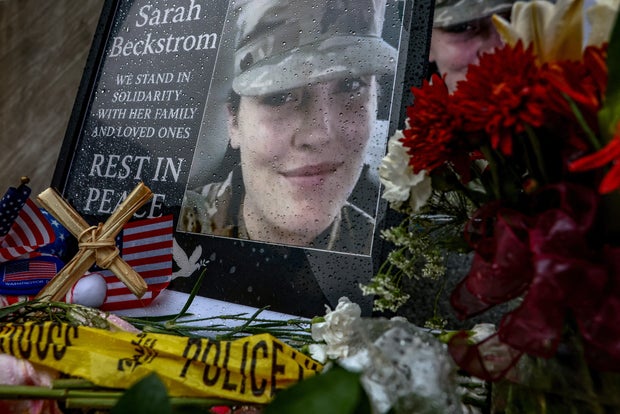
Public and emotional reactions to these events have also materialized, characterized poignantly by a makeshift memorial for Sarah Beckstrom. This memorial stands as a somber tribute to her and marks a site of loss and reflection for the community, friends, and family influenced by this tragedy.
As legal proceedings continue, with Lakanwal’s next court appearance scheduled for mid-January, many await further developments on this case, which not only concerns the fate of an individual but reverberates through aspects of national security, immigration policies, and the collective consciousness of a community in mourning. Meanwhile, the discourse surrounding terrorism, mental health, and safety continues to unfold, reflecting the multifaceted impacts of this unfortunate incident on various spheres of American life.