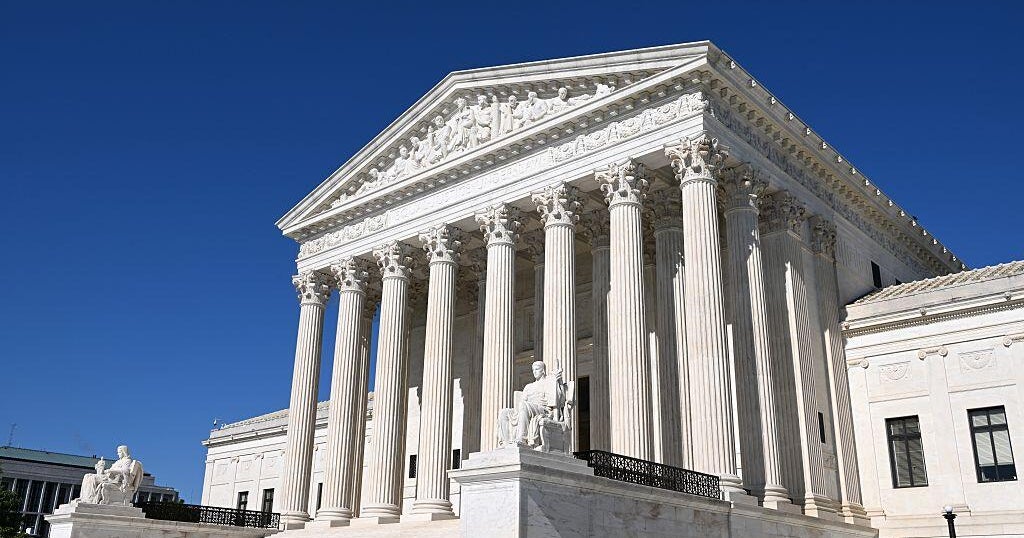
In a significant and polarizing decision, the U.S. Supreme Court has given the green light for Alabama to implement a congressional redistricting map that favors Republicans, a move that has stirred considerable controversy and drawn accusations of racial discrimination. This decision, marked by a 6-3 split along ideological lines, overrides a lower court’s ruling that had previously barred the state from using the 2023 map, citing intentional discrimination against Black voters.
The contentious map, designed by the Republican-led Alabama legislature, reallocates the boundaries of the state’s congressional districts and retains just one majority-Black district out of seven, despite significant Black populations that could arguably support more representative districts. This redrawing of the map was challenged almost immediately after its creation, with critics arguing that it dilutes Black voting power in a state where nearly 27% of the population is Black.
Prior to the Supreme Court’s recent ruling, a three-judge panel at the district level had intervened, mandating the use of a court-selected map for the 2024 elections, which featured two districts where Black voters could more feasibly elect candidates of their choosing. Under this judicially mandated map, the congressional makeup potentially allowed for a more balanced representation of five Republicans and two Democrats.
However, the Supreme Court’s latest order effectively shelves this interim solution, endorsing the state’s original plan which reshapes the district currently represented by a Democrat into one that heavily favors Republicans. The potential outcome is an overwhelming 6-1 Republican advantage in Alabama’s House representation.
The high court’s majority did not provide detailed commentary in their brief unsigned opinion but highlighted their belief that Alabama was likely to succeed in its argument that the 2023 map was lawful. Conversely, Justice Sonia Sotomayor, writing for the dissenting justices, criticized the majority’s choice to disregard the implications of a map crafted with discriminatory intent. She expressed concerns over the disruption and confusion that the use of a new and contested map could bring to upcoming elections, describing the majority’s decision as an affront to both democratic values and the rule of law.
The state’s Republican officials had sought urgent relief from the Supreme Court following the district court’s ruling, which they argued overstepped by impeding on the state’s prerogative to draw its own districts. They defended the 2023 map as an attempt to maintain regional integrity by keeping the Gulf Coast region united within a single district. Their argument found backing from the Trump administration, which echoed Alabama’s stance on judicial overreach and the importance of respecting state’s rights in the context of elections and redistricting.
However, opposition to the map remains strong, particularly among voting rights advocates who see these maneuvers as strategic political gerrymandering undermining the electoral influence of Black communities. These advocates, including prominent organizations like the NAACP and the ACLU, represented by a coalition of alarmed voters, argue that the legislature’s redistricting efforts did not purely pursue partisan advantages but were entangled with racial biases that undermine the integrity of the state’s democratic processes. They warned that the Supreme Court’s intervention could lead to voter confusion and hinder the administration of the electoral process.
Critics, including Kristen Clarke, general counsel of the NAACP, have vocally condemned the Supreme Court’s decision, arguing it perpetuates racial discrimination by endorsing a map previously identified as discriminatory. Clarke’s statement encapsulated a sentiment of alarm and urgency, urging Black voters to mobilize and express their dissent through robust participation in upcoming elections.
This legal struggle over Alabama’s congressional map reflects broader national debates around voting rights and gerrymandering, particularly in Southern states. The Supreme Court’s April ruling which weakened a key provision of the Voting Rights Act and subsequent redistricting controversies in states like Louisiana and Texas indicate a growing contentiousness surrounding electoral integrity and fairness in the United States.
Undoubtedly, Alabama’s congressional redistricting saga, with its complex interplay of race, politics, and law, is far from concluded. As the state gears up for the 2026 elections under this newly sanctioned map, the eyes of the nation will remain fixed on how these developments affect the representation and voices of its citizens, particularly those of its Black population. This case, emblematic of larger systemic issues, highlights the ongoing challenges and debates inherent in striving for a more equitable and representative democratic process.