As the year draws to a close, Senate Republicans are keenly focused on advancing a series of funding bills before Congress adjourns for the holiday recess. With the memory of the longest government shutdown in U.S. history still fresh, lawmakers are pressed to act swiftly to prevent a recurrence. The previous shutdown, which painfully stretched into historical lengths, concluded with Congress passing an initial set of funding legislation in November. However, further progress on subsequent financial measures has hit a stalemate.
Upon their return in the new year, Congress will face a tight deadline—mere four weeks to secure government funding or risk a partial shutdown slated for February. In the wake of passing three out of twelve annual appropriations bills in November, Senate GOP leaders and appropriators are eager to push ahead with the next bundle of bills. The forthcoming package, colloquially termed a “minibus,” encompasses five crucial bills covering a range of sectors. This package aims to secure funding through to September for several key departments including the Department of Defense; Labor, Health and Human Services, and Education; Transportation, Housing and Urban Development; Commerce, Justice and Science; and Interior and Environment. However, specific challenges and disagreements within the Senate are causing delays.
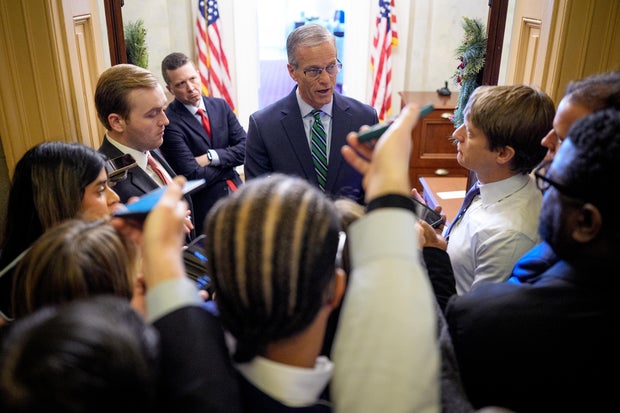
Senate Majority Leader John Thune, in a conversation with reporters, acknowledged the ongoing efforts and the hurdles yet to be overcome, stating, “We’re still working it. Not there yet.” The aim is to progress these funding measures before the Senate adjourns later this week. Nonetheless, as Thune noted, the realization of this goal remains uncertain.
This so-called minibus strategy marks a continued effort by Republicans to veer back towards passing individual spending bills through regular legislative order, rather than lumping them into a massive, end-of-year omnibus package. This approach not only provides clearer scrutiny of individual budgets but also avoids the frantic rush typically associated with end-of-year funding deadlines. Historically, such deadlines have compelled lawmakers to hastily agree on massive spending packages before departing Washington for the year-end recess.
Despite the avoidance of a pre-holiday deadline this year, Senate GOP leaders are still making a concerted effort to advance the minibus funding package. They are currently faced with resistance from within their own ranks, with several senators placing “holds” on the package, signaling their objections in its current form. Among these are Senators Rick Scott of Florida, Mike Lee of Utah, Ron Johnson of Wisconsin, and John Kennedy of Louisiana. These holds are a procedural strategy allowing senators to express their discontent with aspects of the legislation.
Senator Thune expressed hope that these holds, especially those from his party, are being addressed adequately to enable their eventual removal. However, he conceded that resolutions are not yet finalized.
Notably, Senators Kennedy and Johnson are maintaining holds, with Johnson pushing for the inclusion of a measure to ensure federal employees are paid during shutdowns. He expressed a preference for concrete outcomes over mere amendment votes, underlining a desire for tangible results rather than procedural gestures.
In the midst of these negotiations, GOP Senator Susan Collins of Maine, a leading appropriator, indicated that the current holds are “soft holds” that she believes can be resolved, hinting at possible progress on the minibus as soon as the following day.
Amid these legislative maneuvers, a looming deadline in January threatens to complicate matters further. Should the Senate fail to make headway on the minibus this week, they face a daunting challenge upon their return—funding the remaining government agencies and programs under a tight deadline which, if missed, could trigger another partial shutdown. The initial batch of funding bills passed in November helps mitigate this risk somewhat, as it included funding for several critical departments through September 2026.
On a broader scale, resolving these funding issues is essential not just for operational continuity but also for political stability. The impetus for achieving bipartisan agreement on funding is amplified by recent memory of the disruptive shutdown and its ramifications on governance and public trust.
Moreover, upcoming debates, particularly surrounding healthcare—highlighted by a significant impasse during the last shutdown over Affordable Care Act tax credits—remain unresolved. Both parties had their health care proposals voted on last week without reaching a consensus, suggesting that negotiations and legislative efforts will continue into the new year.
As discussions persist, Senate Minority Leader Chuck Schumer and Thune have been holding conversations, indicating ongoing bipartisan efforts to navigate the complex landscape of government funding. These efforts underscore a mutual understanding of the importance of timely legislative action to avert another government shutdown, reflecting a recognition of the broader implications such failures have on the nation’s stability and the public’s perception of governmental efficacy.
As the Senate hustles to finalize the funding details before their recess, the nation watches closely, hopeful for a resolution that prevents another governmental standstill and ensures continued support for crucial federal programs and services.