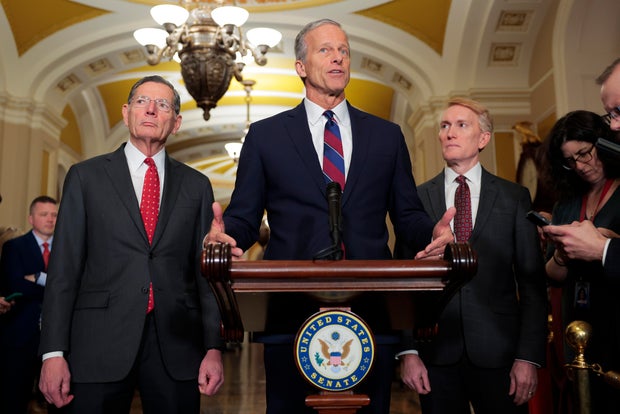
In a notable development within the political landscape of Washington, Senate Majority Leader John Thune, a Republican from South Dakota, disclosed plans to introduce a GOP-crafted health care bill. This announcement was made during a press conference that followed a luncheon meeting of Republican senators on Tuesday. Thune highlighted that the GOP’s proposed legislation would be presented for a vote alongside the Democratic proposal, which seeks to extend the enhanced tax credits under the Affordable Care Act (ACA). The voting on both these measures is scheduled to take place later this week.
Speaking to the purpose and timing of the introduction of the Republican bill, Thune conveyed a sense of urgency and a strategic response to what he perceives as the Democrats’ refusal to reform the existing healthcare system. He stated, “The Democrats have decided, ‘We’re not going to do anything to reform it,’ and so we’ll see where the votes are on Thursday.” He further emphasized that the GOP proposal would reflect the collective viewpoints of the Republican senators.
The Republican proposal, officially named the Health Care Freedom for Patients Act, was unveiled earlier in the week by GOP Senators Bill Cassidy of Louisiana and Mike Crapo of Idaho. Unlike the Democratic proposal, which seeks to continue the enhanced ACA tax credits, the GOP bill aims to redirect these funds into health savings accounts for individuals who opt for bronze plans available through the state exchanges.
Thune advocated for the proposed GOP bill, emphasizing its efficiency and direct benefit to consumers over insurance companies. He articulated that the measure “actually does make health insurance premiums more affordable. It delivers the benefit directly to the patient, not to the insurance company, and it does it in a way that actually saves money to the taxpayer. That is a win-win proposal.”
However, the Democrats, led by Senate Minority Leader Chuck Schumer, have sharply criticized the GOP bill, labeling it as “junk insurance.” This stark difference in viewpoints sets the stage for a contentious showdown in the Senate vote planned for Thursday.
The Democratic initiative to bring the three-year extension of the ACA’s enhanced tax credits to the floor comes as part of a broader strategy following an agreement that concluded a recent government shutdown. The credits have been crucial in assisting approximately 22 million low- and middle-income Americans to afford health insurance in 2025. Research from the Center on Budget and Policy Priorities anticipates that the premium costs could surge by an average of more than $1,000 annually per person if these enhancements are not extended. Furthermore, an estimate from KFF predicts that without the extension, annual premiums could more than double next year, from an average of $888 in 2025 to $1,904 in 2026.
While Democrats may be using the vote to make a political statement by attempting to highlight Republican opposition to extending what they deem necessary subsidies, the outcome of the vote remains uncertain. With 53 Republicans in the upper chamber, it is expected that neither the GOP-led bill nor the Democratic proposal will amass the 60 votes typically necessary to advance legislation in the Senate.
Several Republicans have proposed alternative measures in recent days, reflecting varied approaches to the extension of tax credits and the eventual redirection of funds. For instance, Senators Bernie Moreno of Ohio and Susan Collins of Maine proposed a two-year extension, whereas Senator Roger Marshall of Kansas suggested a one-year extension followed by a transition to health savings account-style funding in 2027.
In his concluding remarks, Thune expressed skepticism about the Democratic bill’s legislative intent and indicated that the Democrats seemed more interested in making a political point rather than forging actionable legislation. He hinted at the possibility of bipartisan cooperation, stating, “At some point if they want to make a law, I think we’ve got people on our side who are interested in doing that.” Thune’s comments suggest a readiness among some Republicans to engage in substantive legislative negotiations to address the pressing issues within the U.S. health care system.
This ongoing debate in the Senate over health care policy reflects the broader national discourse on the best methods to provide affordable health care to Americans and represents a key area of ideological division between the country’s two major political parties. As the scheduled vote approaches, both sides continue to articulate their visions for the future of health care, highlighting a crucial aspect of policy that directly impacts millions of Americans.