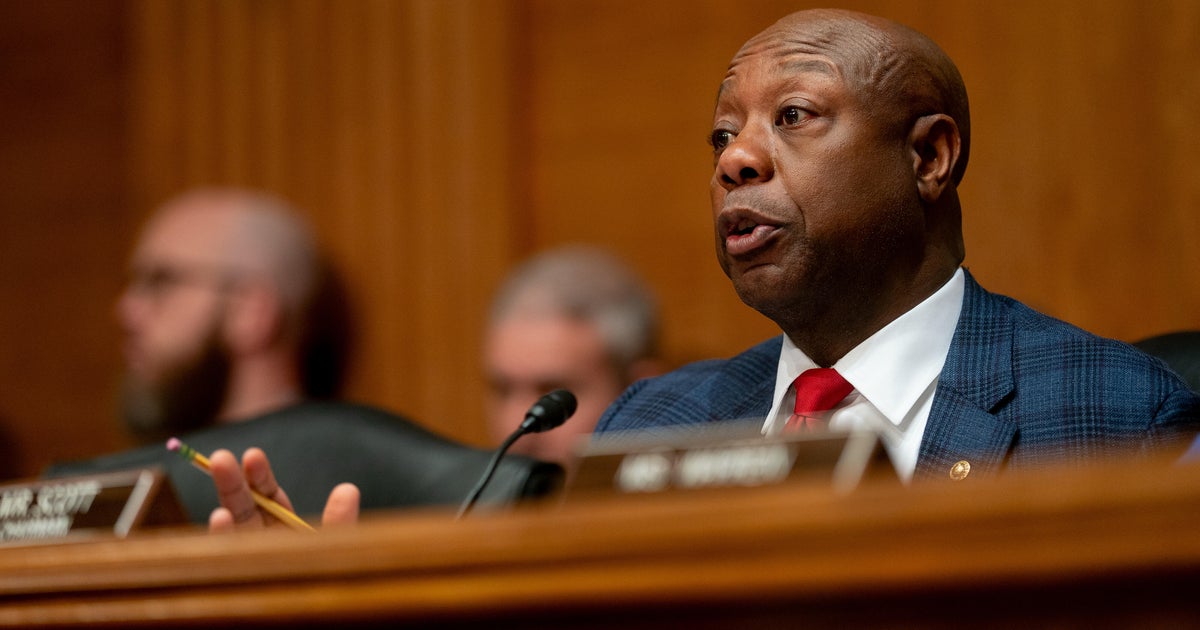
Scott Tells GOP Senators: ‘We’re in the Fight for Our Lives’ as Party Maps Path to Keep Senate Majority
Senate Republicans are entering the final weeks of the 2026 midterm campaign with a clear-eyed assessment of the dangers ahead, but the party’s top Senate strategist believes there is still a viable path to holding the chamber. In a closed-door meeting with GOP lawmakers on Wednesday, Sen. Tim Scott of South Carolina, chairman of the National Republican Senatorial Committee (NRSC), made the case that Republicans can withstand a difficult political environment and retain their majority in November, multiple people in the room confirmed to CBS News.
“We’re in the fight for our lives with a record number of toss-up races,” Scott told his colleagues during the private gathering, according to lawmakers present. The comment was first reported by Semafor, and CBS News subsequently confirmed the remark with multiple sources inside the room.
With just under six weeks remaining until the midterms, Scott laid out a strategy that will concentrate spending on a small cluster of tight races. Some of those contests involve defending GOP-held seats, while others represent opportunities to flip Democratic seats. Scott specifically named Maine, Texas, Ohio, Iowa and Alaska as Republican-held seats the party is working to protect, and he identified New Hampshire and Michigan as the most promising offensive targets.
The meeting came at a precarious moment for Republicans, who are simultaneously defending narrow majorities in both the House and the Senate while grappling with political headwinds caused by President Trump’s sagging approval ratings. Voter dissatisfaction with the cost of living and frustration over the war in Iran have weighed heavily on the party’s standing in national polls, and Democrats have sought to capitalize on that discontent by mounting surprisingly strong challenges against GOP Senate candidates in traditionally red states such as Ohio, Texas, Iowa and Alaska.
A Challenging Political Environment
Historically, the party that controls the White House almost always loses ground in midterm elections. That historical pattern is one of the central challenges Republicans face as they try to navigate a map full of competitive contests. But Scott argued that the party could follow a trajectory similar to the one Democrats traced in 2022, when they managed to gain a Senate seat even as they lost control of the House and struggled with then-President Joe Biden’s rough approval ratings. That precedent, Scott suggested, shows that a party can beat the odds and outperform a difficult national environment by focusing on local dynamics and candidate quality.
During the presentation, senators were also told that Republicans are aiming to take advantage of a recent Supreme Court ruling that struck down limits on the amount of money groups like the NRSC can spend in coordination with candidates. The ruling, which was first noted in the closed-door session, could significantly change the financial landscape of the final weeks of the campaign. By allowing party committees to coordinate spending more directly with candidates, the decision gives Republicans a new tool to deploy resources where they are needed most.
Scott’s presentation came as Republicans hold a 53-47 majority in the Senate, giving them a measure of cushion. With Vice President JD Vance available as a tiebreaker, the conference can afford to lose as many as three seats and still retain control of the chamber. But the map is daunting, with several GOP incumbents running in states that have become increasingly competitive, and Democrats are also eyeing a handful of open seats as pick-up opportunities.
Defending Turf in a Hostile Year
One of the most vulnerable GOP-held seats is in Maine, where Sen. Susan Collins is seeking a sixth term in a state that has trended leftward over the past decade. Collins, a moderate Republican known for her independent streak, is running against Democratic former state lawmaker Troy Jackson. Despite Maine’s shifting political character, Collins has survived tough reelection battles in the past. In 2020, she won by 8.6 points even though she was dramatically outspent by her Democratic opponent, a display of the personal appeal and cross-partisan support that has made her a perennial target for Democrats. Whether that resilience can hold in a second consecutive difficult cycle is one of the central questions of the midterm campaign.
In North Carolina, a light-red state that President Trump narrowly won three times in a row, Democrats are aiming to pick up the seat being vacated by retiring Republican Sen. Thom Tillis. Their standard-bearer is former Gov. Roy Cooper, a popular two-term governor who has consistently led Republican nominee Michael Whatley in public polling. Cooper’s name recognition and moderate reputation make him one of the strongest recruits Democrats have fielded in years, and Republicans acknowledge privately that the race is a serious challenge. Scott told his GOP colleagues on Wednesday that internal polling showed the North Carolina race tightening, but he did not offer any definitive predictions about the outcome.
Minnesota also emerged as a race to watch during the closed-door session. Scott said internal polls showed the contest tightening between Democratic Lt. Gov. Peggy Flanagan and Republican former sports reporter Michele Tafoya. The Minnesota seat is open because the incumbent Democrat is retiring, giving Republicans a rare opportunity to make inroads in a state that has not voted for a Republican presidential candidate since 1972. Tafoya, a well-known former television personality, has tried to position herself as a moderate alternative, while Flanagan has leaned into the state’s Democratic tradition and her own record in the governor’s office.
The Offensive Map
While much of the focus is on defending their own seats, Senate Republicans are also looking to go on offense in several blue-leaning states. The two most prominent targets are New Hampshire and Michigan, both of which are open seats currently held by retiring Democrats. In New Hampshire, the GOP nominee is former Sen. John E. Sununu, a member of one of the state’s most famous political dynasties. Sununu previously represented the state in the Senate from 2003 to 2009, and his father and brother have both served as governor. That family name still carries significant weight in New Hampshire, and Republicans believe Sununu gives them a credible chance to flip a seat they have not held since his own defeat more than a decade ago.
In Michigan, Republicans are hoping to exploit lingering divisions within the Democratic Party after progressive Abdul El-Sayed won the nomination. El-Sayed, a physician and former public health official, represents the left wing of the party and has energized younger voters, but his nomination has also fueled concerns among some establishment Democrats about his appeal to independent and moderate voters. Michigan Republicans believe those fissures, combined with a strong GOP ground game, could give them an avenue to victory in a swing state that has been highly competitive in recent cycles.
Georgia is another offensive target for Republicans. The seat is held by Democratic Sen. Jon Ossoff, who narrowly won a runoff in 2021 and has been regarded as one of the most vulnerable Democratic incumbents ever since. Most polls, however, show Ossoff leading the GOP nominee, Rep. Mike Collins, and Republican sources have previously told CBS News that the party is considering whether to scale back its spending on the Georgia Senate race. That would be a significant admission, given Georgia’s growing importance in national politics and the large investment both parties have made there in recent cycles.
A Difficult Map for Both Parties
Scott’s remarks highlighted the reality that the 2026 Senate map is challenging for both parties, but particularly for Republicans. The GOP has to defend a number of states that are not reliably Republican, while the few true offensive opportunities available may not be enough to offset potential losses. Democrats, by contrast, are playing offense on a field that includes Ohio, Iowa, Texas and Alaska, all states that have trended right in recent years but where GOP candidates have struggled to consolidate support.
In Texas, for example, no Democrat has won statewide in more than 30 years, but the party’s nominee, James Talarico, is running against a polarizing Republican candidate in Attorney General Ken Paxton. Paxton defeated incumbent GOP Sen. John Cornyn in the primary, and his campaign has been overshadowed by legal troubles and a combative conservative brand that some Republicans worry could alienate suburban voters. Talarico, a young state legislator with a polished social-media presence and a compelling personal story, has been able to raise substantial sums of money, forcing Republicans to spend significant resources in a state they once considered reliably safe.
In Iowa and Ohio, two former swing states that have shifted rightward, Democrats have also managed to keep races competitive. Both states have developed strong conservative leans, but the Republican candidates in those races have faced questions about their fitness and electability. In Alaska, a ranked-choice voting system creates unique dynamics that have allowed Democrats to compete even in a state that voted overwhelmingly for Trump. Each of these races represents a potential Democratic upset, and Scott’s decision to identify them as priority defenses underscored how fragile the Republican majority has become.
As the campaign enters its final stretch, Scott’s message to his colleagues was not one of panic, but of focused determination. He argued that by concentrating spending on the most competitive races and taking advantage of the new Supreme Court ruling on coordinated spending, Republicans could still outrun the political headwinds and retain the Senate. But he made no attempt to minimize the scale of the challenge. With a record number of toss-up races and a historically unpopular president, the path to a Republican majority is narrow, and every race on the board will matter down to the final days.
The coming weeks will test whether Scott’s strategy is enough. Republicans will need to defend every vulnerable incumbent, seize at least one open Democratic seat, and hope that the political climate shifts in their favor before Election Day. Democrats, meanwhile, are confident that the environment, combined with a strong candidate recruitment cycle, will allow them to break the GOP’s grip on the chamber. In a battle with so many moving parts, the only certainty is that the outcome will be decided by a handful of races in states that have become the nation’s premier political battlegrounds.