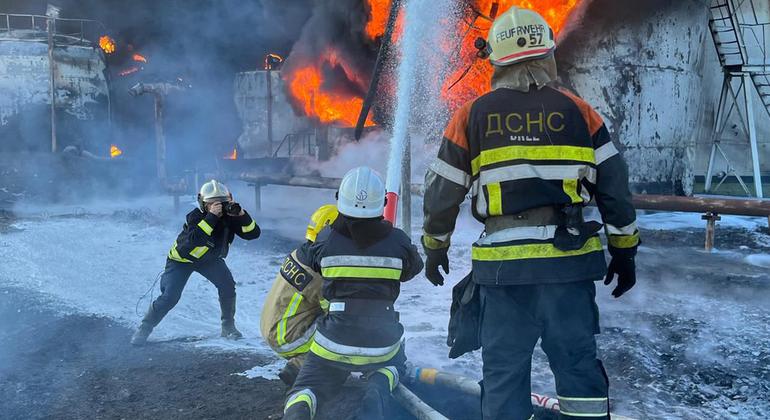
The United Nations Human Rights Monitoring Mission in Ukraine has issued a warning about the severe damage caused to power plants and the escalating energy crisis in the country. This crisis has led to a lack of access to electricity, clean water, and heating, as well as a surge in prices for consumers. The mission highlighted a coordinated attack on Ukraine’s national grid on 26 August, which they described as one of the largest assaults by Russia since the full-scale invasion began. This attack involved over 100 missiles and drones targeting energy and other critical infrastructure, leading to nationwide power cuts to stabilize the grid.
The report from the Mission revealed that there have been nine waves of long-range and large-scale coordinated attacks on Ukraine’s electric power system between March and August 2024. These attacks have caused significant damage to numerous power generation, transmission, and distribution facilities, resulting in harm to the civilian population and disrupting essential services such as electricity supply, water distribution, sewage systems, heating, public health, education, and the economy.
The report also raised concerns about the impact of the recent attacks on energy infrastructure, noting that over 3.7 million people in Ukraine are at risk of consuming contaminated drinking water. This poses a particular risk to vulnerable groups such as infants, young children, older individuals, and those with compromised immune systems or underlying health conditions.
Since March 2024, Russian attacks have targeted facilities in 20 of the 24 regions under Ukrainian control, including the capital city of Kyiv. The Mission recorded 36 strikes on power plants in nine regions and over 100 attacks on electricity distribution and transmission facilities in 17 regions. Many energy facilities have been repeatedly targeted, some to the point of complete destruction, leading to significant challenges in repairing and restoring the infrastructure.
Prior to the full-scale invasion in February 2022, Ukraine had a total electricity capacity of 44.1 gigawatts from nuclear, thermal, hydroelectric, and renewable sources. However, by April 2023, nearly half of this capacity had been lost due to occupation and destruction. Additionally, 42 out of 95 high-voltage transformers were damaged, further disrupting the distribution of electricity to households across the country.
The ongoing conflict in Ukraine has also led to a significant number of people being displaced from their homes. According to the UN Refugee Agency (UNHCR), over 6.7 million Ukrainians have fled the country since the Russian invasion, with 6.2 million seeking refuge in Europe and 3.6 million remaining internally displaced within Ukraine. The UNHCR anticipates that these numbers are unlikely to decrease in the near future.
Border monitoring conducted by UNHCR and its partners has shown a slight increase in departures from Ukraine since April, indicating ongoing concerns about the safety and security of those residing in conflict-affected areas. The situation in Ukraine remains fragile, with the continued attacks on critical infrastructure exacerbating the humanitarian crisis and threatening the well-being of millions of people in the country.