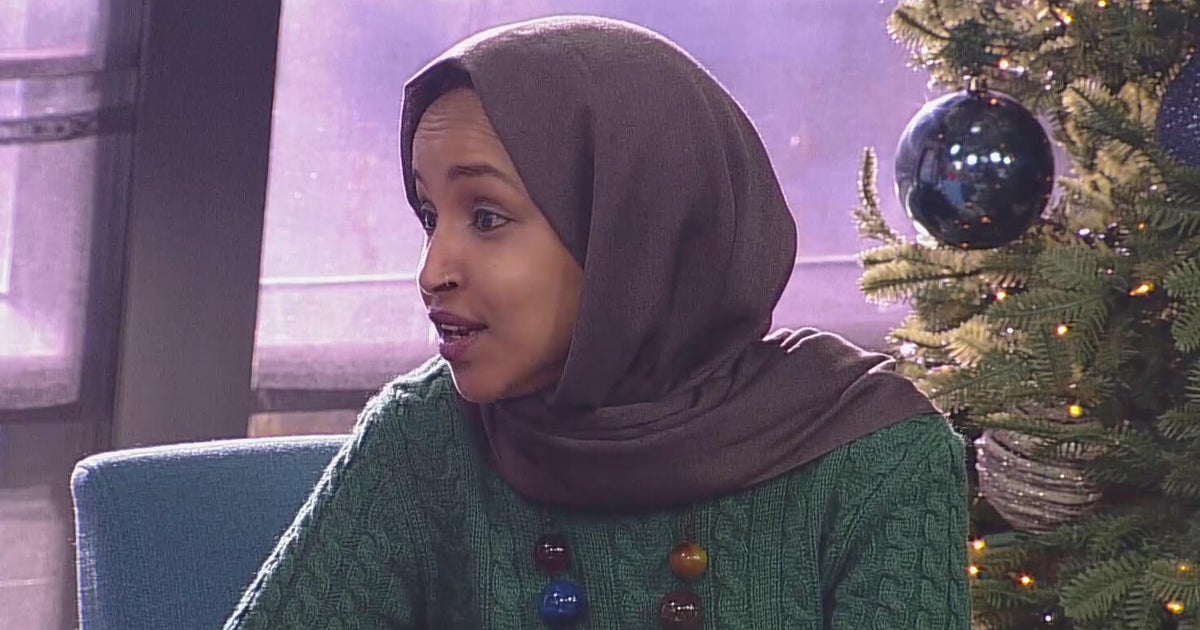
In a recent development that has stirred controversy and discussions around racial profiling and law enforcement practices, Representative Ilhan Omar of Minnesota disclosed an incident involving her son and federal immigration authorities. The Democratic Congresswoman reported that her son was stopped by agents from U.S. Immigration and Customs Enforcement (ICE) on a seemingly ordinary day after he visited a Target store. During this encounter, he was asked to prove his citizenship but was allowed to leave after showing his passport ID.
This incident was recounted by Omar during an interview with Esme Murphy on WCCO Sunday Morning. She highlighted her concerns about the safety of her son, stating that he now carries his passport with him at all times due to such incidents. Adding to her worries, Omar shared another disturbing episode where ICE agents allegedly entered a mosque where her son and others were praying. Fortunately, in this instance, they left without causing any disruptions.
Omar’s revelations did not sit well with ICE, however. Acting Director Todd Lyons responded to these allegations by firmly denying any record of ICE officers stopping the Congresswoman’s son. Lyons accused Omar of attempting to “unfairly demonize our law enforcement officers.” He was stark in his rebuttal, describing her claims of racial profiling as “disgusting, reckless and categorically false.”
Nevertheless, a spokesperson from Omar’s office staunchly defended her statements. Addressing the ICE’s dismissal of the records concerning her son’s stop, the spokesperson criticized ICE as a “rogue agency beyond reform,” implying chronic issues with record-keeping and transparency within the agency. “It’s no surprise that an agency known for disappearing people also can’t keep its records straight,” the spokesperson added, expressing a willingness to review any records ICE claimed to have regarding the incident.
These individual stories of alleged profiling come amidst broader tensions involving ICE operations in Minnesota, particularly targeting the Somali immigrant community. Earlier this month, a surge of federal agents was reported in the Twin Cities with a focus on undocumented Somali immigrants. This increased enforcement has been linked to derogatory remarks from President Trump who explicitly expressed his dislike for Somali immigrants and made disparaging comments about Rep. Omar, whom he derogatorily called “garbage.”
In reaction to these heightened enforcement actions and the president’s inflammatory statements, Omar penned a letter to Kristi Noem, the U.S. Secretary of Department of Homeland Security, and Todd Lyons. In her letter, she accused federal agents of engaging in “blatant racial profiling” and using an “egregious level of unnecessary force.” She connected these actions directly to what she framed as President Trump’s racist stance against the Somali community.
Minnesota, according to the U.S. Census Bureau, hosts the largest Somali population in the United States, with approximately 107,000 Somali individuals residing there, over 80,000 of whom live in the Twin Cities. Omar pointed out that a large majority of Somalis in America are U.S. citizens. This demographic detail underlies the contentious nature of the ICE operations which, according to Omar, seem to disproportionately target a community comprising predominantly of American citizens.
Born in Somalia, Omar herself moved to the U.S. as a child and became a U.S. citizen in 2000. Drawing from her personal journey and the collective experiences of her constituents, Omar’s outcry against the ICE operations reflects deeply-rooted concerns regarding civil rights and the treatment of immigrant communities in America.
This narrative unfolds against a backdrop of strained interactions between law enforcement agencies and the communities they serve, a longstanding issue that has cyclically gained national attention amid incidents perceived as discriminatory or unjust. The face-off between Rep. Omar and ICE underscores the broader, ongoing dialogue about immigration policy, law enforcement’s role in communities, and the pernicious effects of racial profiling.
As this conversation continues, it remains central to understanding the dynamics at play between immigrant communities and federal authorities tasked with enforcing immigration laws. It poses challenging questions about fairness, justice, and the proper scope of authority in dealing with matters of citizenship and community safety. These discussions are crucial as they touch upon the fundamental ideals of dignity, respect, and the inclusive ethos that many believe should define America.
In the broader context of journalism and public discourse, this situation between Rep. Omar and ICE is part of a more extensive narrative concerning the rights of individuals versus the mandates of government agencies. This incident serves as a focal point for ongoing debates surrounding immigration reform, law enforcement practices, and the safeguarding of civil liberties in a diverse and evolving societal landscape.