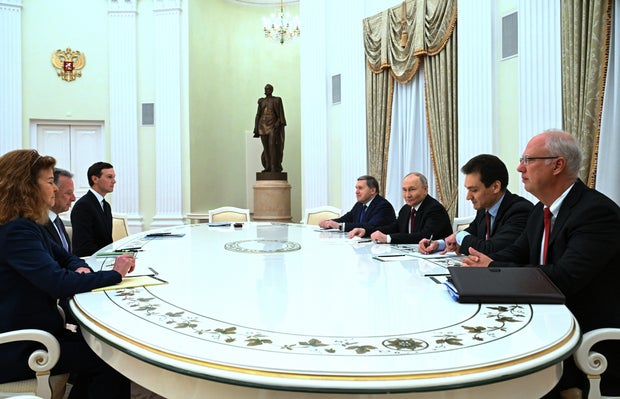
In a series of high-stakes diplomatic engagements, key officials from the United States and Russia convened in a crucial attempt to negotiate terms that could potentially lead to the de-escalation of the ongoing conflict in Ukraine. At the heart of these deliberations was a meeting held in Moscow, where Jared Kushner, senior advisor and son-in-law to U.S. President Donald Trump, along with U.S. special envoy Steve Witkoff, met with Russian President Vladimir Putin. This dialogue comes as part of President Trump’s broader initiative to forge a resolution to the war in Ukraine, exemplifying his administration’s commitment to addressing this pivotal geopolitical issue.
The discussions in Moscow spanned approximately five hours, signifying the gravity and complexity of the issues at hand. These meetings built on prior talks between U.S. and Ukrainian officials that had taken place in Florida over the preceding weekend. The stakes were underscored by the involvement of high-level participants, including Secretary of State Marco Rubio, highlighting the multi-faceted approach the U.S. is employing to manage and ideally resolve the conflict.
Yuri Ushakov, a prominent figure within Putin’s administration, delivered remarks to the press following the meetings. He labeled the talks as “constructive, very useful, and substantive,” yet acknowledged that critical hurdles remain. The primary sticking point, according to Ushakov, revolves around territorial disputes, a core issue that has perpetuated the conflict and complicated diplomatic dealings. Despite certain American proposals appearing somewhat acceptable to the Russian side, a comprehensive agreement on territorial concessions was elusive.
The central narrative emerging from these discussions is the absence of a definitive resolution or pathway forward concerning territorial issues. Despite the insights gained and proposals tabled, Ushakov articulated a need for ongoing work and examination of suggested formulations, illustrating the intricate nature of diplomacy where each word and clause can tip the scales in negotiations.
Adding a layer of complexity, Ushakov mentioned that the Russian delegation received additional documents from the U.S. side, which supplemented the original 28-point peace plan outlined by the Trump administration. These documents signal an evolving U.S. stance, possibly in response to feedback and developments since the initial proposal. However, specific details regarding these documents were not disclosed, adhering to an agreement between the parties to keep the finer details of their discussions confidential.
Notably, the meetings also served as a conduit for President Putin to communicate indirect messages to President Trump, with Ushakov noting that Kushner and Witkoff were tasked with relaying significant political signals upon their return to the United States. This aspect of the talks illustrates the layered nature of international diplomacy, where communication often occurs through a series of proxies and indirect channels.
Upon the conclusion of the meetings in Moscow, Kushner and Witkoff planned to debrief President Trump on the nuances and outcomes of their discussions, ensuring that the highest levels of the U.S. government were directly informed and involved in subsequent strategic decisions. This step is vital as it prepares the groundwork for continued dialogues, either through direct meetings or phone conversations, further emphasizing the ongoing nature of these diplomatic efforts.
This dialogue occurred in the shadow of broader regional discussions and developments. Over the recent weekend, Secretary of State Marco Rubio described meetings with Ukrainian officials as productive yet complex due to the “many moving parts” involved. President Trump, reflecting on these gatherings, expressed cautious optimism about reaching a deal, noting substantial Russian concessions, particularly concerning cessation of hostilities and territorial aggression.
Contrastingly, Ukrainian President Volodymyr Zelenskyy articulated a more measured approach, responsive to the outcomes of the U.S.-Russia talks. Zelenskyy conveyed readiness to engage directly with President Trump, pending the efficacy and fairness of the proposed agreements as signaled by the American delegation.
The ongoing dialogues underline not just the complexity of the crisis in Ukraine but also the intricate dance of diplomacy where multiple sessions, across various global venues, contribute pieces to a larger geopolitical puzzle. Each session builds upon the last, sometimes altering or refining proposals as new considerations come to light.
In summary, the discussions in Moscow represent a critical juncture in a broader, intricate diplomatic tapestry being woven amidst the backdrop of the Ukrainian conflict. While significant strides were made in terms of dialogue and mutual understanding, the path forward remains laden with challenges, notably around contentious territorial issues. These dialogues underscore a pivotal moment not just in U.S.-Russia relations but also in the broader context of global diplomacy and conflict resolution. The world watches as these powerful nations navigate the turbulent waters of negotiation, seeking a harbinger of peace in a region marked by prolonged and devastating conflict.