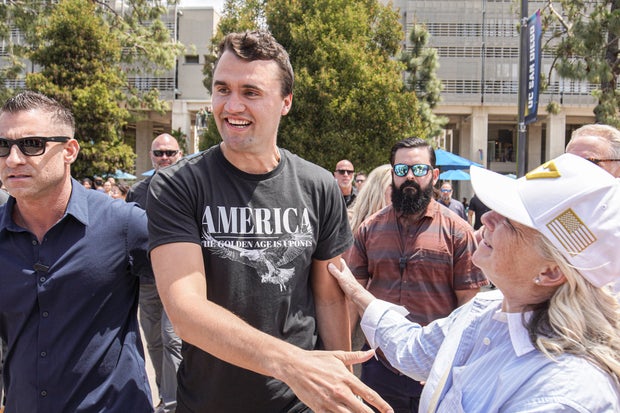
In a shocking and deeply sorrowful incident, Charlie Kirk, the renowned conservative commentator and activist, lost his life in a horrific shooting during an event held by Turning Point USA at Utah Valley University. The unfortunate event occurred on a calm Wednesday afternoon, but the echoes of the gunshots that ended Kirk’s life would resound fiercely across the nation.
President Trump, with whom Kirk was closely associated and widely revered, publicly disclosed the tragedy and expressed his profound grief and admiration for Kirk’s youthful zeal and leadership. In a heartfelt post on Truth Social, President Trump lamented, “The Great, and even Legendary, Charlie Kirk, is dead. No one understood or had the Heart of the Youth in the United States of America better than Charlie. He was loved and admired by ALL, especially me, and now, he is no longer with us.” The President’s words not only signaled his personal bereavement but also marked a moment of national mourning, as he ordered flags to be flown at half-staff throughout the country up until Sunday evening to honor Kirk’s memory.
The tragedy was politically intensified when President Trump released a video on Truth Social, casting blame on the “radical left” for what he considered an act of terrorism. He spoke with resentment about how people like Kirk have been depicted in political discourse: “For years, those on the radical left have compared wonderful Americans like Charlie to Nazis and the world’s worst mass murderers and criminals. This kind of rhetoric is directly responsible for the terrorism that we’re seeing in our country today, and it must stop right now.”
The ensuing unrest was palpable on the floor of Congress. Speaker Mike Johnson’s call for a moment of silence descended into a heated disagreement between members. Republican Representative Lauren Boebert from Colorado clashed verbally with Democratic colleagues who resisted, exacerbating the tensions evident in current political climates. The discord underscored the underlying national division, embodying the vitriolic environment that incidents like the murder of Kirk further provoke.
In his appearance on Fox News, Speaker Johnson described a society at a crossroads, one where debates devolve into disputes far too easily. He reminisced about Kirk’s character as a person delighted by fruitful dialogue and passionate discourse, emphasizing the need for a return to a more civil and respectful political exchange.
Throughout the nation, reactions poured in from various quarters of political leadership, painting a somber picture of a country grappling with escalating political violence. Former President Joe Biden decried the attack, stating that such violence has no place in America, a sentiment echoed fiercely by former President Barack Obama who labeled the attack as “despicable violence.”
As the nation reflected on the tragedy, the community also found different ways to honor Kirk’s legacy. Vice President JD Vance, expressing his grief, recognized Kirk’s pivotal role during the Presidential election and his lasting impact not only in politics but equally on the personal lives he touched. He poignantly noted on X, a social media platform, that Kirk’s advice during his own campaign was instrumental and celebrated.
The sequence of tributes widened, encompassing various perspectives and personal stories that portrayed Kirk as a central figure in modern conservative politics and a vocal advocate for what his friends and allies viewed as foundational American values. From senators and governors to former Presidents and current Congressional members, praises and condolences reflected the broad impact of Kirk’s life and tragic demise.
Statesmen and women stressed the urgency of remedying the national discourse and curtailing the danger that comes with a politically charged environment capable of inciting violence. Calls for unity and healing underscored the collective need to reassess how political disagreements are managed, suggesting a return to more robust dialogues anchored in mutual respect rather than enmity.
In the wake of such tragedy, the message was clear: Political differences should fortify the nation’s democratic bedrock, not threaten to dismantle it. As America mourns Charlie Kirk, a figure known for his fiery rhetoric but equally for his unwavering commitment to what he deemed were essential freedoms, the challenge remains to channel the grief of his passing into substantive, peaceable, and constructive political dialogue — reaffirming a commitment to democratic principles in a time of profound national reflection.