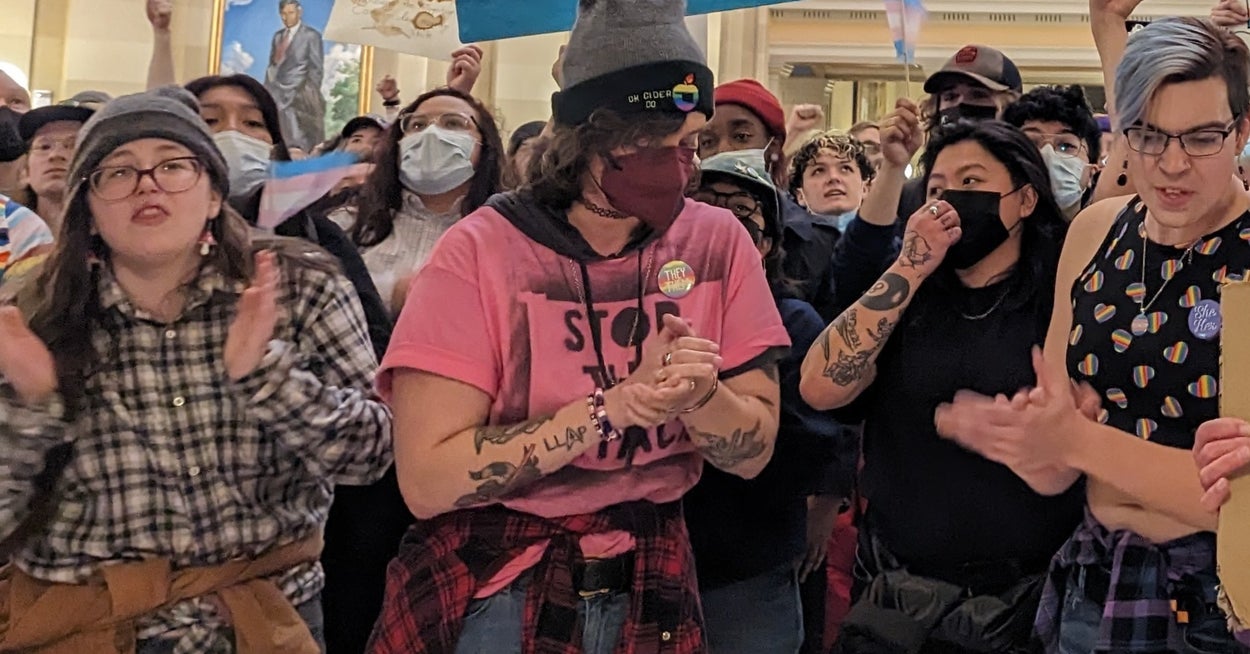
In the wake of a series of legislative moves in Oklahoma targeting transgender individuals, members of the trans community are reevaluating their futures within the state. Among them, Lukas, a student with a robust scholarship, finds himself tethered to Oklahoma due to economic reasons despite the increasingly hostile environment. “The general community is kind of shrinking and, as time goes on, I imagine it’s just going to get smaller after this,” he expressed his concerns about the sustainability of a supportive transgender community in Oklahoma.
The sentiment is echoed by many trans individuals across the state who have spoken to the media and advocacy groups, highlighting how the recent legislative proposals are drastically shaping their lives and decisions. The bills in question have wide-ranging impacts—from altering sex education curriculum, outing transgender youth in schools without consent, to criminalizing the provision of gender-affirming care by medical professionals. Such measures have unequivocally cast a shadow over the lives of transgender residents, prompting some, like Nile Glover, a 30-year-old trans woman, to take drastic steps.
Glover and her partner, Violet, who identifies as nonbinary, decided to leave Oklahoma for Colorado after realizing the dire implications of the state’s legislative actions. They were particularly alarmed by SB 129, viewing it as a clear signal that their safety and well-being were in jeopardy. “They’re very clearly coming for us specifically. We don’t want to stick around and wait for something to stick and live in whatever hellscape that’s going to be,” Glover said, revealing the sense of urgency that compelled them to relocate. Initially, Glover had aspirations to one day move out of Oklahoma, but the sudden legislative shift led to an abrupt and challenging departure from their home state, severing connections with family and friends.
The legislative trend in Oklahoma is part of a broader national movement targeting the rights of transgender individuals, which has sparked significant concern and mobilization among LGBTQ advocacy circles. Nicole McAfee, the executive director of Freedom Oklahoma, a Two-Spirit LGBTQ advocacy organization, is keenly monitoring these developments. McAfee suggests that bills like SB 129 are designed to appear unusually harsh to set the stage for a so-called “compromise” that still severely restricts trans rights but appears less extreme in comparison.
Freedom Oklahoma is tracking other harmful bills poised to affect transgender healthcare access directly. Notable among these are SB 250 and SB 252, which aim to cut public funding for gender-affirming care for minors—a tactic that appears likely to succeed in the current legislative session. Another bill, HB 1011, wants to extend those restrictions to trans individuals under the age of 21, a move that flies in the face of medical consensus.
The push against transgender healthcare in Oklahoma starkly contrasts the positions held by major medical bodies like the American Medical Association (AMA), which ardently supports gender-affirming care as “medically necessary” and opposes any political interference in such medical practices. “It’s especially important to make sure that people know there’s not any age when it’s appropriate to ban best practice medical care for trans folks,” emphasized McAfee, echoing the AMA’s stance.
Despite the medical community’s support, political figures in Oklahoma, spearheaded by Governor Kevin Stitt, have succeeded in rolling back transgender healthcare access at certain institutions. Notably, in October 2022, SB 3 was signed into law by Stitt, effectively cutting off funding for gender-affirming treatments for minors at OU Health, Oklahoma’s primary children’s hospital. Moreover, in his recent State of the State address, Governor Stitt declared his intent to further curtail access to hormone therapies and surgeries for transgender minors, amongst applause from some legislative members—a commitment that has mobilized protests and rallies outside the state capitol by concerned citizens and advocacy groups.
These legislative developments in Oklahoma illustrate a troubling trend toward the restriction of rights and healthcare for transgender individuals, prompting both fear and flight among the community. As more trans residents like Glover and Violet feel compelled to leave their homes in search of safer environments, Oklahoma risks not only the welfare of its transgender population but also its societal integrity by marginalizing and alienating vibrant segments of its community. More broadly, these actions pose worrying implications for civil rights and medical ethics across the United States. The resistance from organizations like Freedom Oklahoma and notable medical authorities signals a contentious battle ahead, centered around the fundamental rights of transgender persons to live and access care unimpeded by discriminatory policies.