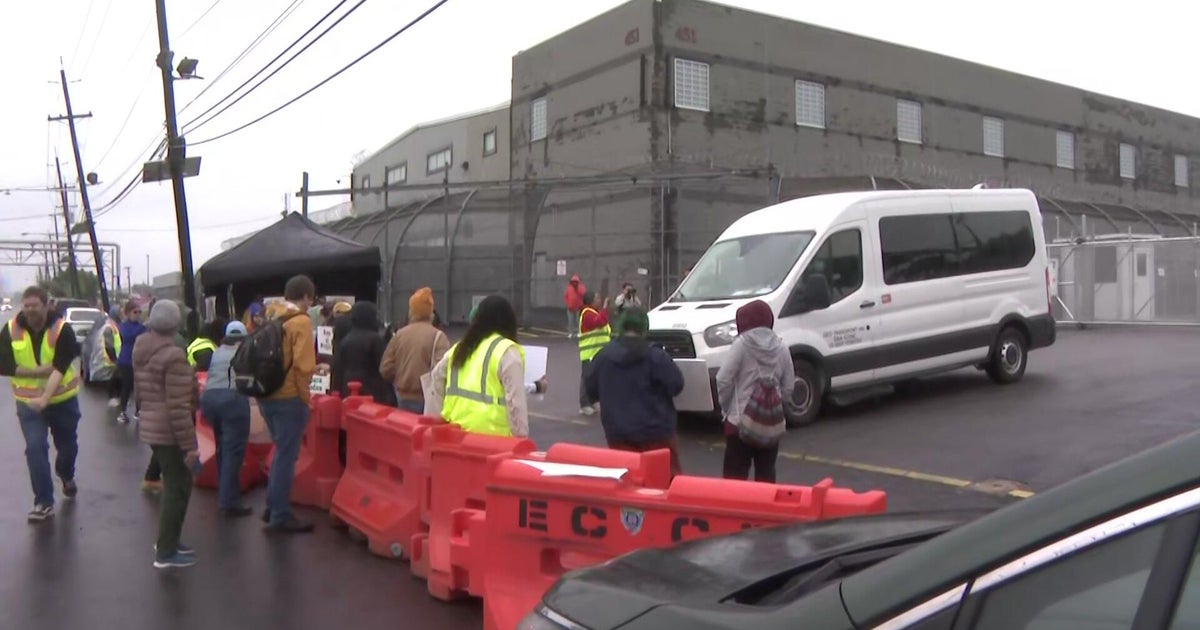
In the heart of New Jersey, a situation unfolds that captures the complex narrative of immigration and detention in America. Newark’s Delaney Hall has become a focal point for advocacy and political action, with state and local leaders, activists, and concerned citizens converging to respond to troubling reports of conditions within the detention facility.
Governor Mikie Sherrill of New Jersey recently demanded access to Delaney Hall to inspect the conditions firsthand, following several distressing accounts of the treatment of detainees. The Governor’s call came against the backdrop of sustained protests outside the facility that began last Friday. Community members and activists gathered to voice their concerns over what they describe as deplorable conditions faced by the detainees—many of whom are immigrants held for various civil violations related to their immigration status.
Over the weekend, tensions escalated outside Delaney Hall. Protestors physically blocked a white van leaving the facility, suspecting that detainees were being transported under questionable circumstances. Among those believed to be in the van was Martin Soto Hernandez, whose wife, Gabriela Soto, has been particularly vocal in the ongoing protests. She claims her husband was taken into custody by ICE while performing a routine family errand—buying diapers. Despite a judge’s order for his release, Gabriela recounted a distressing scene where her husband was allegedly lured with the promise of release only to be manhandled and forced into a van.
Gabriela’s plight has drawn considerable attention and sympathy, particularly as she is pregnant with their third child. Her distress was palpable as she recounted watching her husband screaming for help as he was forcibly taken away, sparking a fierce response from the protestors to block the vehicle.
The Department of Homeland Security has meanwhile defended the actions of ICE, stating without ambiguities that the van was scheduled for a transfer of Soto Hernandez to a different ICE facility. However, they claim that the actions of the protestors, who they refer to as agitators, not only impeded the transfer but also caused physical damage to the vehicle. As a result, visitation to Delaney Hall has been suspended, citing concerns for the safety of staff, detainees, and visitors.
Amidst these controversies, Newark Mayor Ras Baraka and several notable lawmakers have made visits to Delaney Hall, driven by the surge of complaints and advocacy from inside and outside its walls. The detainees, aware of the attention their situation has garnered, have responded to the presence of their supporters by waving hands and flickering lights from within the confines of the facility—a poignant signal of their ongoing distress and hope for intervention.
During these visits, some distressing details have emerged. U.S. Senator Andy Kim relayed detainees’ reports of inadequate medical care, inedible food, and problematic water supply. These on-the-ground testimonies are backed by a loaded schedule for a single judge handling an overwhelming 74 cases in just one day, highlighting systemic issues in the judicial process overseeing these detention cases.
Furthermore, advocacy and political leaders, including U.S. Senator Cory Booker, have taken to social media and public statements to condemn the conditions at Delaney Hall. Booker described the detainees as being on a hunger strike, fighting for basic human rights in face of what he called deplorable conditions. His statement, “Enough is enough – not in New Jersey, not anywhere,” echoes a broader call for reassessment of immigration detention practices, signaling a growing concern over the state and federal handling of such facilities.
New Jersey Congressman Frank Pallone Jr. has also voiced his concerns earlier after visiting the facility. His comments add weight to the growing demands for accountability and oversight, emphasizing the unacceptable nature of the conditions and broader ICE activities in communities.
These events at Delaney Hall illustrate a critical juncture in the broader dialogue on immigration policy and human rights in the United States. The local and national response, encompassing both grassroots activism and political intervention, indicates a shift towards more scrutinous oversight of immigration detention practices. As stories from inside and outside Delaney Hall continue to unfold, they not only highlight the immediate needs and rights of detainees but also challenge policymakers and the public to reconsider the frameworks that govern immigration enforcement and the humane treatment of those in its charge. The convergence of voices—from distressed family members and activists to politicians at all levels—suggests a pivotal moment in the ongoing debate over the ethics, legality, and humanity of immigration detention in America.