In a decisive move to address escalating crime rates in Washington D.C., President Trump has initiated a significant deployment of military and federal assets throughout the nation’s capital. This week, on a directive from the President himself, 800 members of the D.C. National Guard were mobilized under the Title 32 status, granting them authority over specific law enforcement activities while still under presidential control. This action aligns with the President’s strategy to reinforce law, order, and public safety across the city.
Parallel to this military deployment, President Trump has taken the unprecedented step of assuming temporary command over the District’s Metropolitan Police Department. This shift in control comes with the reinforcement of several hundred federal law enforcement officers from various agencies, significantly expanding the presence of law enforcement officers on the streets of D.C.
During a press conference at the White House, President Trump expressed his directive clearly, “I’m deploying the National Guard to help reestablish law, order and public safety in D.C., and they’re going to be allowed to do their job properly.” The D.C. National Guard confirmed their activation in a statement, noting that while the total soldiers activated are around 800, only 100 to 200 would be actively supporting law enforcement efforts at any given time. Their roles are set to include a mix of administrative, logistical, and physical tasks essential for re-establishing public order.
The necessity of such substantial military involvement stems from unique legislative circumstances surrounding D.C. The city is a federal district, meaning the President has ultimate authority over the National Guard unlike state governors. This was noted by Defense Secretary Pete Hegseth who stated the Guard’s current deployment is to support rather than replace traditional law enforcement roles, as similarly seen in their recent deployment in Los Angeles during protests against the Trump administration’s immigration policies.
Secretary Hegseth outlined that the Guard’s involvement wouldn’t include detaining American citizens but would engage in operations similar to those in Los Angeles, including temporary detention and logistical support, handing off law enforcement duties to appropriate agencies. He emphasized the preparedness and proactive stance of the Guard stating on Fox News, “If you take an action or a shot at them, there will be consequences.”
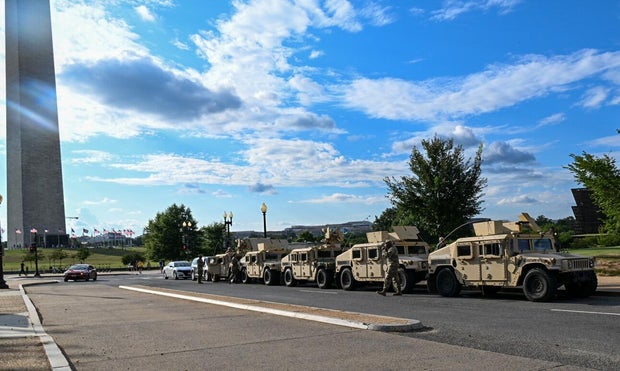
The visuals of National Guard troops assembling near prominent locations like the Washington Monument have been circulating on social media, with several vehicles identified as belonging to the Guard’s 273rd Military Police Company which typically assists in high-profile events within the district.
Interestingly, while the Guard members are not restrained by the Posse Comitatus Act under Title 32 status—meaning they can engage in certain law enforcement actions—they are primarily meant to augment existing efforts led by federal and city law enforcement agencies.
Reacting to the President’s use of military resources, the administration has specified that there is no slated end date for the deployment. It will continue until President Trump decrees that “conditions of law and order have been restored.”
To ensure effectiveness and responsiveness, the deployed National Guard troops will undergo specialized training focusing on de-escalation techniques and rules for engagement, paralleling concerns and precautions typical of law enforcement training.
The expansion of federal control also involves the Drug Enforcement Administration (DEA), with Administrator Terry Cole appointed to oversee daily operations of the D.C. police, under the guidance of Attorney General Pam Bondi and supervised directly by President Trump. This situation creates a unique dynamic within D.C.’s law enforcement framework, leveraging federal oversight to address local crime issues in a direct, forceful manner.
According to White House press secretary Karoline Leavitt, the ripple effects of this deployment were quickly felt, with overnight operations resulting in multiple arrests and confiscations of illegal weapons. This is part of a broader initiative branded as a task force operation including diverse federal entities such as the U.S. Capitol Police, Homeland Security Investigations, and the FBI among others.
As the President’s plan unfolds, reception among local officials and the broader public remains mixed. D.C. Mayor Muriel Bowser has described the federal intervention as “unsettling and unprecedented,” highlighting a potential conflict over the control and administration of the local police force. Meanwhile, D.C. Police Chief Pamela Smith notes the potential benefits of such partnerships, focusing on the objective to enhance public safety by stemming illegal firearms and associated violent crime.
The unfolding scenario in D.C. underscores a compelling chapter in the administration’s law and order campaign, positioned at the intersection of federal power and local governance. As the situation develops, the balance between emergency response and maintaining civil liberties remains a point of critical observation.