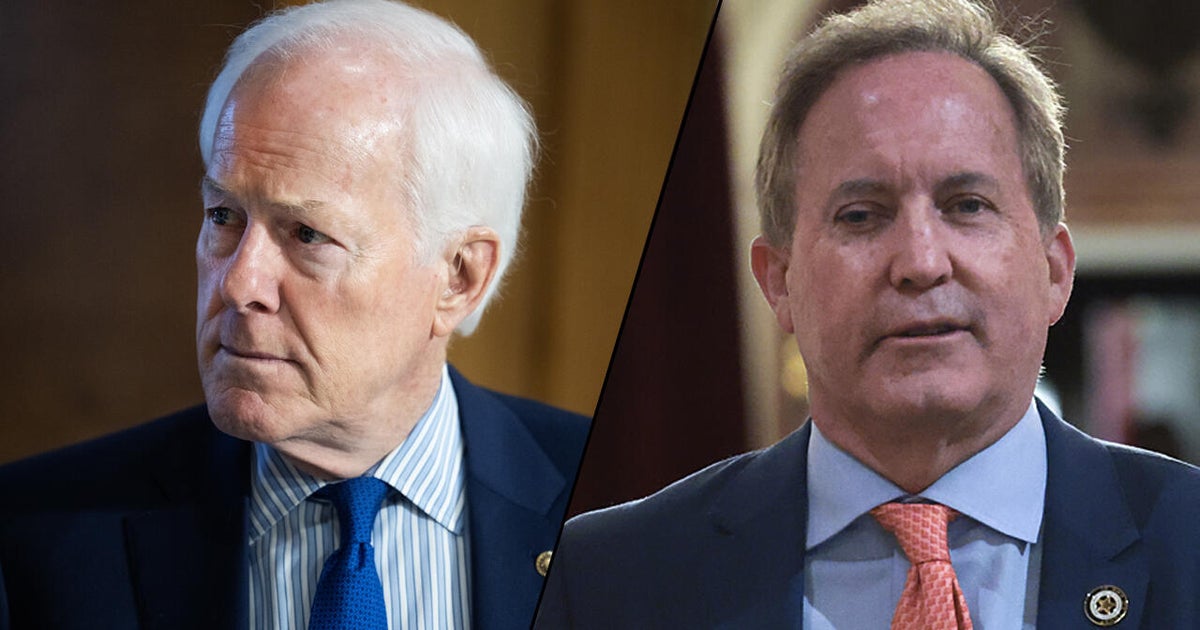
On Tuesday, the fiercest and most expensive Senate primary in U.S. history will culminate as Texas Republicans decide between incumbent Sen. John Cornyn and state Attorney General Ken Paxton in the runoff elections. This primary, which has set a new record in campaign spending, primarily in advertising, will also determine the outcome of several other races, including those for attorney general, state railroad commissioner and a variety of congressional races.
The face-off between Cornyn and Paxton in the Republican primary runoff comes after neither candidate managed to secure a majority in the March primary. The outcome of this race could potentially have a profound impact on the Senate. Especially since President Trump, last week, gave his endorsement to Paxton, a move that could significantly tip the scales in his favor.
Cornyn, who first took office in 2002, emerged as the top vote-getter in the three-way primary in March. However, he fell short of securing at least 50% of the vote. Cornyn, a former Republican whip and chair of the Senate GOP fundraising arm, has at times found himself at odds with President Trump, despite being a strong ally to the president in his second term. Comparatively, Paxton has been a fervent supporter of President Trump for years.
Given that no Democrat has secured a statewide office in Texas since 1994, whoever emerges victorious in Tuesday’s runoff is likely to be the favorite to win in the November elections.
The lack of endorsement from President Trump had been a distinctive feature of the race, with conjectures circulating after the primary that he would back Cornyn. Two days after the primary, President Trump announced he would endorse “SOON” and encouraged whoever he chose not to endorse to withdraw from the race. Paxton responded by saying he would only step aside after the Senate passed a voter ID law backed by President Trump known as the SAVE America Act.
President Trump held a rally in Texas in March but refrained from endorsing any candidates at the time, thereby permitting the deadline to be removed from the ballot to pass without an endorsement. However, one day after early voting for the runoff started, and six days before the voting day, he gave his endorsement to Paxton.
According to Rice University political science professor Mark Jones, “The moment Donald Trump endorsed Ken Paxton, he took a somewhat unlevel playing field and turned it into a steep cliff.” The weight of President Trump’s endorsement has been evident in Republican contests earlier this month. For instance, in Louisiana, he endorsed Sen. Bill Cassidy’s opponent, and the incumbent failed to advance to the runoff. Similarly, in Kentucky, frequent Trump antagonist Rep. Thomas Massie was defeated by a challenger backed by the president.
Generally, Republicans had viewed Cornyn as a stronger candidate against James Talarico, who won the March Democratic primary. The Senate Republican fundraising arm has invested millions to defeat Paxton, who has a weaker fundraising record than Cornyn. This means that if Paxton wins the runoff, Senate Republicans will have to invest more money into the general election race, having already spent millions opposing him.
Paxton first assumed the role of Texas attorney general in 2014, adopting an aggressive stance against the Obama administration upon taking office. He then became a close ally of President Trump’s, even going to the extent of filing a lawsuit challenging former President Joe Biden’s win in the 2020 election in Pennsylvania, Michigan, Georgia, and Wisconsin. However, the case was dismissed by the U.S. Supreme Court.
Paxton also has a history of legal issues related to his role as attorney general. In 2015, he was indicted on securities fraud charges, but they were later dropped in 2024 as part of a pre-trial diversion deal. In 2023, he was impeached on charges of bribery, dereliction of duty, and disregard of official duties by the GOP-majority Texas House of Representatives in a 121-23 vote. He was later acquitted by the state Senate. After the trial, President Trump posted a message in support of Paxton.
The contest between Cornyn and Paxton is already the most expensive primary on record, with AdImpact reporting that spending across both the March primary and Tuesday runoff has topped over $120 million in advertising alone.
In the 18th Congressional District, the Democratic primary runoff will see two incumbents, Rep. Christian Menefee and Rep. Al Green, competing against each other. This situation has arisen after Texas’ Republican-controlled Legislature redrew congressional districts to create five additional seats that are more favorable to the GOP.
Menefee, who won a special election earlier this year to replace Democratic Rep. Sylvester Turner, who passed away last March, was the top vote-getter in the March primary. Menefee appears to be winning over supporters of another candidate, Amanda Edwards, from the March race, according to a University of Houston poll conducted earlier this month.
On the other hand, Green, who has represented the 9th Congressional District since 2005 and is known for his opposition to Trump, chose to run in the 18th District after Republicans rearranged the boundaries of his district to make it more Republican-leaning. With the district being heavily Democratic, the winner of Tuesday’s primary is expected to win in the November elections.
Democrats are also making efforts to stop Maureen Galindo, who is accused of antisemitism, from winning the Democratic primary runoff in Texas’ 35th Congressional District. Galindo, a sex therapist, is competing against Johnny Garcia, a former sheriff’s deputy, in the San Antonio-area district that has become more Republican-leaning after Texas Republicans redrew the congressional map.
Galindo led the March primary, earning 29% of the vote compared to Garcia’s 27%. After she called for the imprisonment of “American Zionists,” House Democrats condemned Galindo, with some saying they would force a vote to expel her if she prevails in the runoff and general election.
The Democratic Congressional Campaign Committee got involved in the race last week, placing a last-minute ad buy as the House Democrats’ campaign arm sought to tip the scales in Garcia’s favor. The ad referred to Galindo as “MAGA Maureen,” in reference to support she’s received from a political action committee that has been linked to Republicans.
James Talarico, Texas Democrats’ Senate nominee, has endorsed Garcia over Galindo and said he won’t campaign with Galindo if she becomes the nominee. Incumbent Rep. Greg Casar, who currently represents 10% of the district since it was redrawn and is instead running in the 37th District in Austin, has also backed Garcia.
There is also a runoff for Republicans in the district, which now covers parts of San Antonio and some suburbs. State Rep. John Lujan is facing off against Carlos De La Cruz, the brother of Rep. Monica De La Cruz of the 15th District.
In the newly-redrawn Dallas-area 33rd District, Democratic incumbent Rep. Julie Johnson is facing former Rep. Colin Allred in what has become a contentious primary matchup.
Johnson was first elected in 2024, when Allred, who had flipped the former 32nd District in 2018, opted to instead run for Senate against Ted Cruz. Allred ultimately lost, but finished five points ahead of Vice President Kamala Harris statewide in that cycle.
However, Johnson’s current district, which includes parts of Dallas and its suburbs, had been altered during Texas Republicans’ 2025 redistricting push, turning it from a district that was 62% Democratic in 2024 to one that’s projected to be 41%. Longtime Rep. Marc Veasey’s 33rd District, which now only includes Dallas County, remained strongly Democratic, but he decided not to run for reelection, and Johnson is now vying to replace him.
Allred, meanwhile, had initially jumped into the U.S. Senate race again. He dropped out after Rep. Jasmine Crockett, who had represented another Dallas-area district that was redrawn, decided to run in that race. Allred then got his paperwork in on the filing deadline to run against Johnson and two others in the 33rd Congressional District.
Allred received the most votes in March, coming out more than 10 points ahead of Johnson but failing to secure the 50% of the vote needed to avoid a runoff. Since then, Allred and Johnson have criticized each other’s records in Congress. Allred has enlisted Crockett on the campaign trail, while Talarico is backing Johnson.
The district is heavily Democratic. There is a runoff between Republican candidates Patrick David Gillespie and retired police officer John Sims in the district, but neither is expected to win the general election.
With Paxton running for Senate, conservatives statewide are split in the runoff for attorney general. Even before the race headed into the runoff, it was already the most expensive attorney general race in the country’s history.
U.S. Rep. Chip Roy finished second in the March primary to state Sen. Mayes Middleton. Although President Trump has not weighed in, Middleton has attempted to depict Roy as not being loyal enough to the president and his agenda. Roy was one of a handful of Texas Republicans to vote against Cruz’s attempt to object to the 2020 election results in Arizona and Pennsylvania, and he delivered a speech after the Jan. 6, 2021, attack on the U.S. Capitol criticizing President Trump. But he voted against impeaching him one week later.
Roy served as Paxton’s first assistant attorney general before being elected to Congress and has criticized Middleton for working as an executive in the oil and gas industry. Middleton has said he is a practicing attorney in oil and gas law.
A statewide poll from the University of Houston earlier this month had Middleton leading 48% to 39%, although 13% remained undecided. Lt. Gov. Dan Patrick, the second-highest statewide official, is backing Middleton, while Roy is backed by Cruz.
Democrats are also in a runoff for their nomination, with state Sen. Nathan Johnson facing off against former Galveston Mayor Joe Jaworski.
Texas’ railroad commissioners regulate the state’s oil and gas industry, making the three-person commission one of the most powerful agencies in the state and one that attracts a lot of campaign funding. The commissioners are elected to staggered six-year terms.
Chairman Jim Wright is being challenged by Bo French, the former Tarrant County GOP chair. Republican leaders had asked French to step down last year after he posted a poll on social media asking whether Jews or Muslims are “a bigger threat to America.” French, whose family owns an oil company in Midland, resisted those calls and only stepped down this year to focus on running for railroad commissioner. He has focused part of his campaign on what he called the “Islamic invasion of Texas,” while also calling for the U.S. to deport 100 million people, including Native Americans.
In the March primary, Wright received 32.1% of the vote and French received 31.75%, according to The Associated Press.
Wright has been backed by the other two railroad commissioners, as well as Gov. Greg Abbott, Patrick, a slew of other elected Republicans and the Texas Oil and Gas Association Good Government Committee. French has received the backing of Turning Point Action and two GOP congressional nominees — state Rep. Steve Toth, who defeated Rep. Dan Crenshaw in the March primary, and Brandon Herrera, the nominee in the 23rd District.
According to Jones, the political science professor, “You know Bo French has crossed the line on the ideological spectrum when Gov. Abbott and Lt. Gov. Patrick consider him to be an extremist.”
Jones said French generally does better with Paxton voters than Cornyn voters, meaning if Cornyn voters don’t show up on Tuesday, there’s a chance French wins the nomination.