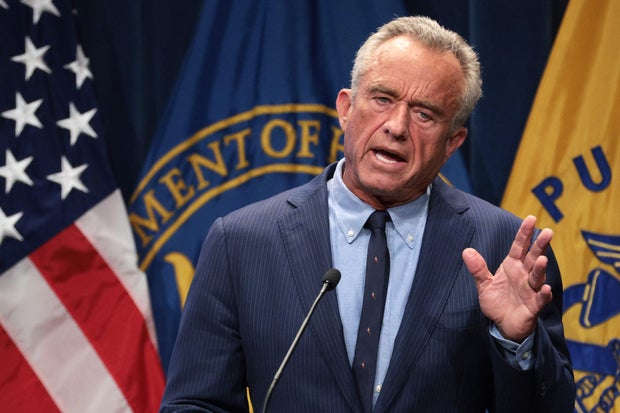
Robert F. Kennedy Jr., the current Secretary of Health and Human Services, finds himself at a critical juncture in his political career. As a prominent figurehead of the “Make America Healthy Again” (MAHA) movement—an offshoot of the broader Trump-era political phenomena—Kennedy has been a vocal advocate for controversial health policies, including a substantial rollback on mandatory vaccinations. This stance places him in a delicate balancing act between his MAHA base, who are pushing for more radical reforms, and a White House that is grappling with President Trump’s fluctuating approval ratings and policy direction.
Kennedy recently made headlines during a speaking event at the Cleveland City Club. Addressing a deeply divided audience, his comments advocating for parental choice in child vaccinations were met with both applause and disapproval, illustrating the polarized response to his policy suggestions. This event is part of Kennedy’s broader tour across northern Ohio, aimed both at promoting his health policy mandates and solidifying his support base in anticipation of the upcoming midterm elections.
The political landscape is becoming increasingly challenging for Kennedy. His advocacy for curtailed vaccine mandates and investigations into unconventional health theories, such as the alleged toxicity of airplane contrails, has created friction with the White House. President Trump, who once gave Kennedy free rein to “go wild” on health issues, appears to be repositioning, prompted by political pressures and the upcoming election cycle. This shift became evident when Trump nominated Dr. Erica Schwartz, a pro-vaccine advocate, to lead the Centers for Disease Control and Prevention (CDC), signaling a move towards more mainstream health policies. This nomination stands in stark contrast to Kennedy’s firing of the previous CDC director, Susan Monarez, who claimed her dismissal was due to her refusal to align CDC recommendations more closely with MAHA’s controversial stances.
Adding to the complexities, the Make America Great Again (MAGA) base, with whom MAHA shares considerable overlap, experienced a shake-up with Trump’s recent nomination of Nicole Saphier for the U.S. Surgeon General role. Saphier, a radiologist and former media personality noted for her conventional medical perspectives, seems a strategic choice to pivot away from the more extreme medical freedom rhetoric championed by Kennedy and his followers. This nomination was met with resistance from key MAHA figures who expected someone more aligned with their views, particularly on vaccination and alternative health policies.
At stake is not just political alignment but the strategic direction of Republican campaigns in the upcoming midterms. Kennedy’s push for controversial health reforms, while resonating with a segment of the electorate, poses a risk of alienating broader voter bases who are more concerned with pressing issues like healthcare costs and insurance coverage. Recent polling indicates a growing disconnect between voter concerns and the political agendas pursued by some in the Republican camp, with health care affordability and medication costs cited as more pressing than vaccine mandates.
Kennedy’s own political ambitions have been a topic of speculation. Despite his vocal base’s push for him to consider a presidential run in 2028, Kennedy has publicly declined any intent to pursue the presidency, aligning himself instead with supporting Republican candidates in the midterms. This stance, however, has not quelled the underlying tensions nor the speculation about his future in politics, particularly as President Trump considers his options for potential successors, including Secretary of State Marco Rubio and Vice President JD Vance.
The Secretary’s continued navigation through these complex political currents underscores a broader narrative about the intersecting influence of health policy and political ideology in American politics. As Kennedy continues to advocate for his health policy changes—tempering his focus on vaccines while highlighting issues like food safety and nutrition—he faces the task of reconciling his advocacy with the pragmatic demands of electoral politics. His efforts to balance these dynamics will likely shape not only his political legacy but also the broader trajectory of health policy in a deeply polarized America.
The unfolding story of Robert F. Kennedy Jr.’s tenure as Secretary of Health and Human Services is a testament to the challenges and complexities of navigating health policy in a time of intense political division. As Kennedy positions himself ahead of the midterm elections, his strategies, choices, and the responses they invoke will significantly influence the political landscape, shaping both his career and the broader health policy discourse in the United States.