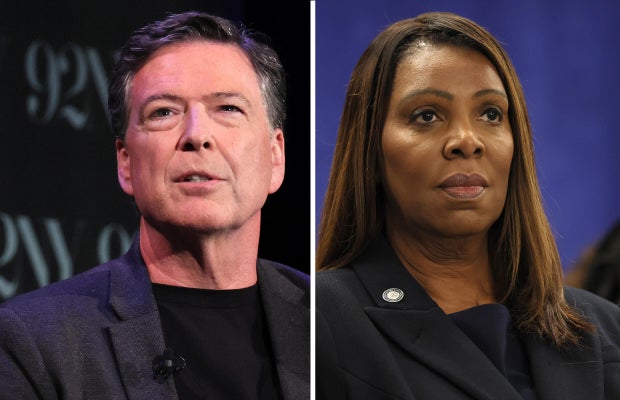
In a decisive turn of events, U.S. District Judge Cameron Currie ruled to dismiss the criminal charges against former FBI Director James Comey and New York Attorney General Letitia James on Monday. This decision came after an extensive review into the legitimacy of the appointment of interim U.S. Attorney Lindsey Halligan, who played a central role in securing their indictments. The verdict emanated from Washington, being yet another tumultuous ripple in the pond of U.S. national politics where controversies and high-stakes legal battles seem to perpetually emerge.
The root of the controversy pivoted on Halligan’s role and her qualification to serve in the capacity that led to the issuing of the indictments. Appointed temporarily to fill the U.S. attorney position in the Eastern District of Virginia, Halligan found herself in a legal and political maelstrom shortly after her placement. The contention was over whether her appointment by Attorney General Pam Bondi conformed to the requisite legal frameworks or if it was, as concluded by the court, an unlawful exercise of the appointment power.
In her ruling, Judge Currie emphasized that Halligan’s appointment violated both a federal statute—Section 546, which addresses vacancies in U.S. attorney positions—and the Appointments Clause of the Constitution. According to Currie, the attorney general’s power to appoint an interim U.S. attorney does exist, but it is substantially bounded. The position, once vacated by a Senate-confirmed U.S. Attorney, permits an interim attorney, appointed by the attorney general, for only a 120-day period after which, if still vacant, the responsibility transits to the district court until a new Senate-approved attorney is appointed.
Currie highlighted that the sequence of interim appointments ultimately led to Halligan assuming the role in a manner not aligned with this stipulation. Comey’s indictment occurred mere days after Halligan’s assumption of the interim post and James was indicted shortly thereafter. Both indictments have been staunchly pronounced as retributive by the accused, suggesting these legal actions were politically motivated by existing partisan undercurrents, intensified by former President Donald Trump’s administration’s contentious relationship with Comey and apparent adversarial stance towards James.
Responding to the ruling, Attorney General Pam Bondi, present at a news conference in Memphis, declared the Department of Justice’s intention to appeal the decision immediately. Bondi’s defense of Halligan underscored her belief in Halligan’s capabilities and the legality of her appointment.
The legal skirmishes encapsulate not only the contested indictments of Comey and James — with Comey accused of lying to Congress and obstructing a legislative proceeding, and James charged with bank fraud — but also broader themes of justice, governance, and the extent of executive powers. Bonds and discourse within the political sphere are severely tested when legal actions might be perceived as veneers for settling political scores.
In their responses, both Comey and James expressed relief and gratitude towards the judicial decision and reinforced their positions. James acknowledged the support she received nationally and reiterated her commitment to her duties, unaffected by the charges she decried as baseless. Comey, on the other hand, released a video statement where he underscored the critical importance of the judiciary’s role in preventing misuse of legal systems by the reigning presidential administrations for political gains.
The dismissal of these charges, albeit without prejudice — allowing for the possibility of re-filing charges should new or compelling evidence arise (except in Comey’s case where the statute of limitations has expired) — brings temporary relief to Comey and James but signals deeper interrogations into the appointments and operations within U.S. judicial and executive branches.
Moreover, Judge Currie’s rulings inject a critical examination into how U.S. attorneys are appointed and the implications of these appointments on high-profile legal actions. The ongoing debates and ensuing legal battles are likely to intensify discussions on the ethical, legal, and political dimensions of prosecution in America, particularly those tinged with alleged political motivations.
As the Justice Department gears up for an appeal, the political and legal landscapes continue to brace for the reverberations of this case, which is emblematic of the complex interplay between law and politics in the United States. The outcomes and precedents set here will potentially have lasting impacts on the interpretative and procedural aspects concerning the authority and appointments of interim U.S. attorneys, sharpening the contours of American legal jurisprudence in political contexts.