Scars of War: Iran’s Opening Attacks on Bahrain Caught U.S. Off Guard and Upended Military Families
On the first day of the Iran-U.S. war, Iran launched a barrage of ballistic missiles and drones at Naval Support Activity Bahrain, the Navy’s Middle East headquarters. Yet even as explosions lit the sky, American military families were still scattered across island, waiting for an evacuation that would not come for days. According to multiple families who spoke to CBS News, some had to wait a week or more before reaching safety. It was a chaotic beginning to a conflict that would test American military posture in the Gulf and upend the lives of the very people stationed there to keep it.
.
One military spouse described the terror of that opening week in stark terms. “You’re definitely scared,” she said. “As the week goes on, you wake up to ballistic missiles being fired. We went to sleep with the sound of ballistic missiles again.” Another spouse said Iranian missiles and drones targeted Bahrain consistently for several days after the war began. The scale and duration of those attacks appeared to take the U.S. government by surprise, three sources who were in Bahrain at the time told CBS News, in part because families had not been required to evacuate until the war had already begun. The assault was not a single, isolated strike. It was sustained, repeated, and close enough that families could hear explosions and see the contrails of incoming weapons streaking overhead.
The military had anticipated some kind of retaliation and had even evacuated the headquarters buildings on the base. But the scale of what followed was nonetheless shocking. “We weren’t expecting that [scale],” one U.S. official said. And still, several military families were living off the base nearby, outside the protective perimeter. They were left to ride out the attacks in apartments and houses while the world around them turned into a war zone. One spouse said she could see the contrails of missiles and drones. Another heard explosions from attacks. CBS News granted anonymity to the spouses who feared retaliation for speaking publicly about their experiences.
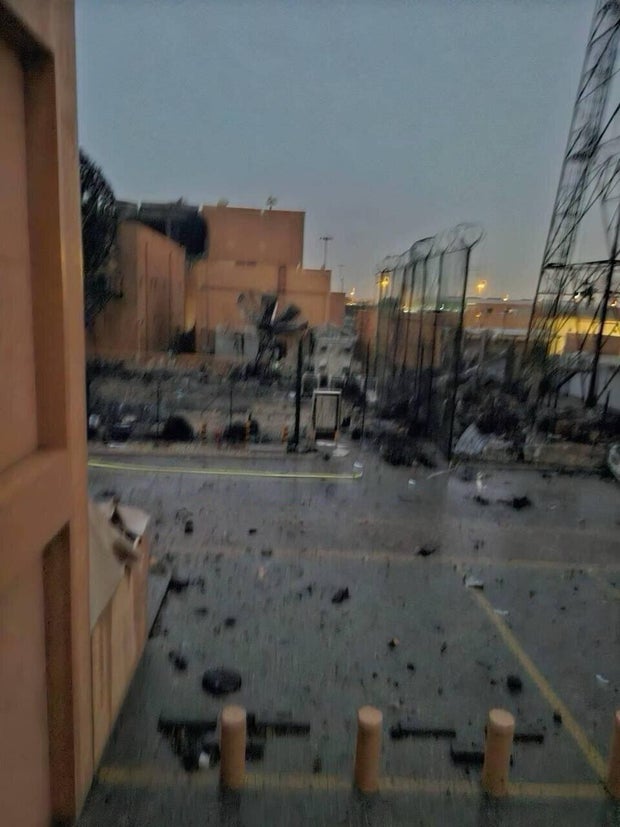
The attacks did not kill any U.S. military personnel, but they left a visible scar on one of the Navy’s most important installations in the Middle East. Later, images circulating on social media—which sources say are authentic—showed extensive damage to the base. One of the images captured an explosion during an attack on the first day of the war that targeted a key radar system. The photographs offered a rare public glimpse of the destruction, but they also raised questions that remain unanswered: How much did Iran’s opening barrage actually cost? What will it take to rebuild? And why were so many families still in harm’s way when the first missiles fell?
A Base Damaged, and a Cost Unknown
Despite the damage, the Pentagon has not released a public estimated cost of what Iran’s attacks destroyed. The U.S. military has not included the damage to bases in its broader cost estimates of the war so far because officials say they don’t yet know what will be rebuilt. The uncertainty is itself telling: planners cannot fully account for a war’s price tag when some of its physical wreckage is still being assessed.
.
Acting Navy Secretary Hung Cao was more blunt. In a recent interview with The Epoch Times, he said Iran’s retaliatory attacks “blew the hell out of Bahrain.” The remark captured the frustration and the scale of destruction that officials had been reluctant to describe in detail. For a base that had long functioned as a linchpin of American naval power in the region, the damage was not just symbolic. It was operational.
An Indispensable Hub Under Fire
Since Naval Support Activity Bahrain officially became the headquarters for the Navy’s Fifth Fleet in the 1990s, it has served as a logistics hub for ships in the Middle East, including during the wars in Iraq and Afghanistan. According to the Navy’s website, the facility serves approximately 8,300 military personnel, Defense Department civilian employees and their families. Its location in the Persian Gulf put it at the center of American naval operations, a place where ships could pull in for supplies, repairs, communications, and crew support. It was, in many ways, the beating heart of U.S. Navy operations in one of the world’s most volatile regions.
That strategic importance made it an obvious target when war broke out. But the sustained nature of the attacks suggested that Iranian planners had not merely wanted to make a point. They wanted to degrade an installation that the United States had relied on for decades. The damage has therefore been felt far beyond the base’s gated perimeter.
A Logistics Nightmare at Sea
The ripple effects quickly reached sailors at sea. Earlier this year, the USS Abraham Lincoln aircraft carrier faced food shortages as the Navy adjusted its resupply routes away from Bahrain. The New York Times reported that some supplies had to come through Diego Garcia, an island some 2,200 miles away in the Indian Ocean. That is not a short detour. It is a journey across an ocean, requiring time, fuel, and coordination.
The extended route requires 14- to 18-day logistics cycles to deliver supplies to ships, according to a Pentagon Inspector General report. That is compared to 5 to 7 days from Bahrain, two former officials said. While there are other logistics hubs in the region, Bahrain was a key option before the war began. Losing it, even temporarily, forced the Navy to rethink how it sustains its fleet far from home.
.
Chief of Naval Operations Admiral Daryl Caudle, the Navy’s top officer, at a town hall last month acknowledged the service has had to restructure how it supplies ships in the Middle East. He was direct about the early difficulties. “There was some early learning there on getting the logistics process in place that I think now we have in a very good situation,” Caudle said.
He also offered a sobering update to sailors who had been evacuated from Bahrain. Officials are working on retrieving belongings that were left behind because the Navy does not have imminent plans to return to the same level of footprint on the base. Caudle did not sugarcoat the timeline. “We’re not getting back in there anytime soon, I just want to be completely honest with that,” he said.
For those still trying to reclaim their lives, the Navy’s guidance has been clear but not necessarily easy to execute. According to a Navy spokesperson, service members in Bahrain can ship their household goods and vehicles in person. Those outside Bahrain can designate a representative to act on their behalf, or coordinate travel back to Bahrain to move household goods and vehicles. But that assumes a person can afford the time, the money, and the emotional energy to reconstruct a household from thousands of miles away.
Families Left in Financial Limbo
Since those opening days of the war, the Navy has helped evacuate about 1,450 service members and families from Bahrain. Many are now in a financial bind because they are paying for at least two households—one in Bahrain and another in the United States. For some, that means carrying rent or mortgage on a home they fled, while also paying for housing, food, schools, and everyday expenses in a new place. The double burden has been devastating.
“We have burned through our savings,” one of the spouses told CBS News. “We have started having to take money out of our kids’ college funds to pay down all the bills that we’re incurring.” For a military family, that kind of financial strain is especially cruel. They had already committed their lives to service, and now they were being asked to absorb costs that the system was slow to reimburse.
The Pentagon is providing benefits to reimburse housing costs in both places, but families told CBS News that claims can take weeks to months to process. That delay matters when bills are due now. It matters when children need clothes for a new school, when a family needs a car in a new city, when every day of limbo adds another expense.
In a statement, a Navy spokesperson said: “The Navy remains in close communication with all affected service members, affiliated civilians and families through command channels and continues to provide timely information, individual case management,and relocation support.” The spokesperson said families have until the end of November to transition from a safe haven to an established designated residence to continue receiving housing, relocation and separation entitlements. Until then, the clock is ticking for hundreds of families trying to rebuild their lives.
Uprooted, Scattered, and Trying to Settle
Even if some families have not struggled financially through this process, all of them have been uprooted. Many were evacuated to Norfolk, Virginia, which is a Navy hub, or to Tampa, Florida, where U.S. Central Command’s headquarters is located. Those cities offered support networks, military infrastructure, and fellow service members who understood what they had been through. But they were not home.
Blue Star Families, a non-profit that supports military families, provided supplies to evacuees in Tampa. Suzy Malloy, the executive director of the chapter in the Tampa Bay region, described the kind of practical help that made a difference in the chaotic first weeks. “We gave these kids backpacks with school supplies,” Malloy told CBS News. “We gave families brand new clothing, we gave them air fryers and crockpots so that they could cook in hotel rooms until they could adjust to something more permanent,” like an Airbnb or temporary military housing.
Malloy said the evacuees are still in a bit of limbo but are starting to settle into Tampa. She praised the military’s family readiness programs for helping hold things together. “My opinion is [U.S. Central Command]and their family readiness program have done a remarkable job keeping the train on the tracks,” Malloy said.
But settling does not erase the fear or the frustration. None of the families CBS News spoke to blamed the military for their challenges. They understood that war is chaotic, that decisions had to be made quickly, that no one could have predicted exactly how the first days would unfold. They were not looking for someone to blame. They were looking for stability, for answers, for a way forward.
A Long, Uncertain Wait
The families are stuck in a strange middle ground: evacuated, safe, but not home. They have left behind homes, schools, routines, and possessions. Some do not know when or whether they will return to Bahrain. Others do not know how long the financial strain will last. And almost all of them are waiting for news.
“Nobody expected this to go on so long,” one of the spouses said.
The war, as it turned out, was not the only thing that came suddenly. The evacuation, the logistics breakdown, the financial burden, and the long aftermath have all become part of the story too. For the sailors and families who lived through those first terrifying days in Bahrain, the opening barrage was not just a distant geopolitical event. It was the moment their lives were turned upside down—and the moment they learned that even in a war full of advanced weapons and complex strategy, some of the deepest scars are carried by the families left behind.
.
For those who may be affected, the Navy has directed families to its command channels and family support programs for case management, relocation assistance, and information about housing and entitlements. But for many, the most important resource is simply time—time to process what happened, time to rebuild, and time to discover what comes next.