The U.S. Border Patrol’s focused operations during President Donald Trump’s administration have been marked by controversy and heated debate, especially with regard to the agency’s intended targets and operational outcomes. A recent crackdown on immigration enforcement in Charlotte, highlighted by the Department of Homeland Security’s Operation Charlotte’s Web, serves as a case study in understanding these complexities.
The operation, which began over a weekend in mid-November, involved deployment of approximately 200 Border Patrol agents clad in their distinctive green uniforms. The ensuing activities resulted in over 270 immigration arrests. However, a revealing internal document from the Department of Homeland Security, obtained by CBS News, indicates a significant discrepancy between the administration’s public statements and the operation’s actual results. Despite claims from Trump administration officials that the operation was mainly aimed at targeting criminally active illegal immigrants posing a threat to public safety, the figures speak differently. Of those arrested, fewer than 90 were classified as “criminal aliens,” constituting less than one-third of the total number arrested.
This revelation calls into question the underlying justification for the operation purported by officials, suggesting that the scope of enforcement may have been broader than initially communicated. The document, unfortunately, does not provide a breakdown of the severity of crimes committed by those deemed criminals, nor does it clarify whether the charges were allegations or prior convictions.
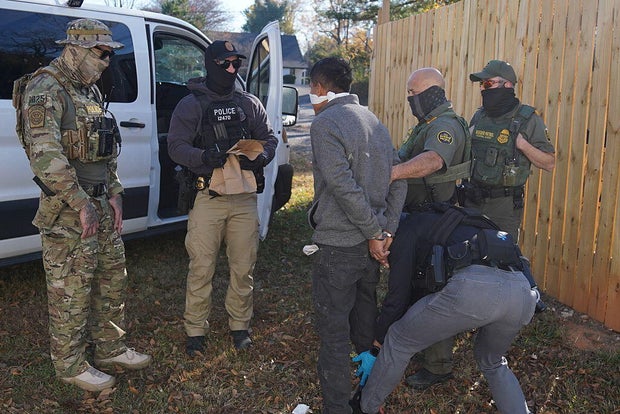
The visual captured during these operations offers a narrative of its own. One photo depicts a tense scene where a U.S. Border Patrol agent apprehends an individual in a half-constructed fast-food restaurant. However, images and ground realities often tell only a part of the story.
As the crackdown in Charlotte wraps up, with Border Patrol agents demobilizing from the area, the operations reflect more than just the events on the ground—they encapsulate the broader strategies and political motivations behind such immigration enforcement surges. It is noted that while Border Patrol has concluded its major operations in Charlotte, Immigration and Customs Enforcement (ICE) maintains a permanent presence and is expected to continue its activities in North Carolina.
In parallel, CBS News has learned from U.S. officials and internal documents that similar operations are poised to extend to other cities, with New Orleans cited as a potential upcoming location for another enforcement surge as early as December.
However, further scrutiny and skepticism about the claimed focuses of these operations continue. A DHS spokesperson challenged the accuracy of CBS’s reporting, emphasizing that recent press releases outlined the capture of 130 individuals within just two days, including 44 with alleged or convicted involvement in serious crimes such as aggravated assault, battery, and DUI, among others. Some detainees were also identified as gang affiliates, reinforcing the narrative of targeting dangerous individuals.
The evolving situation brings into relief the role of Border Patrol beyond its traditional confines. Historically tasked with safeguarding U.S. borders from unauthorized entry and contraband, the agency’s urban operations under the direction of controversial figures such as Commander Gregory Bovino, signify an unprecedented pivot. This strategic shift has seen agents executing arrests in city landscapes far from border lines—shopping centers in Charlotte, parks in Los Angeles, and residential neighborhoods in Chicago—fundamentally widening the operational scope traditionally associated with Border Patrol activities.
The operations, spearheaded by engaged and often visible law enforcement personnel including Bovino, have not gone without significant public and political pushback. Critics argue that the methods employed are excessively harsh and indiscriminate, amounting to racial profiling, especially against Hispanic communities including U.S. citizens. In Charlotte, for example, agents were videotaped forcibly breaking a car window belonging to a U.S. citizen, and encounters frequently occurring in front of local businesses have led to temporary closures and widespread community fear.
Escalating tensions have triggered broader social repercussions, including protests from local high school students and significant absenteeism within regional schools, pointing to a rippling effect of such federal actions on community cohesion and public sentiment.
Public opinion reflects this controversy, with a recent CBS News poll indicating that a majority of Americans view the federal immigration enforcement strategies as overly aggressive, detaining more individuals than necessary. This perception underscores the complex balance between national security interests and community and individual rights—a balance that continues to challenge policymakers, enforcers, and the society at large.
As Operation Charlotte’s Web concludes and its effects continue to percolate through national discourse and policy debates, the broader implications of such immigration enforcement practices on the fabric of American society remain to be fully understood and addressed.