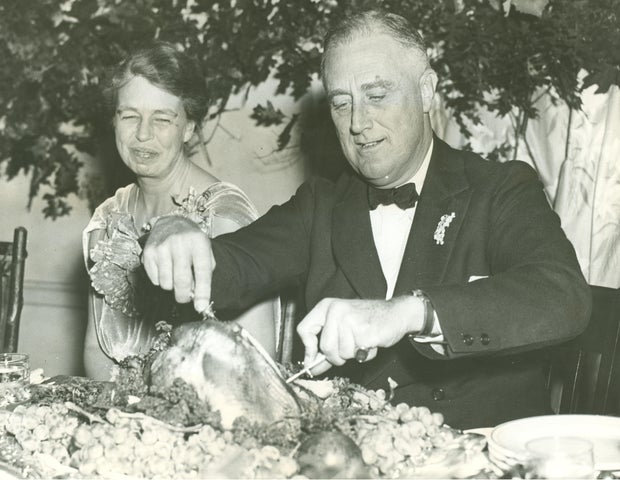
The tradition of presidential turkey pardons has become a cherished ritual in the United States, marking a moment of light-heartedness and national unity on the eve of Thanksgiving. This week, the continuation of this unique American tradition saw two fortunate turkeys making their way from the opulent surroundings of the Willard Hotel to the prestigious grounds of the White House, where they were pardoned by the President in a ceremonial event.
The origins of Thanksgiving itself trace back more than 160 years to when President Abraham Lincoln, amidst the throes of the Civil War, deemed it crucial to unify the nation through gratitude and communal remembrance. President Lincoln’s proclamation was motivated by a series of impassioned campaigns led by Sarah Josepha Hale, a prominent writer and editor of “Boston’s Ladies Magazine”. Hale dedicated over three decades to the cause, persistently advocating for a national Thanksgiving holiday. It was under her persuasive influence that Lincoln finally declared Thanksgiving a national holiday on October 3, 1863.
While Thanksgiving as an official holiday was given its permanence on the fourth Thursday of November by a Congressional act passed on December 26, 1941, it’s the turkey pardoning that captures significant public imagination today. Surprisingly, this practice has disarmingly humble and personal origins.
The very first act that could be seen as a turkey pardoning was during Lincoln’s presidency. A dispatch by White House reporter Noah Brooks in 1865 recounts that Lincoln’s youngest son, Tad, successfully pleaded for the life of a turkey destined for the family’s Christmas meal. This act, inspired by personal sentiment, is recorded as the first instance of presidential clemency towards a turkey.
Although not formally recognized as a regular public event until much later, various presidents displayed similar whimsical mercy over the years. Notably, the tradition of receiving turkeys gifted by poultry organizations became popular in the 20th century, but it wasn’t always accompanied by a pardon. It was during Ronald Reagan’s presidency in the 1980’s that pardoning a turkey became a more expected, if still unofficial, practice. This was largely seen as Reagan responding to questions about whether he would grant pardons in other, more serious spheres, by humorously discussing the turkey’s fate instead.
However, it was under President George H.W. Bush in 1989 that the turkey pardon became an established annual event. Photographs from that time show President Bush granting the official reprieve to a visibly relieved turkey, emphasizing that the bird was granted a presidential pardon, a scene that would become familiar in the years to follow.
This year, like every other, the presidential pardon brought a comic relief to the serious corridors of power with President Trump pardoning turkeys named Gobble and Waddle, in a ceremony that was attended by the First Lady. The birds were selected through a competitive process and, reflecting modern times, were even “trained” for the big moment. The pardoned turkeys are eventually sent to live out their days in a farm, free from the fate of the dinner table.
Beyond the spectacle of the turkey pardon, Thanksgiving at the White House holds a mirror to how it’s celebrated across the nation – a time for gathering with family and friends. Historical records from the White House Historical Association (WHHA) detail that the first recorded family Thanksgiving within the White House was held by President Rutherford B. Hayes in 1878. Since then, regardless of the surrounding circumstances, whether it be economic hardship or international conflicts, subsequent presidents have carved out time to observe Thanksgiving traditions amidst the demands of governance.
Interestingly, the venues for presidential Thanksgivings have also varied according to the sitting president’s preference. For instance, President Ronald Reagan often spent the holiday at his ranch in California, President Trump frequently visited Mar-a-Lago during his tenure, and former President Joe Biden has made Nantucket a regular destination.
Thus, as this year’s pardoned turkeys settle into their new homes and the President resumes the duties of office, the tradition of the turkey pardon stands as a reminder of America’s capacity for whimsy and the comfort of continuity in presidential customs. While seemingly light-hearted, these traditions serve to humanize the office of the Presidency, reminding us all of the simple joys of Thanksgiving and the spirit of gratitude that defines the holiday.