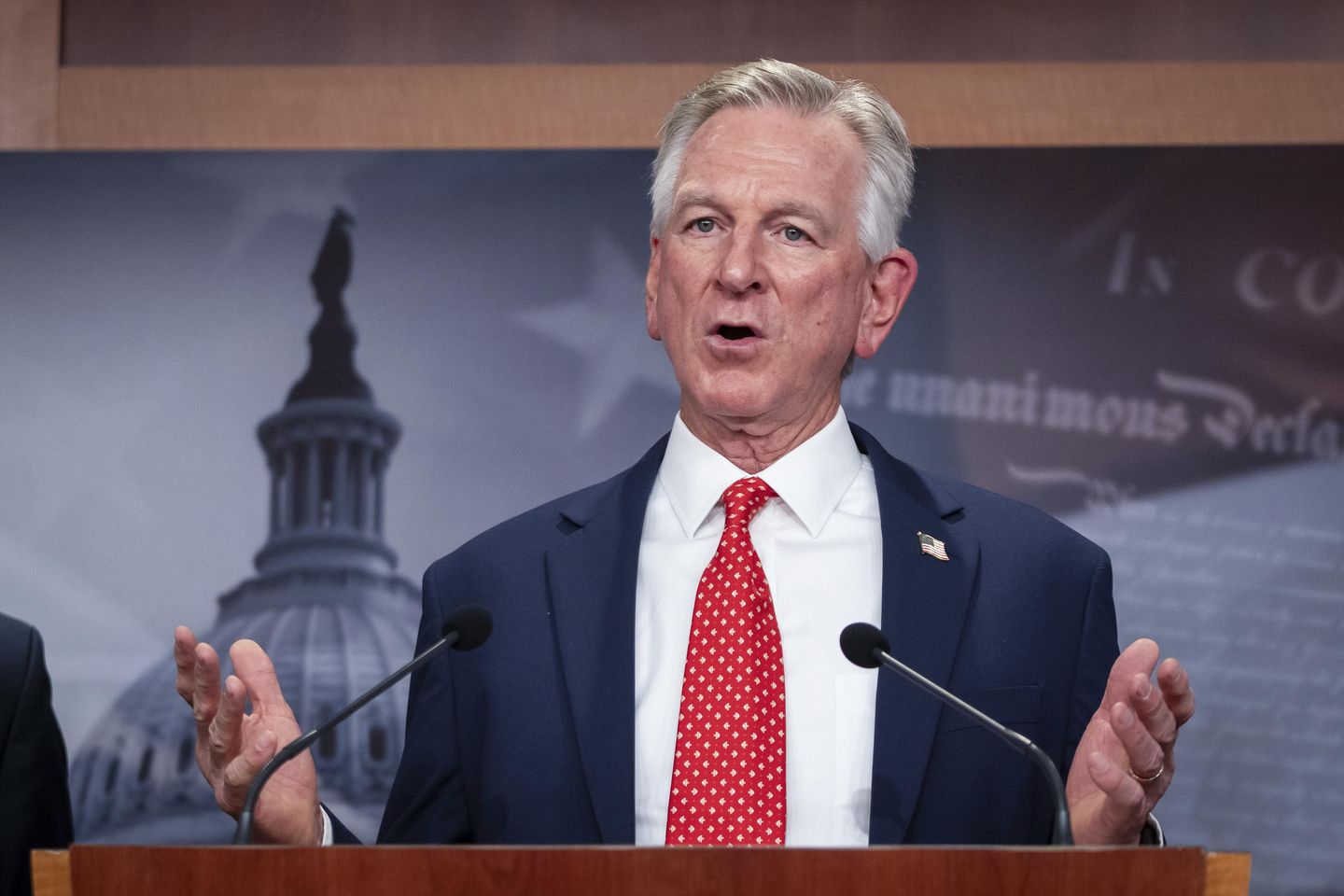
In a recent development, Senator Tommy Tuberville has made a controversial statement, calling for the government to both ban and deport Islamic immigrants in the wake of a shooting incident involving two National Guards members. The alleged perpetrator of the attack is believed to be an Afghan national. The incident, which occurred in Washington, D.C., has stoked the fires of an already heated debate on immigration policy in the United States.
The shooting incident, as reported, took place in the heart of the nation’s capital, Washington D.C., causing widespread alarm and triggering a renewed debate about national security. The victims, two members of the National Guard, were reportedly stationed in the city when they were ambushed and subsequently wounded. The alleged shooter was identified as an Afghan national, a detail which has been seized upon by those advocating for stricter immigration policies.
In the aftermath of this tragic event, Senator Tommy Tuberville has emerged as a vocal advocate for a hardline stance on immigration. Senator Tuberville, known for his conservative views and uncompromising stance on issues related to national security, has called upon the government to implement a ban on Islamic immigrants. Additionally, he has urged the government to deport those who are already residing in the country.
According to Senator Tuberville, this drastic measure is necessary to safeguard the nation’s security in the face of what he perceives as a growing threat from Islamic immigrants. The senator’s call for action has sparked a fierce debate, with opponents arguing that such a sweeping measure would be discriminatory and in violation of the United States’ long-standing tradition of welcoming immigrants from all walks of life. Critics argue that Tuberville’s proposal unfairly targets an entire religious group due to the actions of a single individual.
Despite the controversy, Senator Tuberville remains firm in his stance. A former football coach turned politician, Tuberville argues that the incident involving the Afghan national and the National Guard members is not an isolated one. He cites other instances where Islamic immigrants have been involved in acts of violence, asserting that these incidents justify a stricter approach to immigration policy.
However, Tuberville’s viewpoint is not shared by all. Many have voiced their opposition to his proposed ban, arguing that it is unjust to paint all Islamic immigrants with the same brush due to the actions of one individual. They argue that the vast majority of Islamic immigrants are law-abiding citizens who contribute positively to American society in myriad ways. Critics of the senator’s stance assert that such a broad-brush approach is not only unfair, but it also undermines the principles of diversity and inclusivity that the country was built upon.
Moreover, opponents of Tuberville’s stance point out that the United States has a strong tradition of accepting immigrants from all over the world, regardless of their religious beliefs. They argue that a ban on Islamic immigrants would be a drastic departure from this tradition and could potentially damage the nation’s global reputation as a beacon of freedom and opportunity.
However, despite the criticism, Tuberville is not alone in his views. A segment of the population, particularly those with conservative inclinations, support the senator’s call for stricter immigration policies. They argue that national security should be the country’s paramount concern, even if it means implementing measures that could be seen as discriminatory or exclusionary.
In the wake of the shooting, the debate on immigration policy and national security has intensified. On one hand, there are those who echo Tuberville’s sentiments, arguing that the nation’s security should be prioritized above all else. On the other hand, there are those who maintain that a blanket ban on Islamic immigrants would be a betrayal of the nation’s core values.
As the debate rages on, the government is faced with a difficult decision. Will it heed Senator Tuberville’s call and implement stricter immigration policies, potentially at the cost of its reputation as a welcoming nation? Or will it reject his proposals, uphold its commitment to diversity and inclusivity, and continue to welcome immigrants from all backgrounds?
Regardless of the outcome, the incident in Washington D.C. and Senator Tuberville’s subsequent call for stricter immigration policies serve as a stark reminder of the ongoing struggle to balance national security concerns with the country’s commitment to openness and diversity. It is a delicate balance, and one that will undoubtedly continue to be a critical issue in the nation’s political discourse for years to come.