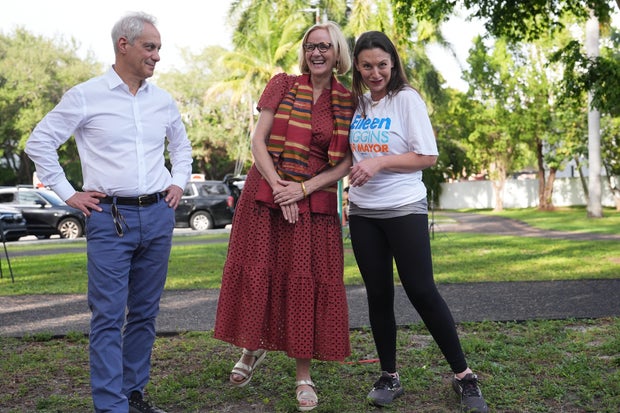
In a recent political development that has captured the attention of both local and national audiences, Democrat Eileen Higgins emerged victorious in the Miami mayoral runoff election, securing approximately 59% of the vote. This notable triumph marks the first time in nearly 30 years that a Democrat has been elected to the mayoral office in Miami, signaling a significant political shift in a city that has long been under Republican dominance.
The significance of this victory cannot be overstated. Miami’s election of a Democrat as mayor comes after decades wherein the Democratic Party had struggled to regain a foothold in Miami’s political landscape. Higgins’ success in this election is viewed by many as a direct referendum on current national immigration policies, a topic that has been a focal point of her campaign. Eileen Higgins, who holds a position as a county commissioner, has been vocal about her stance on immigration, describing the current tactics as “not only cruel” but also “sinful,” a sentiment shaped by her Catholic upbringing.
The political discourse around this election was intensely fueled by the sharp contrasts between Higgins and her opponent, Emilio Gonzalez. Gonzalez, a Republican, has a notable resume including roles as a former city manager, Miami-Dade County commissioner, and director of U.S. Citizenship and Immigration Services under former President George W. Bush. Despite being endorsed by former President Trump, who pushed for the election to be a referendum on his endorsement rather than his immigration policies, Gonzalez wanted the focus to be solely on his credentials and vision for Miami.
The mayoral race, though technically nonpartisan, drew significant national attention and resources. High-profile Democrats including former Secretary of Transportation Pete Buttigieg, Arizona’s Senator Ruben Gallego, and former Chicago Mayor Rahm Emanuel, rallied behind Higgins, contributing to a visible and energetic campaign. Their involvement underscores the strategic importance placed on this election by the Democratic Party, eager to reclaim influence in a historically Republican stronghold.
Further intensifying the stakes was the early voting data, which demonstrated a promising lead for Democrats, surpassing Republican turnout by approximately 8%. This data provided a beacon of hope for the Democratic Party, suggesting a potential shift in voter sentiment within Florida—a state crucial not only for its electoral significance but also as a Republican bastion in recent years.
The response from the Republican camp was measured, with the state party chair downplaying the election’s significance despite the narrow victory margin exhibited by Vice President Kamala Harris in Miami in the 2024 presidential election. Florida Republicans, perhaps unsettled by the possible implications of a Democratic win in their stronghold, have remained cautiously optimistic about maintaining their influence over the state’s political affairs.
Amid these political maneuvers, Miami’s demographic and cultural composition added another layer of complexity to the election. With a majority of the population being foreign-born and a significant number holding citizenship, immigration policy stands as a crucial issue that resonates deeply with the electorate. Republicans in South Florida have historically garnered support from Cuban, Venezuelan, and Nicaraguan communities, who lean conservative due to their opposition to socialist and communist regimes in their home countries. However, Higgins argued that the current administration’s harsh immigration policies, exemplified by increased state trooper enforcement and controversial detention centers, have not only been inhumane but also damaging to Florida’s economy.
In contrast, Gonzalez criticized Higgins for prioritizing national issues over local concerns, suggesting that such focus might detract from addressing immediate city-specific issues. Nonetheless, Higgins maintained her stance, promising to cooperate with federal authorities on agreeable terms while vowing to assert her opposition when necessary.
As the city of Miami stands on the cusp of a new political era under Mayor Eileen Higgins, the ramifications of this election will undoubtedly echo beyond the confines of the city. This victory not only represents a significant achievement for the Democratic Party but also sets the stage for upcoming electoral battles in Florida. With this pivotal win, Democrats are hopeful that they can continue to make inroads in traditionally Republican territories, potentially reshaping the political landscape in the lead-up to the next presidential election. The outcome in Miami signals a broader message about the evolving political climate and voter sentiment, hinting at a more competitive and dynamic electoral process in future contests.