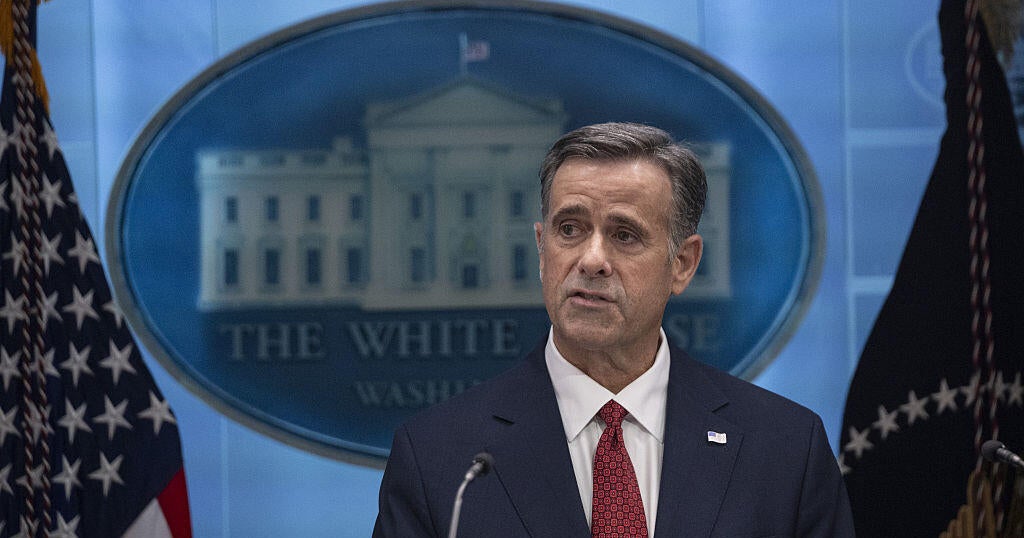
In a significant diplomatic move, CIA Director John Ratcliffe journeyed to Havana, Cuba, on Thursday for a pivotal meeting with top Cuban officials amid heightened tensions and under the weight of U.S. sanctions impacting the island nation. According to an agency official who spoke to CBS News, Ratcliffe’s visit aimed to deliver a potent message from the U.S. administration: Washington is ready to enhance economic and security ties with Cuba, provided Havana undertakes sweeping and fundamental reforms.
This rare visit takes place against a backdrop of an unfolding crisis in Cuba, as the country grapples with a catastrophic failure of its national power grid. This power outage has plunged numerous provinces into darkness and highlights the severe infrastructure challenges facing the nation, which has been squeezed by U.S. sanctions contributing to an acute shortage of oil and gas.
In his discussions, Ratcliffe met with Raul Rodriguez Castro, the grandson of Cuba’s former President Raúl Castro, signaling the importance of the meeting which sought to bridge gaps in a historically fraught bilateral relationship. Notably, on the same day, several U.S. officials confirmed ongoing steps towards indicting Raúl Castro, aged 94, for his alleged involvement in the 1996 downing of two planes operated by Brothers to the Rescue, a humanitarian group, an incident that had resulted in deadly consequences.
During the meeting, which also included Cuban Interior Minister Lazaro Alvarez Casas and the head of Cuba’s intelligence services, discussions encompassed topics of intelligence cooperation, economic stability, and security issues. The U.S. delegation emphasized the imperative for Cuba to cease being a sanctuary for adversaries in the Western Hemisphere.
Ratcliffe articulated to Cuban leaders the U.S.’s offer of “a genuine opportunity for collaboration,” underlining the potential for assisting Cuba in stabilizing its floundering economy. He cautioned, however, that this window of opportunity would not remain open indefinitely and that the U.S. would enforce “red lines” as deemed necessary.
Adding to the geopolitical narrative, President Trump had previously indicated that discussions with Cuba were forthcoming. Earlier in the week, he had hinted at the urgency felt by Cuba for assistance and intimated that dialogues would commence “at the right time.”
The confirmation of Thursday’s meeting by Cuban officials positioned it as part of ongoing efforts to uphold political dialogue, amid what Havana describes as “complex bilateral relations.” In a defiant yet diplomatic outreach, Cuban state media portrayed the meeting as an attempt to reassure the U.S. delegation that Cuba does not pose a threat to American national security and should thus be removed from the U.S. list of state sponsors of terrorism.
Adding another layer to the unfolding scenario, earlier in the same week, the U.S. State Department had announced a proposal to channel an additional $100 million in direct humanitarian aid to the Cuban populace through the Catholic Church and other autonomous entities. This offer, according to the State Department, could be realized if Havana allowed it. U.S. Secretary of State Marco Rubio criticized the Cuban government for stonewalling this aid and for rejecting other forms of support, including satellite internet access, during the country’s deepening economic turmoil.
On the ground, the situation appeared dire as Cuban authorities reported a major early morning failure in the national energy grid that had disconnected power to the island’s eastern provinces. Despite the challenges, Cuban leaders expressed willingness to accept international aid, provided it conformed to globally recognized norms for humanitarian assistance.
Earlier in the year, Ratcliffe had visited Caracas to meet Venezuela’s interim President Delcy Rodríguez, marking a significant gesture since the American-led operation that dethroned former Venezuelan leader Nicolás Maduro. During that visit, Ratcliffe conveyed a message from President Trump advocating for an “improved working relationship” but also issued a stern warning against Venezuela continuing to harbor narcotraffickers and other nefarious elements antagonistic to U.S. interests.
The Trump administration has increasingly portrayed Cuba, together with Venezuela, as focal points in a broader geopolitical contest in the Western Hemisphere that involves major global players like China, Russia, and Iran. This narrative underscores the administration’s intent to recalibrate its foreign policy to address new and emerging threats while fostering potential opportunities for cooperation in a volatile international landscape.
Such strategic diplomatic engagements highlight the complex and evolving nature of international relations in the Western Hemisphere and the significant role high-level dialogues play in shaping the geopolitical chessboard. As Cuba faces one of its most severe crises, the outcome of these engagements could well determine the future trajectory of U.S.-Cuba relations and, by extension, the stability of the region.