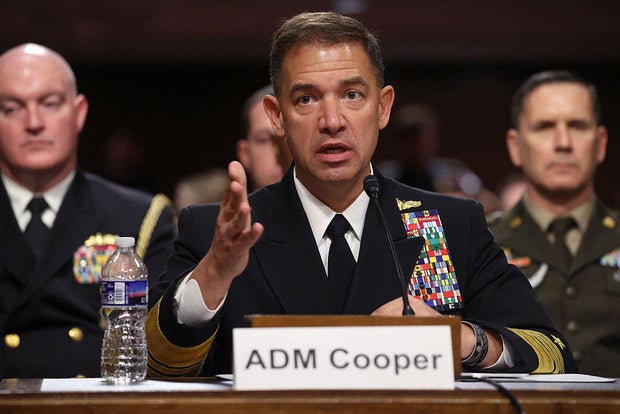
In a comprehensive briefing presented to the United States Senate Armed Services Committee, Admiral Brad Cooper, the current head of U.S. Central Command, outlined the significant impacts of Operation Epic Fury against Iran. The operation, a major U.S. military offensive, was intended to substantially degrade Iran’s military capabilities and prevent any regional hegemony or disruption, particularly in the strategically vital Strait of Hormuz. This strait plays a crucial role in global oil markets, and its security is paramount not only to U.S. interests but also to the global economy.
Admiral Cooper highlighted the success of the operation in meeting its primary objectives. A key achievement was the destruction of over 90% of Iran’s 8,000 naval mines, a significant accomplishment given the mines’ potential to block or significantly disrupt the passage through the Strait of Hormuz. Despite this, the Admiral acknowledged that Iran retains some capacity to threaten maritime traffic, though their ability to halt commerce has been “dramatically degraded.”
Further testifying before the committee, Admiral Cooper drew attention to the resilience and perceived threats from Iran. The Iranian government continues to claim control over the Strait and to project threats, which resonates loudly within the merchant marine and insurance industries, heightening tensions and concerns over security in these sectors.
In the broader scope of military capabilities, Admiral Cooper reported that more than 85% of Iran’s ballistic missile, drone, and naval manufacturing capacity was either damaged or destroyed. He estimates a generational timeline for Iran to rebuild its naval capabilities and several years to recover its drone and missile production facilities. This statement came following over 1,450 targeted strikes on critical weapon-manufacturing installations within Iran.
Despite these heavy setbacks to Iranian military infrastructure, recent assessments suggest that Iran has retained a considerable portion of its ballistic missile arsenal. The details on these assessments remain classified, and when pressed by congressional committee members, Admiral Cooper was reticent, citing the sensitivity of the information.
Admiral Cooper also referenced the uptick in Iran’s ballistic missile capabilities and intents during the latter part of 2025, which posed significant threats justifying the initiation of Operation Epic Fury. This ongoing conflict, despite a ceasefire officially taking effect on April 7, continues to see sporadic military engagements, including a U.S. naval blockade of Iranian ports and recent exchanges of fire.
A troubling aspect raised during the testimony was the mention of a strike that affected an Iranian girls’ school at the onset of the bombing campaign, resulting in approximately 150 fatalities. Although a preliminary U.S. assessment suggested the U.S. was likely responsible, there was no intentional targeting of the school. Investigations continue, with Admiral Cooper stressing the military’s commitment to avoiding civilian casualties and its ongoing efforts to refine operational tactics to prevent such occurrences.
The complexity of the conflict also involves international dimensions, with questions about the potential involvement of China and Russia in supporting Iran through intelligence sharing. These issues, mentioned during questioning by Democratic Senator Elissa Slotkin from Michigan, were suggested by Admiral Cooper to be discussed in a more secure, classified setting.
Financial implications of the ongoing military actions were also a point of contention. Democratic Senator Tim Kaine of Virginia emphasized the lack of transparency concerning the legal justifications for the military interventions, as highlighted by the Department of Justice’s refusal to disclose opinions that could justify the president’s authority to launch strikes against Iran. This has raised serious policy and ethical questions about the oversight and governance of such military decisions, especially as Congress negotiates funding for an expansive $1.5 trillion military budget.
In sum, while Operation Epic Fury has achieved tactical and strategic victories in terms of degrading Iranian military capabilities, the broader geopolitical, ethical, and legal implications continue to unfold. The ongoing negotiations and discussions in the U.S. Senate, coupled with the complexity of international involvement and the dire humanitarian impacts, paint a picture of a conflict that, while contained on the battlefield, continues to have wide-ranging effects on diplomatic and civilian fronts globally.