The Recent End of the Government Shutdown: Analysis and Reactions
The recent cessation of what was the longest government shutdown in U.S. history has triggered a complex array of responses among the American populace, reflecting deep-seated political divisions and varying perceptions of the outcome. While relief is a prevalent sentiment, many, particularly within the Democratic Party, express significant frustration regarding the nature of the compromise that led to reopening the government.
Partisan Responses to the Shutdown’s Resolution
In the aftermath of the shutdown, a notable dissonance in opinions has emerged between members of the two major political parties. Many Democrats believe their congressional representatives conceded too much in the negotiations that ultimately ended the shutdown. This sentiment is reflected in a recent CBS News/YouGov survey, which indicates that a majority of Democratic respondents perceive their party as having compromised excessively. Conversely, a similar majority of Republicans believe that their party’s negotiation strategy was appropriate, striking the right balance in the compromise.
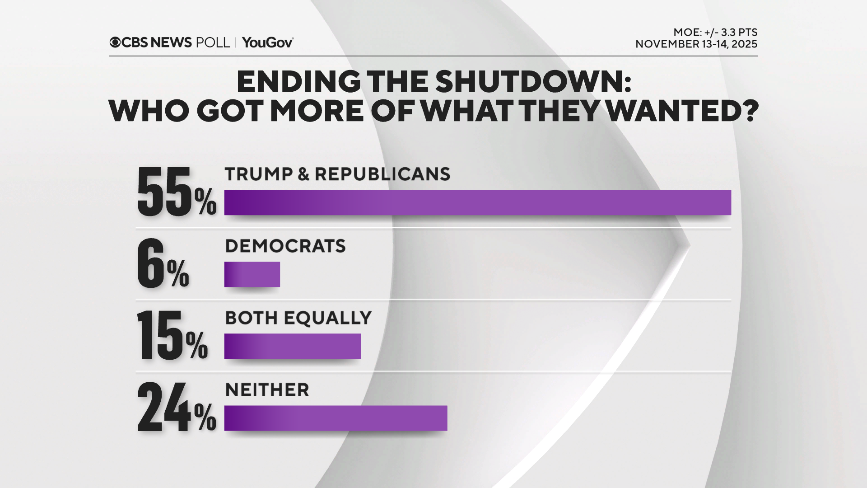
The perception of who gained more from the negotiations also aligns closely with party lines. A significant portion of the American public, including many Democrats, feel that President Trump and the Republican Party emerged as the winners, having secured more of their demands in the negotiations compared to their Democratic counterparts. This perspective was further underscored by visual data published, showing that among the wider public more individuals felt Congressional Republicans had insisted on their positions rather than compromising adequately when compared with Congressional Democrats.
Public and Cross-Party Reactions
The broader sentiment among U.S. citizens shows a pervasive sense of disapproval of how all parties handled the shutdown. Disapproval ratings are particularly high for Congressional Democrats, an increase that might be due to changing perceptions following the end of the shutdown—possibly influenced by the compromise outcomes. Interestingly, this disapproval includes a larger proportion of independents and even some Democrats, who may have previously been more supportive.
In terms of the emotional reaction to the deal, many Democrats express feelings of frustration, dissatisfaction, and pessimism—emotions that overshadow even relief, despite the end of the shutdown. On the other hand, Republicans are more likely to express relief and satisfaction with the resolution.
The Substantive Issues at Heart
Throughout the duration of the shutdown, essential issues such as healthcare became focal points of debate. The recent survey suggests that a clear majority believe health insurance premiums will increase in the near future, a concern that was likely exacerbated by the shutdown. Furthermore, with the resumption of regular operations, improvements in sectors like air travel are anticipated as government employees, including air traffic controllers, return to work and stabilize the industry.
Looking Forward
As the dust settles, the implications of the shutdown are becoming clearer. Most Democrats believe that their party’s core positions justified the duration and impact of the shutdown, which likely contributes to their subsequent frustration with the perceived excessive compromises. This perspective might influence future strategic decisions within the party, particularly as they reflect on public sentiment and prepare for future negotiations.
Moreover, while the shutdown has ended, its effects on public opinion are evident. The mosaic of sentiments captured by the CBS News/YouGov survey reflects a politically divided nation still grappling with the outcomes of contentious negotiations and their broader implications for governance.
Survey Methodology
This analysis is based on a CBS News/YouGov survey conducted nationally. The survey recontacted 1,288 U.S. adults on November 13-14, 2024, following the end of the government shutdown. These participants were initially surveyed during the shutdown from October 29-31, 2024, among a sample of 2,124 U.S. adults. The recontact survey has a margin of error of ±3.3 points, providing insights into the shifts in public opinion pre- and post-shutdown.
As the political landscape continues to evolve, the responses to this significant event reveal the underlying complexities in U.S. politics, where even relief is intertwined with contentious debate and dissatisfaction. These events likely presage future political dynamics, particularly as parties analyze and recalibrate based on public sentiment and the success or failure of their negotiation strategies.