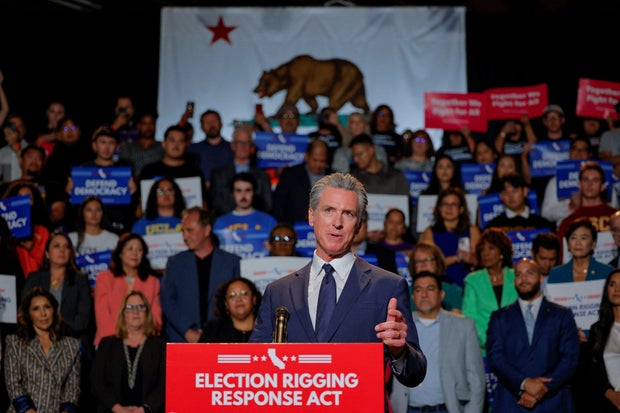
In the heart of America’s political landscape, a fierce battle is shaping up, particularly concerning the redistricting of congressional lines, a crucial factor that could influence the power dynamics in upcoming midterm elections and shape the latter half of President Donald Trump’s second term. The California Democrats, under Governor Gavin Newsom’s leadership, are mounting a vigorous response to a strategic maneuver by Texas Republicans aimed at redrawing congressional district boundaries to secure a political upper hand.
The unfolding drama began earlier this summer when Texas Republicans, emboldened by presidential support, set forth plans to redraw five Democratic-held congressional seats into configurations more favorable to the GOP. This move by Texas is not just a simple redistricting but a calculated political gambit to ensure sustained Republican dominance in key districts, potentially swaying the overall balance of power in the U.S. Congress.
Governor Newsom, a Democratic heavyweight and a potential contender for the presidency in 2028, was swift in his response. In a bold declaration from Los Angeles, Newsom announced California’s intent to convene a special election that would enable the redrawing of the state’s congressional maps. This step is seen as a countermeasure to neutralize the effects of the Texas GOP’s redistricting plans. Newsom’s decisive action underscores a broader Democratic strategy to safeguard fair representation and resist perceived Republican attempts to manipulate electoral boundaries for partisan gain.
Speaking amidst a group of California officials and Democratic leaders, Newsom criticized what he viewed as an overt attempt by Republicans, under Trump’s directive, to manipulate the democratic processes to their advantage. “California won’t stand by and watch Trump burn it all down — we are calling a special election to redraw our Congressional maps and defend fair representation,” Newsom articulated, emphasizing the need to counteract with equivalent force. He also referred to a controversial call wherein President Trump reportedly urged Texas officials to “find me five seats,” spotlighting the direct involvement of the White House in state-level redistricting efforts.
The political landscape in California is, however, significantly different from Texas’, presenting a set of challenges unique to the state. California has long championed fair and independent redistricting processes, a commitment enshrined in the state’s constitution through the establishment of an independent citizens redistricting commission. This body traditionally redraws district boundaries following the decennial census, ensuring that the process is free from political interference.
Despite this, Governor Newsom and his Democratic allies are contemplating bold steps to ensure Democrats do not lose ground. U.S. Democratic Representative Zoe Lofgren of California confirmed ongoing discussions among the state’s Democratic congressional delegation and legislative leaders exploring the feasibility of gaining five Democratic seats to offset potential losses in Texas.
The context of this battle is heightened by the current composition of the U.S. Congress, where Republicans control both chambers. The stakes are high: flipping just a few seats in the House in the upcoming midterms could alter the control dynamics. Hence, Democrats view any loss of seats due to Republican-led redistricting as a direct threat to their chances of regaining a majority.
The unfolding situation has also stoked broader national debates about the fairness and integrity of the redistricting process, often criticized as being susceptible to gerrymandering — where district lines are drawn to influence election outcomes favorably for the party in power. Breakaway Texas state House Democrats have spotlighted this issue by fleeing Texas to deny the necessary quorum for passing the new maps, an act that has echoed nationally. Meanwhile, Democrats face accusations of hypocrisy, given similar maneuvers in historically Democratic states like Illinois, further illustrating the complex, often contentious nature of redistricting in American politics.
As Governor Newsom prepares to potentially reshape California’s political map through a transparent and public process that will require voter approval, California sets the stage for what could be a protracted and pivotal struggle, influencing not just the next midterm elections but the broader trajectory of American democratic practices. The outcome in California could serve as a bellwether for the nation, testing the strength of democratic mechanisms against the tidal forces of partisan ambitions and a deeply divided national political environment.
As this high-stakes political drama unfolds, the nation watches closely, aware that the outcome could recalibrate the power dynamics not just in California and Texas, but across the entire United States. The battle over redistricting, often technical and esoteric, has thus assumed a central role in the fight for the soul of American democracy, highlighting the enduring tension between partisan objectives and the principles of fair representation and electoral integrity.