Democrats’ midterm edge: what the latest CBS News poll tells us
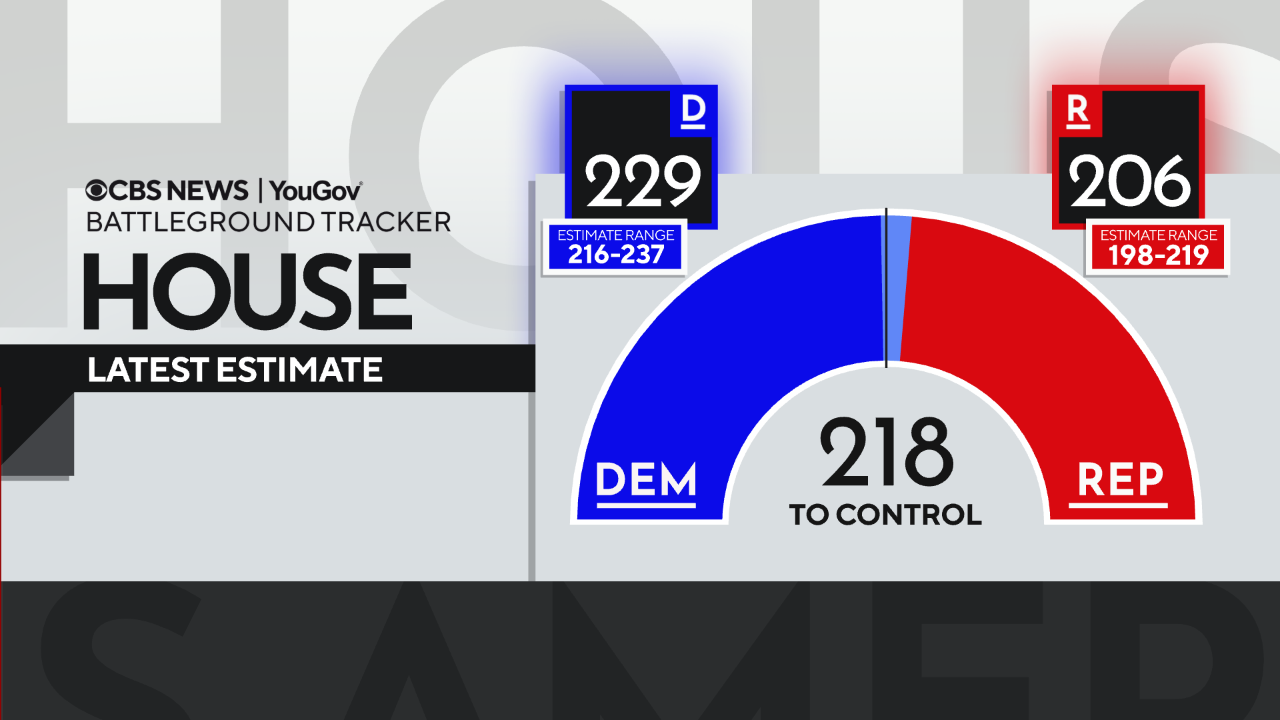
With the 2026 midterm elections approaching, the latest CBS News/YouGov survey and House seat estimates offer a detailed snapshot of an electorate that is uneasy about prices, skeptical of the administration’s priorities, and showing signs of a Republican enthusiasm problem. The CBS News House model currently shows Democrats with a narrow majority of seats and an edge in the national congressional vote preference. That advantage, however, is not being driven by a surge of excitement for Democratic candidates. It is largely a product of opposition to Trump administration policies and a Republican base that, at least for now, appears less motivated to turn out.
Here are ten things voters are telling us, in no particular order.
1. House seats matter more than the popular vote.
National polls can be misleading. Control of Congress is decided district by district, and the CBS News model translates polling data, past vote patterns, demographics, and historical trends into a range of likely seat outcomes. Right now, Democrats are ahead in enough districts to hold a narrow majority, but the margin is small enough that a modest shift in turnout or voter preference could flip the outcome. The popular vote suggests a Democratic edge, but the real story is in the map, not just the topline number.
2. For most voters, the economy is about prices.
When Americans are asked how they judge the economy, they rarely lead with GDP, stock prices, or mortgage rates. They talk about what they pay at the grocery store and the pump. Since the pandemic, that has been the dominant lens, and it remains central today. Most voters say President Trump’s policies are making food and grocery prices go up. Most also believe the war with Iran is pushing gas prices higher. And most say the administration has not focused enough on lowering costs. These price concerns are directly shaping voting behavior, with Democrats drawing support from voters who say prices have been difficult or even a hardship.
3. Price frustration may be suppressing Republican turnout.
One of the more striking findings is that Republicans are less likely than Democrats to say they are certain to vote. The dissatisfaction with prices appears to be part of the reason. Republicans give Mr. Trump much lower ratings on inflation than they do on immigration or on his overall job performance. Those who say the administration is not paying enough attention to prices are less likely to vote. The same is true for Republicans who feel their party’s candidates are not talking enough about the cost of living. There is a group of reluctant Republicans — some staying home, some switching their support — whose frustration could be decisive in close races. And among Republicans who think Mr. Trump’s second term is going worse than his first, the likelihood of voting drops by nearly twenty points.
4. Voters blame the current administration for today’s economy.
There is no lingering sense that the economy is Joe Biden’s fault. By a wide margin, voters say Trump administration policies are responsible for the current state of the economy. That perception matters because it makes this election, at least in part, a referendum on the administration’s handling of costs. It also means Republicans are defending an economic record that most voters see as moving in the wrong direction.
5. Hispanic voters could determine the size of the majority.
Hispanic voters shifted toward Mr. Trump in 2024, but the latest polling shows that movement has stalled or reversed. The percentage of Hispanic likely voters backing Republican candidates is lower than the share Mr. Trump won among Hispanic voters two years ago. Because many congressional districts were redrawn in the last year, this could matter in dozens of districts across the country. For Hispanic voters, economy and inflation are the most important issues, just as they are for voters overall. But immigration and deportation policies also stand out. Most Hispanic voters say the administration is deporting more people than they expected. Compared with voters overall, more Hispanic voters say Mr. Trump is too focused on deportation. And they perceive unfairness in ICE enforcement: they believe Hispanic people are subjected to more searches and deportation efforts than people of other backgrounds.
6. On some issues, Republican candidates are helped by breaking with Trump.
More voters say they are using their vote to oppose the president than to support him. That creates space for Republican candidates to position themselves as independent voices. Most Republican voters say they want a candidate who mostly agrees with Mr. Trump but not always. This is especially clear on tariffs: candidates who oppose new tariffs are finding more support. However, there is one issue on which Republicans hold the advantage. More voters prefer a candidate who says transgender athletes should only be allowed to play on teams that match their sex at birth, and those voters are mostly supporting Republicans. That issue gives the GOP an opportunity to rally voters even in a difficult environment.
7. Democratic candidates also have room to carve their own path.
Voters say Democratic candidates are talking more about the cost of living than Republican candidates are, though neither party is talking about it a lot. Rank-and-file Democrats do not want candidates who always agree with the national party. With both parties viewed negatively, candidates who show at least some independence may be better positioned to win over swing voters. Endorsements from self-identified Democratic Socialists are met with mixed views among Democrats and do little to help beyond that. The lesson for both parties is similar: a little distance from the national brand can go a long way.
8. A crucial question: will Democratic-leaning voters show up?
Democrats may need strong turnout from younger voters to capitalize on their current edge. But older voters remain far more likely to say they will definitely vote, and public records show that they actually do turn out at higher rates. The turnout gap between Republicans and Democrats is currently a warning sign for the GOP, but it also raises a question for Democrats. If their edge is built on younger voters, minority voters, and those most hurt by high prices, they have to hope those groups make it to the polls. The potential is there, but the certainty is not.
9. Iran is an issue, mainly through gas prices.
A number of Republican candidates have begun calling for an end to the Iran war, which aligns with what most voters want from candidates, including a third of Republicans. Most voters think the war would be more likely to end if Democrats win control of Congress. While the conflict with Iran is not as important to voters as the economy, the two are connected. Most voters say the war has contributed to higher gas prices, and those voters are backing Democrats for the House. In that sense, foreign policy is filtering through the same lens as everything else: how much it costs at the pump.
10. AI and data centers have become campaign issues.
The debate over artificial intelligence in 2026 is not just about technology; it is about jobs and the economy. Voters across age groups and, to varying degrees, across party lines say AI will create more problems than it solves. They also think AI will take jobs rather than create them. As a result, more voters prefer candidates who want the U.S. to restrict the use and development of AI. Those voters are voting heavily for Democratic candidates. There is a similar pattern on data centers, with Democratic candidates benefiting from voter opposition to their expansion. These issues may not have been part of past elections, but they are becoming part of the economic landscape voters are reacting to.
Taken together, these findings suggest that the 2026 election will be shaped less by grand ideological arguments than by the practical question of whether voters believe their lives are getting better. The Democratic edge in the House model is real, but it is fragile. It depends on current preferences holding, on turnout among younger and minority voters, and on whether Republicans who are unhappy about prices can be persuaded to return to the fold before November. The Republican base remains loyal to Mr. Trump on many fronts, but the lack of enthusiasm around the economy has created an opening for Democrats that could be enough to tip the House.
The CBS News/YouGov survey was conducted with a nationally representative sample of 2,166 U.S. adults from September 30 to October 2, 2026, and weighted to match the adult population by gender, age, race, education, and 2024 presidential vote. The margin of error for the total sample is plus or minus 2.5 points. The House seat estimates come from a statistical model developed by CBS News and YouGov, combining this poll with district-level characteristics, demographics, and historical patterns. The model simulates many election outcomes and reports a 95 percent confidence interval. These estimates describe which party is ahead today and could change as additional data is collected in the final weeks before the election.