Tillis says Trump’s Xi state dinner is a ‘WTF moment’ as he warns about ‘despots’ over democratic allies
Washington — Republican Sen. Thom Tillis questioned President Trump’s judgment in hosting Chinese President Xi Jinping for a state dinner at the White House this week, saying he’s “worried about the trend of spending more time with despots and less time with democratic leaders of nations.”
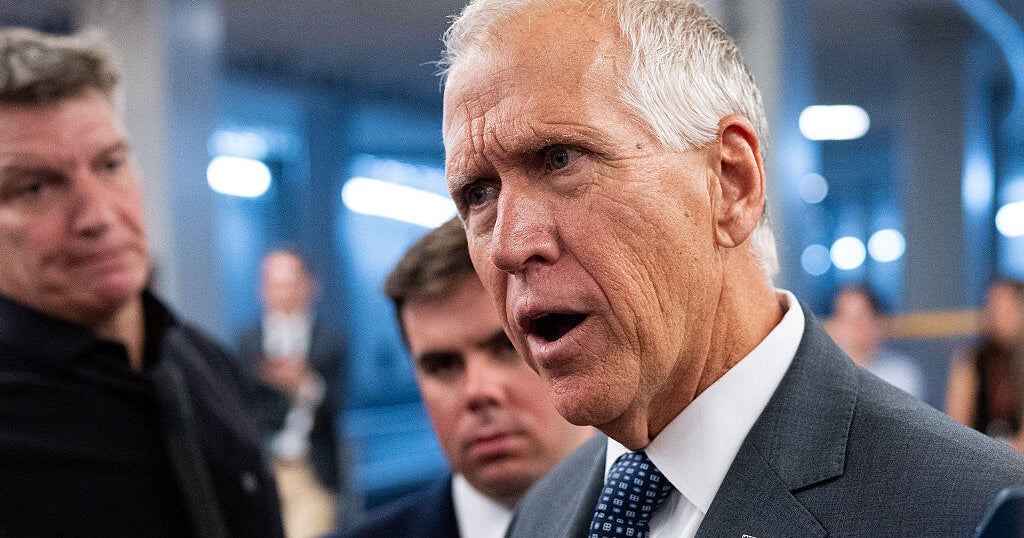
The retiring North Carolina senator made the comments in an interview with “CBS Evening News” anchor Tony Dokoupil on Thursday. Asked about the red-carpet treatment Mr. Trump has given Xi compared with the reception that some U.S. allies, including Ukrainian President Volodymyr Zelenskyy, have received, Tillis did not soften his language. “It’s a WTF moment,” he said.
Tillis said he did not see Xi’s visit as a sign that Beijing is ready to embrace Western values. “It’s not that Xi Jinping is coming here to learn how to become a democratic, capitalist nation. Xi Jinping is trying to understand how his opposition will ultimately embrace their worldview,” he said.
The senator called the visit “bad timing” and listed several issues that he said should worry any American president: China’s human rights abuses against the Uyghurs, its espionage capabilities, reported access to U.S. voter data, and intelligence reports that Iran has used information from China to target U.S. military assets in the region. Tillis also questioned why the administration has held up an arms shipment to Taiwan, a long-standing and sensitive element of U.S.-China policy.
“If we want to build a relationship, a productive relationship with Xi Jinping and China, we also have to hold him accountable for things that are just simply unacceptable,” Tillis said.
The state visit has been a vivid display of diplomatic pageantry. It came less than two years after Mr. Trump returned to office and quickly resumed his confrontational approach to Beijing. Last year he imposed heavy tariffs on Chinese goods, setting off a trade war that at one point pushed duties on both sides above 100 percent. Businesses around the world braced for a sweeping decoupling of the two largest economies. A tariff truce later in 2025 eased tensions, and Mr. Trump has since emphasized his desire for a more productive relationship with China. During the White House arrival ceremony Thursday, he said he and Xi had formed a “truly great friendship.”
The contrast was not lost on Tillis. The senator pointed out that Mr. Trump campaigned on a promise to go hard on China. “The reality is, he was tough on China,” Tillis said. But he said he could not identify what had prompted the new posture. “I just don’t know what has changed. Whatever has changed had to have been at a confidential level, because I haven’t seen any public basis for the sea change that we see right now in our posture towards China.”
Tillis’s comments are all the more notable because he is a Republican, and public criticism of the president’s outreach to foreign leaders has been rare among members of his party. The North Carolina senator is retiring, which has freed him to speak with less concern about political consequences. His use of the word “despots” was a direct challenge to the administration’s framing of the visit as a diplomatic success.
The senator’s critique went beyond a single awkward photo opportunity. He was raising a substantive question about American foreign policy: Is the United States still anchored in the idea that alliances with democracies are its greatest strategic asset? Or is it now willing to treat authoritarian leaders as equals, or even friends, in the hope of securing short-term economic or security gains? Tillis’s answer was clear — he believes the trend is dangerous.
He was also asking a more specific political question: Does President Trump have a secret plan? The idea that there might be confidential information explaining the administration’s turnaround carries significant implications. If there is a deal in the works — on tariffs, technology, Taiwan, or any other major issue — Congress would eventually have to weigh in. If there is no deal, Tillis suggested, the American people are being asked to accept a change in policy without a coherent explanation.
The state dinner itself is one of the most important symbols in U.S. diplomatic protocol. Traditionally, such events are reserved for nations with which the United States shares deep ties and common values. Hosting Xi at a state dinner sends a message to the world about who Washington considers a partner. Tillis argued that message is the wrong one at a time when democratic nations are watching nervously and authoritarian governments are feeling emboldened.
He also sought to distinguish between diplomacy and deference. No one is suggesting that the United States should refuse to meet with China. Nearly every administration has sought a working relationship with Beijing, and many presidents have hosted Chinese leaders at the White House. But Tillis’s point was about the framing of the relationship. A state dinner is not a business meeting. It is a public celebration of a friendship. For a president who promised to confront China on trade, technology, and human rights, the symbolism of that celebration matters.
China, for its part, has sought to project stability and greatness during Xi’s visit. But human rights groups and foreign policy experts have been quick to remind Washington of the darker side of Beijing’s role on the world stage. Tillis echoed those reminders, and his decision to mention the Uyghurs and the reported intelligence sharing with Iran underscored how much distance remains between Chinese and American interests. The administration, however, seemed determined to focus on the potential for cooperation rather than the list of grievances.
Tillis’s reference to the Ukraine comparison is also significant. Zelenskyy has become a hero to many in Washington, but his relationship with Trump has been complicated. The image of Xi being feted with a state dinner while Zelenskyy has had to fight for attention and support has not gone unnoticed in Europe and elsewhere. Tillis’s “WTF moment” remark was an acknowledgment that many U.S. allies are watching those images with alarm.
In the end, the retiring senator’s message was both blunt and simple: Be careful. Engage China, but do not embrace its worldview. Meet with Xi, but do not confuse the relationship with friendship. And if there is a secret reason for the shift in American posture, make the case publicly. Otherwise, Tillis warned, the American people are left to watch a sea change in U.S. policy without being able to trust where it is heading.