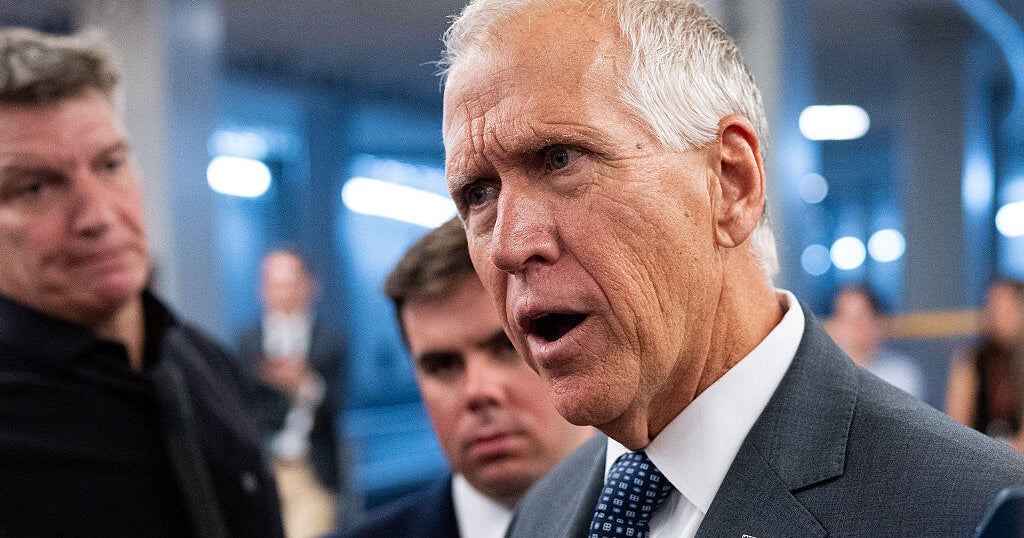
Tillis calls Trump’s Xi state dinner a ‘WTF moment’ and questions White House’s embrace of Beijing
Washington — Retiring Republican Sen. Thom Tillis of North Carolina leveled an unusually blunt critique at President Trump on Thursday, saying the decision to host Chinese President Xi Jinping for a formal White House state dinner this week was a “WTF moment” and evidence of an alarming shift in American foreign policy.
In an interview with CBS Evening News anchor Tony Dokoupil, Tillis said he was “worried about the trend of spending more time with despots and less time with democratic leaders of nations.” The senator contrasted the red-carpet treatment afforded to Xi — complete with a grand arrival ceremony and an evening dinner at the White House — with the reception that U.S. allies such as Ukrainian President Volodymyr Zelenskyy have received in recent months.
“It’s a WTF moment,” Tillis said, voicing frustration that Trump appeared to be showering one of America’s chief strategic rivals with honors while traditional allies were often kept at arm’s length.
Tillis said Xi’s visit should not be seen as an opportunity for constructive dialogue between Washington and Beijing. Instead, he argued, the Chinese leader is pursuing his own strategic objectives. “It’s not that Xi Jinping is coming here to learn how to become a democratic, capitalist nation. Xi Jinping is trying to understand how his opposition will ultimately embrace their worldview,” Tillis said.
The North Carolina Republican called the visit “bad timing,” citing a long list of grievances with Beijing. He pointed to China’s human rights abuses against the Uyghur minority, which have been documented extensively by international organizations and human rights groups. He also mentioned China’s espionage capabilities, alleged access to U.S. voter data, and reports that Iran has used information provided by China to target U.S. military assets in the region.
Tillis also questioned why the administration has held up an arms shipment to Taiwan, a crucial issue for lawmakers who have long pressed the United States to help Taiwan defend itself against Chinese pressure. For Tillis, the decision to delay arms transfers to Taipei while hosting Xi with full state honors sends a troubling signal.
“If we want to build a relationship, a productive relationship with Xi Jinping and China, we also have to hold him accountable for things that are just simply unacceptable,” Tillis said.
The senator’s comments reflect a broader unease among some Republicans who have watched Trump shift from a combative posture on China to a more accommodating tone. Trump’s trade policy toward Beijing has swung widely in recent years. Shortly after returning to office last year, Trump imposed heavy tariffs on Chinese goods, triggering a trade war that briefly caused both countries to hike duties on each other’s products to more than 100 percent.
That confrontation later gave way to a tariff truce, agreed to in 2025. Since then, Trump has repeatedly emphasized his desire for a more productive relationship with China. At the White House arrival ceremony on Thursday, Trump went further, saying he and Xi had forged a “truly great friendship.”
For Tillis, that kind of language marked a striking departure from the Trump who campaigned on being tough on China. The senator said he had not seen any public explanation for the dramatic change.
“The reality is, he was tough on China,” Tillis said. “I just don’t know what has changed. Whatever has changed had to have been at a confidential level, because I haven’t seen any public basis for the sea change that we see right now in our posture towards China.”
His comments highlight the delicate politics of Trump’s relationship with Xi. For years, Trump has argued that his personal rapport with foreign leaders gives the United States an advantage in negotiations. He has often boasted about his relationship with Xi, even as he has also sought to portray himself as the leader who can stand up to Beijing.
But critics, including Tillis, worry that the administration is crossing a line. The decision to roll out a state dinner for Xi — one of the most visible symbols of diplomatic respect — is especially hard to square with the treatment of American allies who have been subjected to tense Oval Office exchanges and public disagreements.
Tillis pointed directly to Ukraine. Zelenskyy, whose country has been fighting off Russian aggression, has at times received a cool reception from Trump and his allies. Some conservative critics have accused the Ukrainian leader of not being grateful enough for U.S. support. Trump has also questioned the scale of American aid to Kyiv.
For Tillis, the contrast was impossible to ignore. Hosting Xi with full ceremony while Zelenskyy faces public criticism sends the wrong message to the world, he suggested. It rewards a government that has engaged in widespread repression and aggressive actions against its neighbors while sidelining a beleaguered ally that has depended on U.S. assistance.
The state visit also carries implications beyond symbolism. Xi’s trip to Washington gives Beijing an enormous diplomatic victory, particularly at a time when the United States and China are still locked in disputes over trade, technology, intellectual property, and regional security.
Tillis’s remarks are notable because he is a retiring senator. With no reelection campaign ahead of him, he may feel freer to speak candidly about Trump’s foreign policy than many of his Republican colleagues. Still, his comments may resonate with a broader group of lawmakers who have watched the administration’s China policy evolve with growing concern.
There are also unresolved questions about Taiwan. The United States has long maintained an unofficial relationship with Taiwan, providing arms and support to help the island maintain its self-defense capabilities. Congress has repeatedly passed measures backing Taiwan, and American presidents of both parties have approved arms sales over the years.
If the Trump administration is now holding up those shipments as a favor to Beijing, Tillis said, that would undercut decades of consistent U.S. policy. He did not say definitively why the shipments were delayed, but he made clear that he believed the administration should not sacrifice Taiwan’s security in the name of strengthening ties with China.
The senator’s concerns extend to other areas as well. He noted China’s cyber operations and its efforts to influence political processes abroad. The alleged access to U.S. voter data has been a particular flashpoint, and Tillis said it was deeply troubling that the administration would host Xi without first demanding answers on that front.
He also pointed to reports that Iran has used Chinese-supplied information to target American military assets in the Middle East. If those reports are accurate, Tillis argued, it is impossible to call China a responsible global actor.
Tillis did not call for canceling the visit outright, but he said the administration should use the opportunity to press Beijing hard on its most destabilizing behaviors. Hosting Xi with a celebratory dinner, he worried, does the opposite. It signals that the United States is willing to overlook serious abuses and security threats in exchange for trade stability and favorable diplomatic optics.
“It’s not that Xi Jinping is coming here to learn how to become a democratic, capitalist nation,” Tillis said again. “Xi Jinping is trying to understand how his opposition will ultimately embrace their worldview.”
The senator’s blunt language reflected the frustration that many China hawks have felt as they watched Trump pivot toward a more accommodating stance. The president has defended his approach, insisting that friendship with Xi can produce tangible benefits for the American people. But for Tillis, the cost of that friendship is too high.
With Xi now back in the headlines and a state dinner in the history books, the question is whether Trump’s approach will lead to real progress or simply give Beijing a pass on its worst behavior. Tillis made clear which outcome he fears.
“If we want to build a relationship, a productive relationship with Xi Jinping and China, we also have to hold him accountable for things that are just simply unacceptable,” Tillis said.
His remarks are a reminder that Trump’s greatest political strength — his willingness to defy conventional expectations — can also be a source of vulnerability. The same president who once promised to be China’s toughest adversary is now welcoming the Chinese leader to Washington with all the pomp of a head-of-state visit.
Tillis’s critique may not change the course of the administration’s policy. But it gives voice to a concern that many foreign policy experts have raised: that the United States, by feting Xi, is sending a signal about its values and priorities. For Tillis, that signal is deeply troubling.
“It’s a WTF moment,” he said.
And for a senator who has spent years focused on national security issues, it is exactly the kind of moment that requires speaking out — even if it means criticizing a president from his own party.