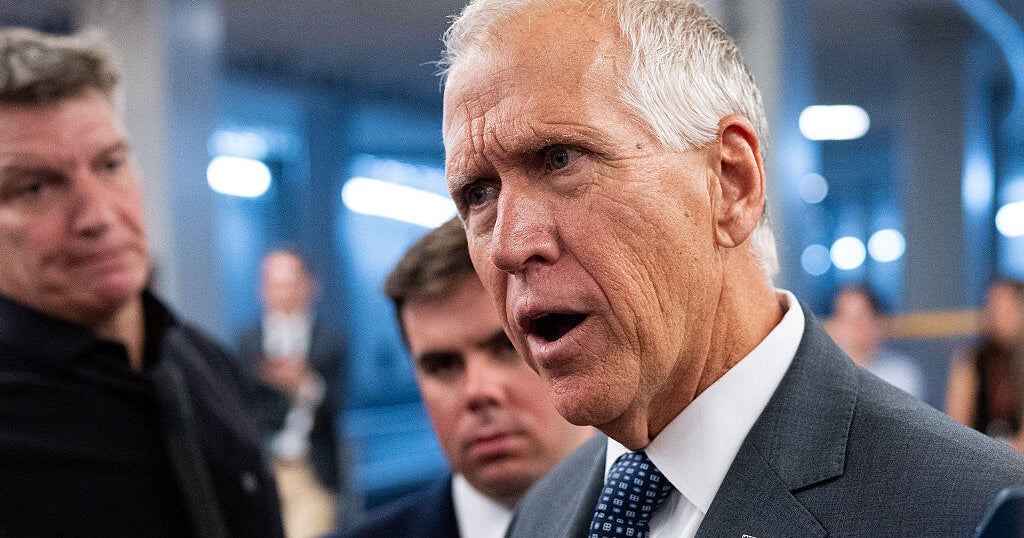
GOP Sen. Tillis Calls Trump’s Xi State Dinner a ‘WTF Moment’ and Warns About ‘Despots’ Over Democratic Allies
Washington — Republican Sen. Thom Tillis of North Carolina took the rare step of publicly rebuking President Trump on Thursday, expressing disbelief at the administration’s decision to host Chinese President Xi Jinping for a state dinner at the White House. “It’s a WTF moment,” Tillis said in an interview with CBS News’ Tony Dokoupil.
Tillis, who is retiring from the Senate and serves on the Senate Armed Services Committee, said he is “worried about the trend of spending more time with despots and less time with democratic leaders of nations.” His comments came as Trump rolled out the red carpet for Xi at the White House, complete with a formal arrival ceremony and the kind of pageantry normally reserved for America’s closest allies. The two leaders were to attend a state dinner later Thursday, capping a visit that the White House has sought to portray as a major diplomatic success.
The North Carolina Republican said the contrast between Xi’s lavish reception and the treatment of some U.S. allies was impossible to ignore. He specifically invoked Ukrainian President Volodymyr Zelenskyy, whose most recent White House visit ended abruptly after a tense exchange with Trump and Vice President JD Vance. “It’s not that Xi Jinping is coming here to learn how to become a democratic, capitalist nation,” Tillis said. “Xi Jinping is trying to understand how his opposition will ultimately embrace their worldview.”
Tillis called the visit “bad timing” and pointed to a long list of concerns about Beijing’s behavior. He cited China’s human rights abuses against the Uyghur population in Xinjiang, its sophisticated espionage operations, alleged access to U.S. voter data, and recent reports that Iran has used information from China to target U.S. military assets in the Middle East. He also questioned why the administration has held up an arms shipment to Taiwan, a democratic island that the United States is legally committed to helping defend under the Taiwan Relations Act. For Tillis, the state dinner sent the wrong message in the middle of so many unresolved disputes.
“If we want to build a relationship, a productive relationship with Xi Jinping and China, we also have to hold him accountable for things that are just simply unacceptable,” Tillis said.
The state visit is the first White House state dinner for a Chinese leader in years, and it marks a significant shift in Trump’s approach to Beijing. When Trump returned to office last year, he made good on campaign promises to confront China economically. He imposed heavy tariffs on Chinese goods, Beijing retaliated, and the two countries quickly found themselves locked in a trade war. At one point, both sides were hiking duties on each other’s products to more than 100%, disrupting global supply chains, hammering American farmers, and rattling financial markets. Trump, who has long described himself as a tariff man, insisted the pressure campaign was working.
But by late 2025, the trade war had cooled into a fragile tariff truce. Since then, Trump has emphasized a more cooperative relationship with China. He has praised Xi as a friend and spoken warmly about their ability to work together. At Thursday’s arrival ceremony, Trump said he and Xi had forged a “truly great friendship,” a remark that delighted Chinese state media and alarmed critics who worry the president is too eager to embrace an authoritarian rival.
Tillis said he was not convinced. He reminded reporters and viewers that Trump had campaigned on being tough on China, and he questioned whether there was a “confidential” reason for the sudden switch. “The reality is, he was tough on China,” Tillis said. “I just don’t know what has changed. Whatever has changed had to have been at a confidential level, because I haven’t seen any public basis for the sea change that we see right now in our posture towards China.”
The senator’s remarks highlight a growing fissure in the Republican Party over how to deal with Beijing. Some Republicans, particularly those aligned with the business wing of the party, believe that maintaining a dialogue with Xi serves U.S. interests and reduces the risk of conflict. They point to the tariff truce and the resumption of certain bilateral talks as evidence that Trump’s strategy is working. But other Republicans, especially those focused on national security and human rights, are increasingly uncomfortable with what they see as unilateral concessions to China. The Xi state dinner has become a flashpoint for those concerns.
Tillis, who has been a reliable supporter of most of Trump’s defense and trade agenda, made clear that his criticism was not about partisan politics. He said the United States must find ways to cooperate with China on shared challenges, but not at the expense of U.S. principles and not in ways that reward Chinese aggression. He said the administration has not adequately explained why Xi is being given the full-state-visit treatment while allies such as Ukraine are treated with suspicion and hostility.
“I’m worried about the trend of spending more time with despots and less time with democratic leaders of nations,” Tillis repeated during the interview. He said Xi’s visit would not change China’s behavior in Xinjiang, the South China Sea, or on the global stage. If anything, Tillis argued, the red-carpet reception gives Xi a propaganda victory and signals to other authoritarian leaders that they can violate international norms without paying a price.
The state dinner itself is one of the most coveted invitations in Washington, and it carries deep symbolic weight. State visits are typically reserved for leaders of countries with which the United States shares strong diplomatic, economic, and security ties. Hosting Xi represents a significant gesture of goodwill, and it stands in striking contrast to the chilly treatment Zelenskyy received during his last Oval Office visit. In February, Zelenskyy had come to Washington to discuss a proposed minerals deal and continued U.S. support for Ukraine’s defense against Russia’s invasion. The meeting instead descended into a shouting match in front of cameras, and Zelenskyy left the White House without signing anything. Trump later accused the Ukrainian leader of disrespecting the United States and of “gambling with World War III.”
For Tillis, the image of Trump laughing and dining with Xi while Ukraine’s democratically elected leader is publicly berated sends a dangerous signal to the world. “It’s a WTF moment,” he said. He added that Xi is not coming to Washington to be converted to democratic capitalism; he is coming to study the United States and to learn how to advance China’s interests in a divided world. Tillis said he hopes Trump and his national security team understand that.
The senator also raised concerns about Taiwan, a longtime friction point in U.S.-China relations. Beijing claims Taiwan as part of its territory and has repeatedly said it will not rule out the use of force to bring the island under its control. The United States, while officially maintaining an ambiguity about whether it would defend Taiwan, has continued to sell arms to the island for decades. Tillis said the administration’s decision to hold up a weapons shipment is dangerous, particularly at a moment when China has been increasing military pressure around Taiwan. He said if the United States is not careful, its pursuit of a friendship with Xi will come at the expense of an important democratic partner.
The White House has not publicly explained the delay in the Taiwan arms shipment, and Tillis said he has not received a classified briefing that would justify it. “I haven’t seen any public basis for the sea change,” he said. He left open the possibility that the administration has access to confidential information that would explain the shift in posture, but he said Congress deserves to be briefed on any such strategy. Without that briefing, he said, the American people are left to judge the relationship between the United States and China based on overly friendly photo opportunities and warm words at a state dinner.
The Xi visit comes at a moment when U.S.-China relations are defined by intense competition over technology, trade, military power, and global influence. The two countries have been fighting a quiet but serious battle over semiconductors, artificial intelligence, and critical minerals. Washington has imposed export controls to slow China’s technological advances, while Beijing has responded by restricting exports of rare earth minerals and other materials essential to U.S. manufacturing. The State Department and the Pentagon have both identified China as the United States’ most significant strategic challenge. Yet Trump continues to speak of Xi as a friend and has repeatedly declined to criticize him in personal terms.
Tillis said he is not opposed to talking with China. In fact, he said, the United States and China have to talk to avoid miscalculation and to manage their disagreements. But he argued that the public optics of a state dinner, especially amid concerns about Chinese espionage, human rights abuses, and the treatment of U.S. allies, undermine the seriousness of the relationship. He said the United States must be willing to engage with Beijing with open eyes, not with the kind of celebratory atmosphere that suggests the two countries are on the same side.
“It’s not that Xi Jinping is coming here to learn how to become a democratic, capitalist nation,” Tillis said. “Xi Jinping is trying to understand how his opposition will ultimately embrace their worldview.” That, more than anything else, is why Tillis believes the state dinner is a mistake. He said Xi will leave Washington with a better understanding of how to exploit American political divisions, and with a prestigious diplomatic victory that will be broadcast around the world.
For now, the state dinner is happening, and Trump appears delighted to play host. He has long been fascinated by larger-than-life leaders and has often said that personal relationships are the key to international diplomacy. He has pointed to his friendship with Xi as evidence that the two countries can avoid conflict and find common ground. He has also said that Xi has been unfairly criticized by the American media and that China has made great economic progress under his leadership.
Tillis’s blunt remarks, however, suggest that not everyone in the Republican conference shares that view. His use of the phrase “WTF moment” was a striking departure from the carefully worded language most lawmakers use when discussing a sitting president’s foreign policy. It reflected a growing unease among national security hawks who worry that Trump is giving away too much to China for too little in return. They fear the state dinner will be seen not as a demonstration of U.S. strength, but as a reward for Chinese aggression.
In the end, Tillis said, the United States does not have to choose between engagement and accountability. It can talk to China while also confronting China. It can host Xi while also arming Taiwan and defending Ukraine. The problem, Tillis said, is that the current administration seems to be doing only the first part. He said he hopes the president will prove him wrong, but until then, he will continue to speak out.
“If we want to build a relationship, a productive relationship with Xi Jinping and China, we also have to hold him accountable for things that are just simply unacceptable,” he said. Until that happens, Tillis suggested, the state dinner will remain exactly what he called it: a WTF moment for American foreign policy.