Trump Announces ‘Top Grade Military Complex’ for Planned D.C. Triumphal Arch With Snipers and Drones
Washington — President Trump said Sunday that he has agreed to convert plans for a massive triumphal arch near Arlington National Cemetery into what he called a “top grade Military Complex,” complete with sniper positions, drone storage, and ammunition reserves. In a post on Truth Social, Trump framed the decision as a response to a request from the United States Military and as necessary for national security.
“At the strong request of the United States Military, and for National Security purposes, I have agreed to convert the magnificent Triumphal Arch, planned since the Civil War Era many years ago, at the Receptive Circle adjoining the Arlington Memorial Bridge, into a top grade Military Complex/Triumphal Arch,” he wrote.
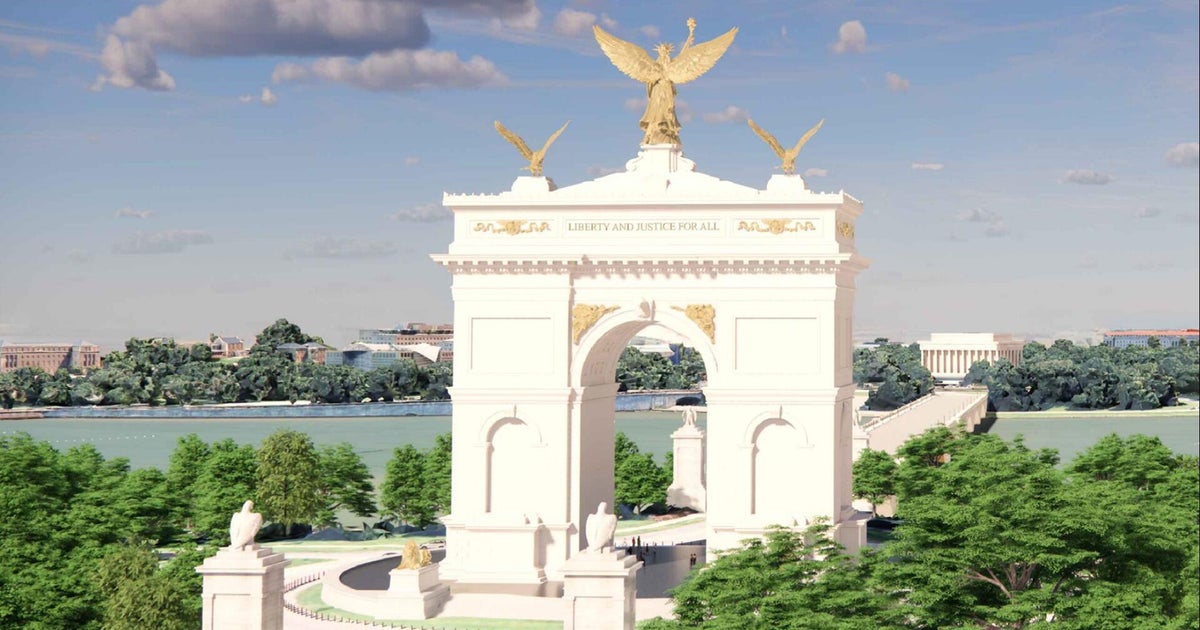
The 250-foot-tall monument is planned for a traffic circle across the Potomac River from Washington, D.C., near Arlington National Cemetery. Excavation was expected to begin this month. According to project plans, the arch would be clad in granite, topped with three golden statues and include an observation deck. The administration has linked the project to the 250th anniversary of the signing of the Declaration of Independence this year and has described it as part of the president’s broader effort to put his architectural stamp on the nation’s capital.
Trump’s Sunday announcement, however, added a new military dimension to what had been conceived as a commemorative structure. “It will house, store, and have the rapid ability to use large numbers of drones, plus Snipers, on both the roof and plaza areas,” he said. The arch would also hold, in his words, “large quantities of sniper ammunition in storage.” He said there would be “no facility like this anywhere in the World.”
He went on to argue that Washington, D.C., is overdue for a triumphal arch. “Out of the 59 top cities and Capitals, Washington, D.C., IS THE ONLY ONE IN THE WORLD THAT DOES NOT HAVE A TRIUMPHAL ARCH, but it will now and, by far, the greatest of them all!” he wrote.
The project has drawn pushback for several reasons. Critics have worried that a 250-foot-tall structure on the traffic circle could interfere with sightlines between major monuments in Washington and Arlington National Cemetery. The arch would sit at the edge of the cemetery, in view of the Lincoln Memorial and other landmarks along the National Mall. Its proximity to Ronald Reagan Washington International Airport has also raised concern.
The Federal Aviation Administration on Friday determined that the arch poses no hazard to flights coming into and departing from the nearby airport. That finding came despite objections from Democratic lawmakers who argued that the project would further complicate an already complex airspace. Air traffic around Reagan National is tightly constrained, with planes following the Potomac River and landing on one of the shortest commercial runways in the country. Lawmakers had pressed federal officials to study the potential effects of a tall structure near the flight path. The FAA’s determination removes a major regulatory hurdle, at least with respect to aviation safety.
But the military-complex announcement raises a separate set of questions. The notion of stationing snipers on the roof and plaza of a public monument, with ammunition stored inside, is highly unusual. It could change the design of the structure, requiring reinforcement, secure storage, communications systems, and other infrastructure. It is unclear whether the observation deck and any public areas would remain accessible if the arch also functions as a military installation. It is also unclear which part of the military requested the change, what types of drones would be stored there, or how drone operations would be coordinated with the heavily restricted airspace around Washington.
Trump did not provide those details in his post. He said only that the military had made the request and that national security justified the conversion. The lack of specifics has left room for further debate. Some may question whether a triumphal arch is an appropriate place for ammunition and armed positions. Others may ask whether placing a fortified structure at the gateway to Arlington National Cemetery is consistent with the character of the site.
The location has deep historical significance. Arlington National Cemetery is the final resting place of hundreds of thousands of veterans and their families. The Arlington Memorial Bridge connects the cemetery to the National Mall and the Lincoln Memorial. A monumental arch at the traffic circle would be one of the first major structures seen by visitors crossing the Potomac from Washington into Virginia. Plans for such an arch have been discussed for decades, and the idea has long appealed to those who want the capital to have the kind of grand ceremonial architecture found in Paris, Rome, and other world capitals.
Supporters say the arch is long overdue and would serve as a fitting tribute to the nation’s 250th anniversary. They point to the famous arches in other capitals as evidence that Washington should have one of its own. Trump’s statement echoes that argument, and his characterization of the proposed structure as the greatest in the world is meant to underscore the scale of his ambitions.
Opponents, however, have raised questions about process, location, and design. The project has moved forward quickly, and the public has had limited opportunity to weigh in. The additional military mission could make the monument even more controversial. A monument that is also a military command post, drone hangar, and sniper position would be unlike any other memorial in the United States. It would blur the line between commemorative space and security infrastructure.
The FAA’s decision on Friday addressed only whether the arch would be a hazard to aircraft. It did not address the visual, historical, or tactical implications of the proposal. Those issues are likely to remain the subject of debate as the project moves from planning toward construction. It is not yet known how the military components will be integrated into the design, whether the structure will be staffed around the clock, or how its presence will affect traffic and security in the surrounding area.
Trump’s announcement could also affect the timeline. Excavation was expected to begin this month, and any changes to the design could delay the start of work. Adding drone storage and sniper positions would probably require additional engineering and coordination with multiple federal agencies. It may also require new security measures around the construction site itself.
The president has made no secret of his desire to shape the physical landscape of Washington. The triumphal arch is part of that vision, tied to the celebration of the 250th anniversary of the Declaration of Independence. With the anniversary underway, the administration may want to break ground as soon as possible. But the new military dimensions could complicate that schedule.
For now, the arch remains a proposal rather than a completed project. What is known is that it is planned to stand 250 feet tall, be made of granite, feature three golden statues, and offer an observation deck. What is new is that it may also house drone fleets, sniper ammunition, and armed personnel. Trump’s post on Sunday combined these elements into a single vision: a monumental arch that is also a high-security military complex.
No facility like it exists anywhere in the world, the president said. If built as described, it would be unique in American history as well. A structure at once commemorative and operational, public and restricted, ceremonial and defensive, would represent a new kind of landmark for the nation’s capital. Whether that vision wins broad support, or becomes another point of contention, may depend on the details that have not yet been provided.
Joe Walsh contributed to this report.