Trump Announces Fortified ‘Military Complex’ Version of D.C. Triumphal Arch
Washington — President Trump said Sunday that he has agreed to convert plans for a long-envisioned triumphal arch near Arlington National Cemetery into a “top grade Military Complex,” a fortified monument he said will include sniper positions, ammunition storage and drone facilities.
“At the strong request of the United States Military, and for National Security purposes, I have agreed to convert the magnificent Triumphal Arch, planned since the Civil War Era many years ago, at the Receptive Circle adjoining the Arlington Memorial Bridge, into a top grade Military Complex/Triumphal Arch,” Mr. Trump wrote in a post on Truth Social.
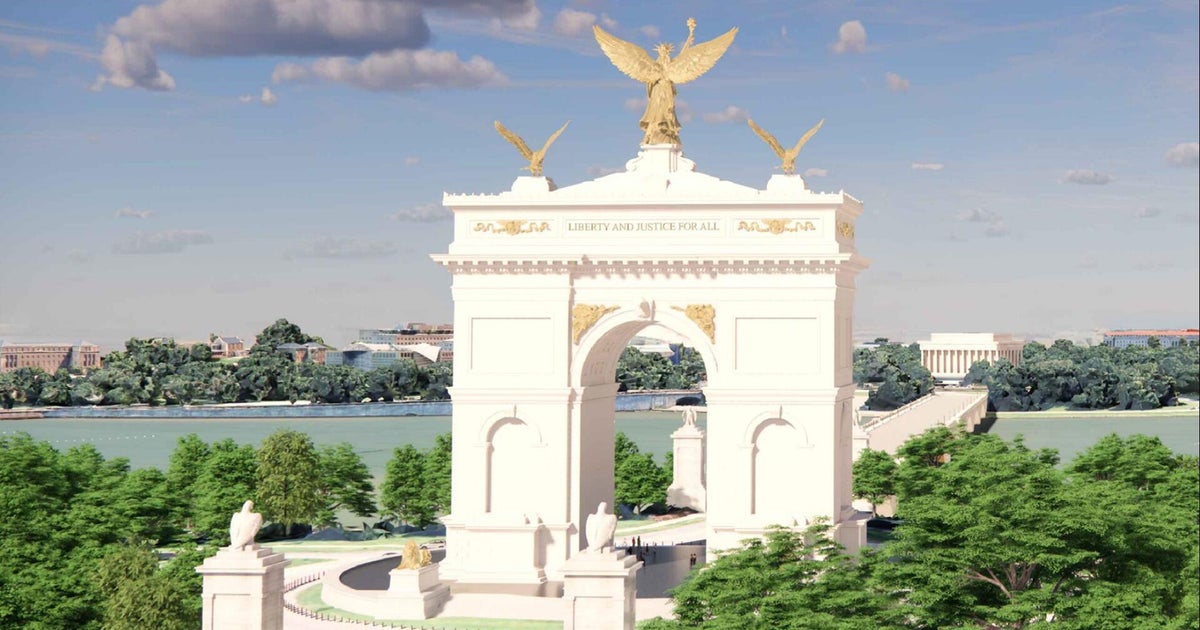
The announcement dramatically changes the scope of a project that was already scheduled to begin excavation this month. The structure, planned to be 250 feet tall, would rise on a traffic circle across the Potomac River from Washington, D.C., near the entrance to Arlington National Cemetery. The monument is intended to be clad in granite, topped with three golden statues, and include an observation deck. But Trump’s new description adds a security dimension that goes far beyond a traditional memorial.
According to the president, the arch will “house, store, and have the rapid ability to use large numbers of drones, plus Snipers, on both the roof and plaza areas,” as well as hold “large quantities of sniper ammunition in storage.” He did not provide additional details about how the military complex would function, who would staff it, or how it might affect public access to the observation deck and the surrounding plaza. But he insisted that there will be “no facility like this anywhere in the World.”
Trump also highlighted what he described as Washington’s unique standing among global capitals. “Out of the 59 top cities and Capitals, Washington, D.C., IS THE ONLY ONE IN THE WORLD THAT DOES NOT HAVE A TRIUMPHAL ARCH, but it will now and, by far, the greatest of them all!” he wrote.
The project is part of a broader administration effort to reshape the capital ahead of the 250th anniversary of the signing of the Declaration of Independence, a milestone that the United States will observe in 2026. The arch is one of several initiatives intended to leave a distinct architectural imprint on the District of Columbia and the surrounding region. Administration officials have framed the monument as both a historic tribute and a patriotic landmark.
Yet the plan has generated considerable pushback. Critics have raised concerns about the arch’s height, warning that a 250-foot-tall structure could interrupt sightlines between major D.C. monuments and Arlington National Cemetery. The cemetery, located on the Virginia side of the Potomac, is the final resting place of hundreds of thousands of American service members and their families. The idea of a military installation perched above those hallowed grounds has added to the unease expressed by some opponents of the project.
Location has also been an issue. The chosen site sits in the flight path of Ronald Reagan Washington National Airport, one of the busiest airports in the region. Planes approach and depart from the airport at low altitudes over the Potomac, and the arch’s scale has raised questions about whether it could create navigational complications or require changes to established flight procedures. The presence of military drones and rooftop snipers at such a prominent location could also have implications for low-flying aircraft and for security operations in the national capital region.
On Friday, however, the Federal Aviation Administration issued a determination that the arch, as currently proposed, poses no hazard to flights coming into and departing from Reagan National. That decision cleared a significant regulatory hurdle for the project, despite concerns from Democratic lawmakers in the region that the monument would further complicate an already complex airspace. It was not immediately clear whether the FAA’s review incorporated the latest changes announced by Trump, including drone storage and sniper positions, or whether additional reviews would be needed.
The site itself has a complicated history. The area now known as Receptive Circle, at the eastern end of the Arlington Memorial Bridge, has long served as a symbolic gateway between the capital and the sacred ground of Arlington National Cemetery. Plans for a grand commemorative arch in the vicinity date back, according to Trump, to the Civil War era. While those plans never came to fruition, presidents and planners have periodically revived the idea of a monumental gateway at the entrance to the cemetery.
The Arlington Memorial Bridge itself was designed to connect Washington’s monumental core with Arlington House, the former home of Robert E. Lee and a site with deep ties to the Civil War. The bridge was completed in 1932, but the area near its Virginia terminus has remained a relatively understated circle with roads leading to the cemetery, the Pentagon and Washington. The new project would transform that traffic circle into a dramatic vertical landmark, visible from the National Mall and from many points along the Potomac River.
Supporters of the arch see it as a fitting tribute to American history and military service. They note that triumphal arches have been erected in capitals across the world to honor military victories and national achievements, from the Arc de Triomphe in Paris to the Arch of Constantine in Rome. A 21st-century arch in Washington, they argue, would finally provide a counterpart to those monuments and celebrate the nation’s founding and survival.
But the new military features raise a host of practical and political questions. Drones are now a routine component of military and security operations, but stationing them at a monument in the heart of the National Capital Region would be a highly visible and sensitive deployment. Sniper positions on a memorial roof and plaza would presumably be intended to protect the arch and adjacent areas, but the prospect of armed marksmen at a monument that is also planned to include an observation deck creates potential tensions between public accessibility and security.
Neither the White House nor the Defense Department has released a detailed plan explaining how the military complex would operate. It is also unclear whether the arch’s granite exterior and golden statues would be altered to accommodate aerial vehicles, weapons and ammunition. Would drones launch from the roof, or from enclosures hidden within the structure? Would observation deck visitors be segregated from security areas? Would the plaza remain open to the public when snipers are positioned there? The president’s social media post did not answer these questions.
What is clear is that the project is moving forward at an accelerated pace. Excavation at the site had been expected to begin this month, timed in part to coincide with the 2026 observances of the nation’s 250th birthday. Trump’s announcement of the new military complex came just as those plans were poised to get underway, suggesting that the design may be evolving even as construction begins.
The FAA’s finding that the tower would not pose a hazard to aviation removes one major obstacle, but it does not end the controversy. Opponents point out that the arch would sit on land that is part of a larger commemorative landscape around Arlington National Cemetery. That landscape has historically been protected from tall structures to preserve the visual connection between the cemetery and the monuments of Washington. The addition of a 250-foot tower and military equipment to the mix could change the character of the site permanently.
In addition, the National Capital Planning Commission and other federal and local agencies typically have review authority over large projects in the Washington region. The extent to which those reviews have been completed remains unclear. Some legal challenges could still emerge, especially if the project alters federally protected views or if the military complex provisions require additional environmental or safety assessments.
For now, Trump’s declaration is the most definitive statement yet that the arch will be more than a monument. “No facility like this anywhere in the World,” he wrote, a phrase that appeared to capture his ambition for the project. In a city where monuments are often contested, and where even a memorial can become a flashpoint for larger debates about security, history and national identity, the proposed arch turned military installation seems destined to remain at the center of argument.
Still, the president’s announcement could also energize supporters who have long wanted Washington to have its own triumphal arch. The promise of a granite-clad tower, crowned by three golden statues and anchored by the presence of the American military, is likely to appeal to those who view the project as a symbol of national strength. Whether the public will be free to visit the observation deck, or whether they will be watched over by snipers and drones, is a question that will be answered only when the complex actually takes shape.
With excavation expected to begin shortly, the next phase of the project will be visible quickly. The site on the traffic circle near Arlington National Cemetery is not hidden; it is one of the most visible intersections in the Washington region. If the work proceeds on schedule, the foundation of the long-planned arch will emerge from the ground in the coming months. Whether that foundation will support a peaceful monument or a fortified military installation—or something of both—remains to be seen.
Joe Walsh contributed to this report.