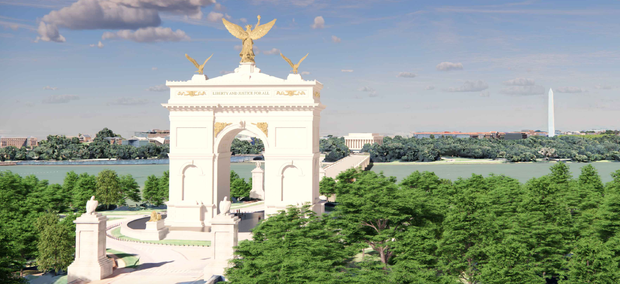
In Washington D.C., a controversy brews over the proposed construction of a 250-foot triumphal arch, a structure that has ignited opposition from various quarters including retired veterans Shaun Byrnes and Jon Gundersen. These two individuals, who have dedicated much of their lives to service in military and diplomatic capacities across multiple presidential administrations, now find themselves engaging in a different type of battle. They are part of a group, including another Vietnam veteran and a historian, that has filed a lawsuit aimed at halting this construction project which is set to rise in a once unoccupied traffic circle located strategically between Arlington National Cemetery and the Lincoln Memorial.
The planned arch, revealed to be vastly taller than the Lincoln Memorial itself, has sparked a heated debate over its implications both historically and aesthetically. The core argument of Byrnes, Gundersen, and their co-litigants revolves around the perceived hasty approval process of the project, which they claim lacked proper legislative oversight from Congress. Another significant concern is the potential disruption of the long-standing visual symmetry and symbolic connection between the Lincoln Memorial and the Robert E. Lee Memorial. This connection was intentionally designed to convey a message of unity and reconciliation in the post-Civil War era.
Speaking on record, Gundersen and Byrnes have expressed that their motivations are not driven by political partisanship but by a profound sense of duty to preserve the sanctity and respect of historical symbols and the memories of those buried at Arlington National Cemetery. Byrnes, who himself is a Navy veteran with tours in Vietnam, mentioned a personal stake in opposing the arch, noting that its presence would cause him to reconsider his own burial plans in Arlington.
The lawsuit led by Public Citizen Litigation Group has been countered by the Justice Department, which argues that the plaintiffs lack standing. Meanwhile, the administration maintains that Congress had already given its nod to this project indirectly by referencing a century-old plan which envisioned the construction of “two stately columns” intended to symbolize the North and South.
Despite a federal judge’s recent decision to deny a temporary stop to the construction, which has yet to commence, Byrnes and Gundersen remain steadfast. They interpret the triumphal arch not as a commemorative gesture to the nation’s 250th birthday but as a self-aggrandizing monument to former President Trump, under whose guidance the arch was conceptualized. This view was reinforced by an incident last year when Mr. Trump, while showcasing a model of the arch which resembles Paris’s Arc de Triomphe, indicated to reporters that the monument was for himself.
In further developments, the U.S. Commission for Fine Arts (CFA) approved the design of the arch despite facing overwhelming public criticism during their meetings. The Urban Planning Commission, filled with allies of the former president, is expected to make a decision on the project soon. This phase of approval has become more contentious as critics and observers equate the proposal to the ostentatious monuments often seen in authoritarian regimes.
Both Gundersen and Byrnes have likened their experiences abroad—having been posted in Moscow and involved in opening U.S. embassies in post-Soviet states—to the concerns they now harbor about the direction of monumental architecture in their own country. They caution against a trajectory where monuments are erected for leaders through the patronage of wealthy oligarchs in exchange for political favors, as opposed to reflecting the consent and will of the governed.
The resistance from Gundersen, Byrnes, and their fellow plaintiffs underscores a broader discourse on how national symbols and monuments should represent historical narratives and collective memories. Their legal challenge weaves together personal experiences, civic engagement, and a call to preserve the integrity of national landmarks. They believe strongly in the principles of their country, and as veterans who have fought for those principles, they remain committed to challenging what they see as an inappropriate and ill-considered undertaking. As this legal and ideological battle unfolds, it raises imperative questions about heritage, respect, and the nature of public monuments in encapsulating the ethos of a nation.