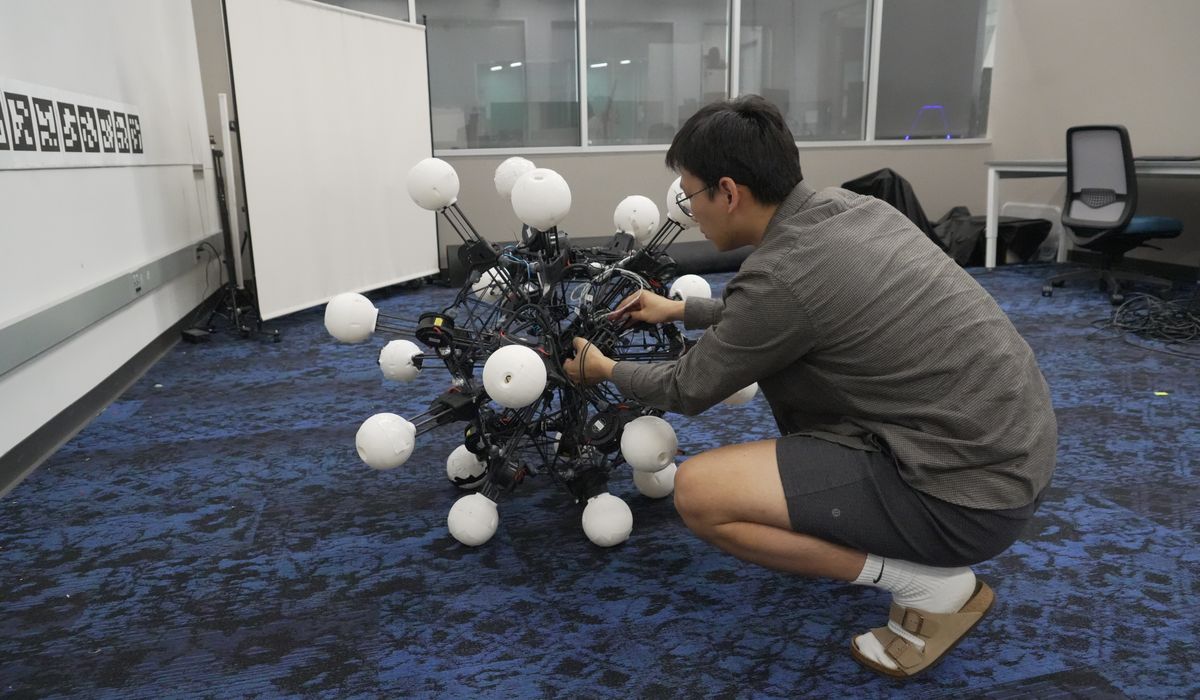
In the bustling city of Durham, North Carolina, an innovative robot is being perfected at Duke University. The robot, which is almost prepared to face the world, is unique in its ability to move in all directions with ease. This groundbreaking development is the result of a shift in focus from trying to replicate symmetrical shapes in nature to a new concept termed as ‘dynamic symmetry.’
The conventional approach to robot development has often involved creating machines that mimic humans, dogs, insects, and other creatures. However, Boyuan Chen, a professor of engineering at Duke University, decided to take a different path. He and his team sought to develop a robot that doesn’t necessarily ‘look’ like anything but instead operates uniformly in action. This principle, which Chen calls “dynamic symmetry,” is the guiding force behind their groundbreaking work.
The team’s research and development efforts led to the creation of a highly unique robot named Argus. Named after a mythological giant with multiple eyes, Argus is a roly-poly robot designed with depth-sensing cameras attached to 20 telescoping legs that radiate from a central core. The spherical design of Argus allows it to see and move in any direction instantly. It doesn’t have a defined front, back, top, or bottom, making it a truly multidirectional machine.
Chen explained the concept behind this innovative design, stating, “Instead of measuring how your legs are arranged around a different part of your body, we’re measuring how fast you can move in any direction.” He questioned the prevalent notion that an effective robot has to bear a resemblance to humans, thus challenging the traditional norms of robotics.
Argus has been put to the test in various environments. In its experimental stages, it has successfully navigated sandy beaches and forest undergrowth, demonstrating its ability to roll over obstacles and stabilize itself after being pushed. Its unique design enables it to climb between parallel brick walls by alternating bracing and thrusting motions with its legs. Argus is also designed to continue functioning even if one or more motors die or a leg breaks, highlighting its robust and resilient build.
Describing their unique creation, Jiaxun Liu, a graduate student and co-author of a study about Argus, stated, “Watching Argus move is unlike watching any other robot we’ve worked with.” He recalled the team’s excitement the first time they saw Argus navigate among trees and rough terrain, even under heavy collisions. They knew then that they had created something truly different.
As part of their research, the team also developed a new design principle known as dynamic isotropy. This principle rates robots on a scale of 0 to 1 based on how uniformly they can accelerate in every direction. Most robots in use today, including humanoids and drones, score below 0.6. However, Argus stands out with a score of 0.91, showcasing its superior ability to move uniformly in any given direction.
Chen believes that this principle can revolutionize the development of search and rescue robots, underwater or aerial vehicles, or robots with the ability to grip objects. He said, “When a robot can accelerate equally well in every direction, it stops needing to face the world in any particular way.”
Chen further suggested that the concept of dynamic isotropy could also be applied to the design of robot hands. He proposed the idea of having Argus be the hand itself, able to manipulate objects in any direction. He believes that the knowledge gained from developing a robot like Argus can be transferred to the rest of the world and can be much deeper than building an existing robot or copying an existing species.
The development of Argus at Duke University is indeed a significant milestone in the field of robotics. It challenges the conventional design principles and paves the way for more innovative and efficient robots. The team’s unique approach to robot design, focusing on dynamic symmetry and dynamic isotropy, offers new possibilities for the development of robots that can operate effectively in various environments and conditions.
The story of Argus’s development doesn’t just end here. With continued research and development, the team at Duke University hopes to refine its design further, making it even more efficient and versatile. As the world watches with bated breath, Argus stands as a testament to the potential of robotics, pushing the boundaries of what is possible.
While Argus is yet to make its mark in the real world, it has already made a significant impact in the field of robotics. Its unique design and remarkable capabilities have set new standards for what robots can achieve. As we look forward to the future, robots like Argus give us a glimpse of what’s possible when we think outside the box and challenge the norm.
As we move forward, it’s clear the world of robotics will never be the same. Argus, with its 20-leg design and ability to see and move in any direction, represents a significant leap forward in the field. It’s a shining example of the innovative thinking and technological advancement happening at institutions like Duke University. As we continue to push the boundaries of what’s possible, there’s no telling what the future of robotics might hold.
In conclusion, the development of Argus at Duke University is a testament to the innovative thinking and commitment to pushing the boundaries in the field of robotics. It’s a story of thinking outside the box, challenging the norm, and making significant strides in technological advancement. The world is eager to see what Argus, with its unique design and capabilities, will bring to the table in the future.